


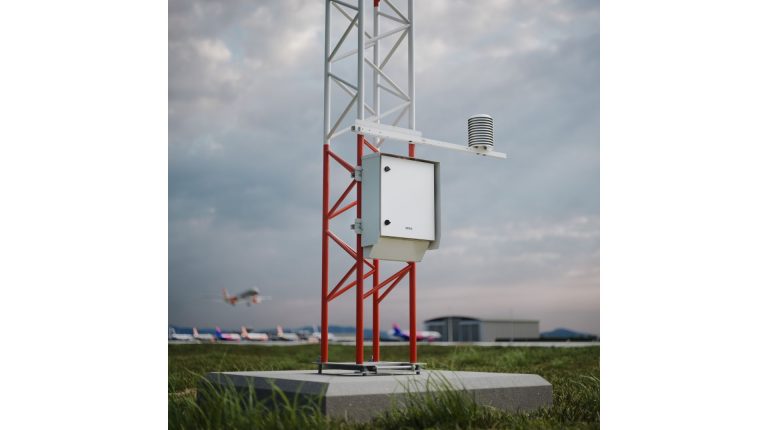
Vaisala has launched the AWS810 Airport Edition, an automatic weather station purpose-built for airport environments where aging infrastructure, growing traffic and tightening regulatory requirements are placing greater demands on weather observation systems.
The system combines Vaisala’s ICAO- and WMO-compliant sensors with a compact, rugged design that includes frangible mast options for airfield safety. It is delivered as a fully factory-tested solution, intended to reduce engineering effort, commissioning time and deployment risk.
The AWS810 Airport Edition integrates with Vaisala’s AviMet airport weather systems, including the latest AviMet 10 software, enabling airports to scale from single-runway installations to fully connected, airport-wide observation networks. At the core of the system is the Vaisala Data Management Unit DMU801, which handles data acquisition, processing and integration. Built-in Ethernet and fiber optic connectivity options remove the need for additional communication enclosures.
“AWS810 Airport Edition, together with AviMet, brings sensing, data management, connectivity and visualization into one future-ready airport weather platform,” said Anne Jalkala, EVP, weather, energy and environment at Vaisala. “It simplifies operations while supporting reliable, compliant performance for decades to come.”
Remote diagnostics, a built-in graphical user interface and streamlined configuration are designed to reduce site visits and lower total cost of ownership over time. An optional lifecycle service offering, Vaisala Care for Airports, provides planned expert support, remote capabilities and proactive maintenance throughout the system’s operational life.
Alongside the AWS810 Airport Edition, Vaisala is also introducing the AviMet Panel Display WID525, a next-generation replacement for earlier display models. The WID525 consolidates multiple hardware models into a single compact 5.7in touchscreen platform capable of displaying wind data, weather data or combined parameter views. Enhanced viewing angles and integrated visual and audible alarms are included, and the unified hardware platform is intended to simplify spare parts management and reduce lifecycle costs.
Related news, R.M. Young Company reengineers SNOdar snow-depth sensor