


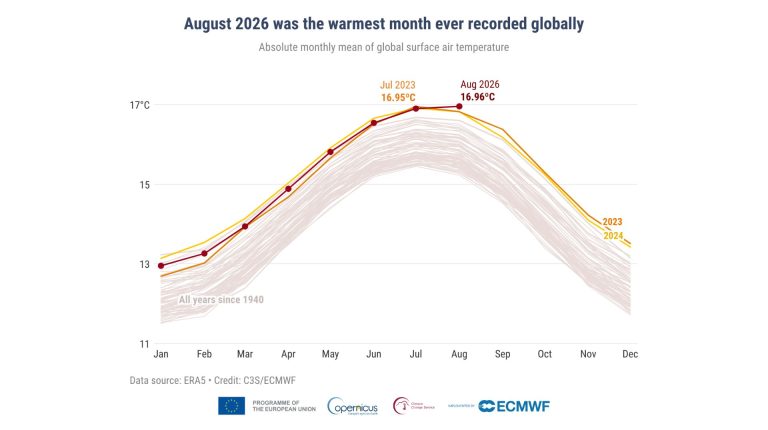
August 2026 was the joint-warmest month ever recorded globally – tied with July 2023 – and pushed global average temperatures back above 1.5°C over pre-industrial levels for the first time since November 2025, reports the the Copernicus Climate Change Service (C3S), implemented by the European Centre for Medium-Range Weather Forecasts (ECMWF).
Last month also saw the average sea surface temperature (SST) over the extra-polar ocean reach a record high, due to global heating from burning fossil fuels and rapidly increasing SSTs in the equatorial Pacific associated with strong El Niño conditions, C3S said.
The global average surface air temperature for August was 16.96°C, 0.85°C above the 1991-2020 average, making it the warmest August in the ERA5 dataset and surpassing the previous joint record set in 2023 and 2024. The month was 1.65°C above the estimated 1850-1900 pre-industrial baseline. June through August 2026 was the joint-warmest such period on record, matching 2024.
Sea surface temperatures across the extra-polar ocean reached a record August high of 21.07°C, and tied the highest monthly average across all calendar months, matching March 2024 – though Copernicus notes this particular finding is based on ERA5 data and is not the highest on record according to some other datasets. A daily record extra-polar SST of 21.11°C was also recorded. Record-high SSTs were observed across the tropical Pacific, where Copernicus’s Atmosphere Monitoring Service reports a strengthening El Niño event that is already contributing to intensified seasonal wildfires in Indonesia.
Western Europe recorded its warmest summer on record, surpassing the previous record set in 2003, following a succession of early, persistent heatwaves that began in May. Widespread dryness affected much of the region along with central and eastern Europe, with severe drought reported in France, the UK, Hungary, Romania and Serbia. Major rivers including the Rhine, Danube, Southern Bug and Dnieper saw exceptionally low flows.
Samantha Burgess, strategic lead for climate at ECMWF, said, “August 2026 was a remarkable month in the global climate record. It was both the warmest August and the warmest month ever recorded, with global temperatures reaching 1.65°C above pre-industrial levels, marking the return of global temperatures above 1.5°C.
“Combined with record global sea surface temperatures and the warmest summer on record for Western Europe, these observations show how climate change is driving extremes across both the atmosphere and the oceans. The impacts of these conditions are increasingly being felt by communities, economies and ecosystems across the world.”
Related news, WMO bulletin warns rising wildfire and heatwave pollution threatens air quality gains