


Close Menu
Meteorological Technology International
  • News
    • A-E
      • Agriculture
      • Automated Weather Stations
      • Aviation
      • Climate Measurement
      • Data
      • Developing Countries
      • Digital Applications
      • Early Warning Systems
      • Extreme Weather
    • G-P
      • Hydrology
      • Lidar
      • Lightning Detection
      • New Appointments
      • Nowcasting
      • Numerical Weather Prediction
      • Polar Weather
    • R-S
      • Radar
      • Rainfall
      • Remote Sensing
      • Renewable Energy
      • Satellites
      • Solar
      • Space Weather
      • Supercomputers
    • T-Z
      • Training
      • Transport
      • Weather Instruments
      • Wind
      • World Meteorological Organization
      • Meteorological Technology World Expo
  • Features
  • Online Magazines
    • January 2026
    • April 2025
    • January 2025
    • September 2024
    • April 2024
    • Archive Issues
    • Subscribe Free!
  • Opinion
  • Videos
  • Supplier Spotlight
  • Expo
LinkedIn X (Twitter) Facebook
  • Sign-up for Free Weekly E-Newsletter
  • Meet the Editors
  • Contact Us
  • Media Pack
LinkedIn Facebook
Subscribe
Meteorological Technology International
  • News
      • Agriculture
      • Automated Weather Stations
      • Aviation
      • Climate Measurement
      • Data
      • Developing Countries
      • Digital Applications
      • Early Warning Systems
      • Extreme Weather
      • Hydrology
      • Lidar
      • Lightning Detection
      • New Appointments
      • Nowcasting
      • Numerical Weather Prediction
      • Polar Weather
      • Radar
      • Rainfall
      • Remote Sensing
      • Renewable Energy
      • Satellites
      • Solar
      • Space Weather
      • Supercomputers
      • Training
      • Transport
      • Weather Instruments
      • Wind
      • World Meteorological Organization
      • Meteorological Technology World Expo
  • Features
  • Online Magazines
    1. January 2026
    2. September 2025
    3. April 2025
    4. January 2025
    5. September 2024
    6. April 2024
    7. January 2024
    8. September 2023
    9. April 2023
    10. Archive Issues
    11. Subscribe Free!
    Featured
    November 27, 2025

    In this Issue – January 2026

    By Hazel KingNovember 27, 2025
    Recent

    In this Issue – January 2026

    November 27, 2025

    In this Issue – September 2025

    August 11, 2025

    In this Issue – April 2025

    April 15, 2025
  • Opinion
  • Videos
  • Supplier Spotlight
  • Expo
Facebook LinkedIn
Subscribe
Meteorological Technology International
Satellites

Mitsubishi to construct Japan’s next-gen weather satellite

Dan SymondsBy Dan SymondsMarch 21, 20232 Mins Read
Share LinkedIn Facebook Twitter Email
Share
LinkedIn Facebook Twitter Email

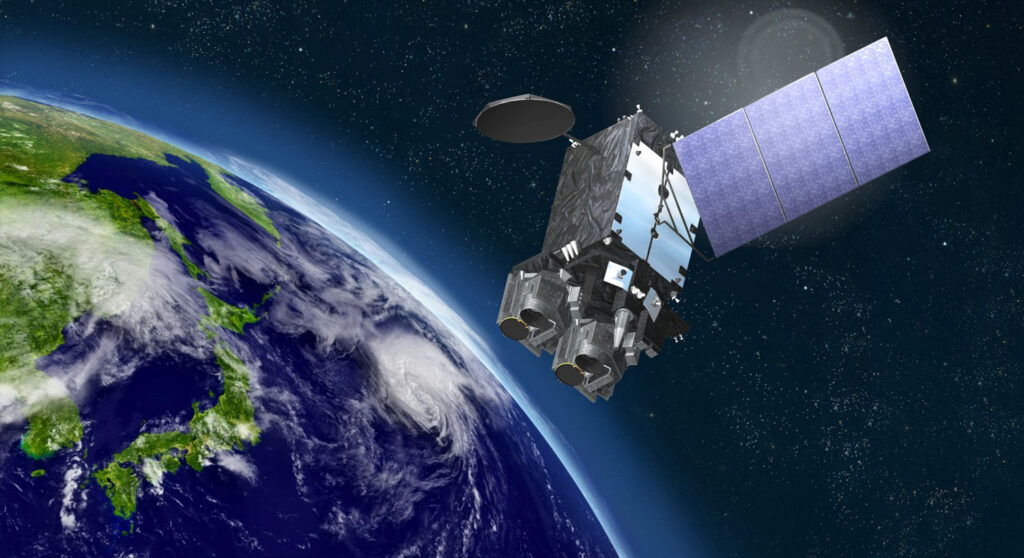
The Japan Meteorological Agency (JMA) has awarded Mitsubishi Electric Corporation the contract to build its new Himawari-10 geostationary meteorological satellite.

Himawari-10 will succeed Himawari-8 and Himawari-9, which are currently operating in geostationary orbit. JMA awarded the contract based on Mitsubishi Electric’s extensive experience with satellites and capabilities of its DS2000 standard satellite platform and ground-data processing software. Himawari-10 will be the fourth JMA satellite to be built by Mitsubishi Electric going back to Himawari-7 around two decades ago.

The new satellite will be equipped with a visible infrared imager and a hyperspectral infrared sounder, both built by L3 Harris Technologies, and a space environment sensor from the National Institute of Information and Communications Technology of Japan (NICT).

The imager, which offers observation wavelength bands and resolutions superior to those of the Himawari-8 and 9, will gather two-dimensional information about cloud and water-vapor distribution, and land, sea and cloud temperatures based on frequent measurement of visible to infrared rays emitted from the Earth’s surface.

Himawari-10 will be the first Japanese satellite to use a hyperspectral infrared sounder to gather three-dimensional information about water vapor and atmospheric temperature by measuring infrared rays with high-spectral resolution for improved forecasting of heavy and torrential rain as well as typhoon paths.

The space environmental sensor will measure the intensity of proton and electron beams in space, which often are the cause of spacecraft malfunctions, to enhance forecasting reliability.

Previous ArticleTime running out to limit warming to 1.5°C rise, warns Met Office
Next Article NOC to manage more than 30 research missions in 2023

Read Similar Stories

Early Warning Systems

China expands MAZU early warning system for developing countries

April 30, 20262 Mins Read
Radar

Météo-France begins construction of France’s tallest weather radar tower in Sembadel

April 29, 20262 Mins Read
Digital Applications

ForecastWatch expands with launch of new independent platform for weather forecast verification

April 28, 20262 Mins Read
Latest News

China expands MAZU early warning system for developing countries

April 30, 2026

Météo-France begins construction of France’s tallest weather radar tower in Sembadel

April 29, 2026

ForecastWatch expands with launch of new independent platform for weather forecast verification

April 28, 2026

Receive breaking stories and features in your inbox each week, for free


Enter your email address:


Supplier Spotlights
  • Senseca
Getting in Touch
  • Contact Us / Advertise
  • Meet the Editors
  • Media Pack
  • Free Weekly E-Newsletter
Our Social Channels
  • Facebook
  • LinkedIn
© 2026 UKi Media & Events a division of UKIP Media & Events Ltd
  • Cookie Policy
  • Privacy Policy
  • Terms and Conditions
  • Notice and Takedown Policy

Type above and press Enter to search. Press Esc to cancel.