


Close Menu
Meteorological Technology International
  • News
    • A-E
      • Agriculture
      • Automated Weather Stations
      • Aviation
      • Climate Measurement
      • Data
      • Developing Countries
      • Digital Applications
      • Early Warning Systems
      • Extreme Weather
    • G-P
      • Hydrology
      • Lidar
      • Lightning Detection
      • New Appointments
      • Nowcasting
      • Numerical Weather Prediction
      • Polar Weather
    • R-S
      • Radar
      • Rainfall
      • Remote Sensing
      • Renewable Energy
      • Satellites
      • Solar
      • Space Weather
      • Supercomputers
    • T-Z
      • Training
      • Transport
      • Weather Instruments
      • Wind
      • World Meteorological Organization
      • Meteorological Technology World Expo
  • Features
  • Online Magazines
    • January 2026
    • April 2025
    • January 2025
    • September 2024
    • April 2024
    • Archive Issues
    • Subscribe Free!
  • Opinion
  • Videos
  • Supplier Spotlight
  • Expo
LinkedIn X (Twitter) Facebook
  • Sign-up for Free Weekly E-Newsletter
  • Meet the Editors
  • Contact Us
  • Media Pack
LinkedIn Facebook
Subscribe
Meteorological Technology International
  • News
      • Agriculture
      • Automated Weather Stations
      • Aviation
      • Climate Measurement
      • Data
      • Developing Countries
      • Digital Applications
      • Early Warning Systems
      • Extreme Weather
      • Hydrology
      • Lidar
      • Lightning Detection
      • New Appointments
      • Nowcasting
      • Numerical Weather Prediction
      • Polar Weather
      • Radar
      • Rainfall
      • Remote Sensing
      • Renewable Energy
      • Satellites
      • Solar
      • Space Weather
      • Supercomputers
      • Training
      • Transport
      • Weather Instruments
      • Wind
      • World Meteorological Organization
      • Meteorological Technology World Expo
  • Features
  • Online Magazines
    1. January 2026
    2. September 2025
    3. April 2025
    4. January 2025
    5. September 2024
    6. April 2024
    7. January 2024
    8. September 2023
    9. April 2023
    10. Archive Issues
    11. Subscribe Free!
    Featured
    November 27, 2025

    In this Issue – January 2026

    By Hazel KingNovember 27, 2025
    Recent

    In this Issue – January 2026

    November 27, 2025

    In this Issue – September 2025

    August 11, 2025

    In this Issue – April 2025

    April 15, 2025
  • Opinion
  • Videos
  • Supplier Spotlight
  • Expo
Facebook LinkedIn
Subscribe
Meteorological Technology International
Climate Measurement

Research assesses forests’ role in carbon cycle

Lawrence ButcherBy Lawrence ButcherFebruary 5, 20213 Mins Read
Share LinkedIn Facebook Twitter Email
Share
LinkedIn Facebook Twitter Email

A research project using ground, airborne and satellite data, conducted by an international team including NASA scientists, has created a new method to assess how the changes in forests over the past two decades have affected carbon concentrations in the atmosphere.

In addition to better understanding the overall role of forests in the global carbon cycle, the scientists say they were also able to distinguish between the contributions of various forest types, confirming that tropical forests are responsible for the largest component of global carbon fluctuations – both absorbing more carbon than other forest types and releasing more carbon into the atmosphere due to deforestation and degradation.

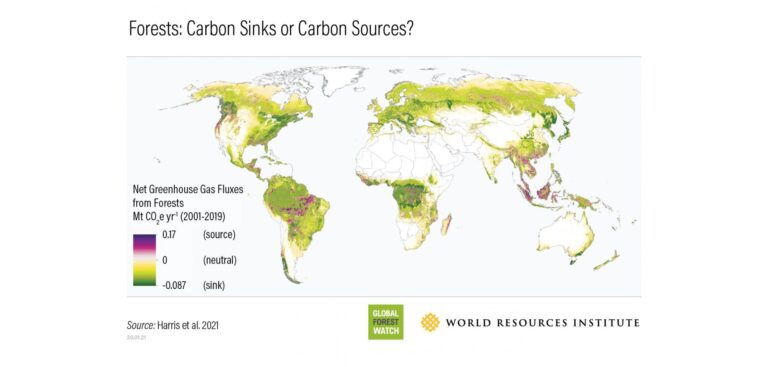
The forest carbon flux map from web-application Global Forest Watch, and accompanying study published in Nature Climate Change in January, shows these carbon fluctuations from forests in unprecedented detail.

According to the researchers, forests collectively absorbed around 15.6 billion metric tons of carbon dioxide from Earth’s atmosphere each year between 2001 and 2019, while deforestation, fires and other disturbances released an average of 8.1 billion metric tons of carbon dioxide per year. Forests around the world are estimated to absorb about 7.6 billion metric tons, acting as a net carbon sink of roughly 1.5 times the annual emissions from the entire USA.

“Forests act as a two-lane highway in the climate system,” said principal investigator Nancy Harris, who serves as the research director for the World Resources Institute (WRI) Forests Program. “A detailed view of where both sides are occurring – forest emissions and forest removals – adds transparency to monitoring forest-related climate policies.”

The new methodology integrates data sets from numerous sources, including on-the-ground reports, aerial data, and satellite observations, to create the first consistent global framework for estimating the carbon flux specifically for forests.

The methodology represents a change from the current annual reporting of national forestry data, which still varies between countries despite standardized guidelines from the Intergovernmental Panel on Climate Change (IPCC), often determined by the resources available in that region. Such a lack of uniformity in the data means that global carbon estimates can contain a sizeable degree of uncertainty.

“The good thing is that we know there is uncertainty and we can actually quantify it,” said co-author Lola Fatoyinbo, a scientist from NASA’s Goddard Space Flight Center in Greenbelt, Maryland. “All estimates come with an uncertainty around them, which is going to keep getting smaller and smaller as we get better data sets.”

The biomass estimates for the study were based on NASA’s Ice, Cloud, and land Elevation Satellite (ICESat) data, primarily designed to track changes in ice sheet coverage but which also provides topography and vegetation data.

NASA’s Carbon Monitoring Systems Biomass Pilot, which combines satellite and field data to improve estimates of vegetation and carbon stocks, NASA’s ICESat-2, and the Global Ecosystem Dynamics Investigation (GEDI) – a laser-equipped instrument on board the International Space Station that records the three-dimensional structures of the world’s temperate and tropical forests – are expected to further improve understanding of carbon removal rates across forest landscapes going forward.

Previous ArticleIncreased accuracy of model-to-model agreement for long-term climate model projections
Next Article How NASA’s tiny weather sat proved big is not always better

Read Similar Stories

Data

Atmospheric G2 secures Japan weather forecasting license

April 21, 20262 Mins Read
Climate Measurement

China completes Antarctic meteorological research mission with Xuelong icebreaker

April 21, 20262 Mins Read
Climate Measurement

Study identifies atmospheric trigger behind flash droughts in Puerto Rico

April 15, 20263 Mins Read
Latest News

Extreme heat posing significant risks to ecosystems and agriculture, FAO-WMO report warns

April 22, 2026

Atmospheric G2 secures Japan weather forecasting license

April 21, 2026

China completes Antarctic meteorological research mission with Xuelong icebreaker

April 21, 2026

Receive breaking stories and features in your inbox each week, for free


Enter your email address:


Supplier Spotlights
  • AIRMAR Technology Corporation
Getting in Touch
  • Contact Us / Advertise
  • Meet the Editors
  • Media Pack
  • Free Weekly E-Newsletter
Our Social Channels
  • Facebook
  • LinkedIn
© 2026 UKi Media & Events a division of UKIP Media & Events Ltd
  • Cookie Policy
  • Privacy Policy
  • Terms and Conditions
  • Notice and Takedown Policy

Type above and press Enter to search. Press Esc to cancel.