


A CU Boulder-led study has revealed that some of the rainiest places on Earth, including the Amazon rainforest, could see their annual precipitation nearly halved if climate change continues to alter the Atlantic Ocean’s current.
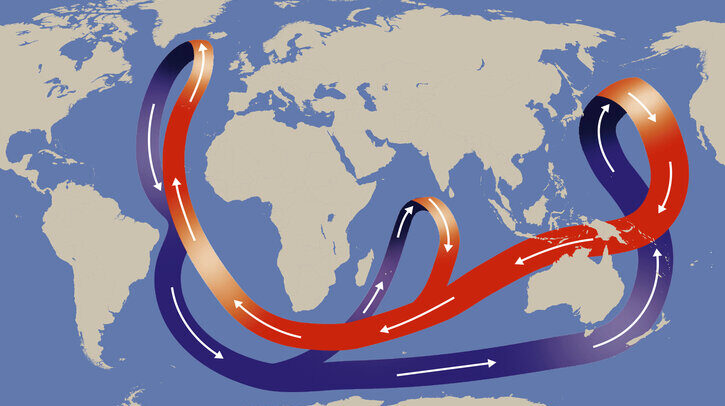
The Tropical response to ocean circulation slowdown raises future drought risk study, published in Nature on July 30, examines the effects of climate change on the Atlantic Meridional Overturning Circulation (AMOC), a massive system of ocean currents that moves water through the Atlantic Ocean, transporting warm, salty water from the tropics to the North Atlantic.
According to the study’s authors, the AMOC plays an important role in regulating the climate by redistributing heat from the southern to the northern hemisphere. It also makes sure the tropical rain belt, a narrow band of heavy precipitation near the equator, stays north of it. The scientists have revealed that even a modest slowdown of AMOC could dry out rainforests, threaten vulnerable ecosystems and upend livelihoods across the tropics.
“That’s a stunning risk we now understand much better,” said lead author Pedro DiNezio, associate professor in CU Boulder’s Department of Atmospheric and Oceanic Sciences, adding that parts of the Amazon rainforest could see up to a 40% reduction in annual precipitation.
The ocean conveyor belt
As the climate warms, melting polar ice and increasing rainfall will dilute the ocean’s surface waters, making them less dense and potentially slowing down the circulation. The impact of a weakened AMOC on the tropics remains uncertain, because scientists have only been monitoring the system directly for two decades.
As a technician at a National Oceanic and Atmospheric Administration (NOAA) lab in Miami in 2005, DiNezio helped calibrate some of the earliest measurements of AMOC. At the time, he had no idea that he’d be studying that very same system two decades later.
“A few years ago, this monitoring system recorded signs of a decline in the AMOC, but it later rebounded. So, we weren’t sure if it was just a fluke. The problem is, we haven’t been measuring the ocean long enough to detect meaningful long-term change,” DiNezio said.
While scientists are uncertain whether the AMOC has already begun to decline, climate models predict the system will eventually weaken because of climate change.
Predicting the future
DiNezio and his team set out to explore how a future slowing of these critical ocean currents could affect global precipitation patterns.
“Changes in rainfall are very difficult to predict, because so many factors are involved in making rain, like moisture, temperature, wind and clouds. Many models struggle to predict how the pattern will change in a warming world,” DiNezio said.
The team turned to climate records from about 17,000 years ago, when the AMOC last slowed down significantly due to natural causes. Evidence of precipitation preserved in cave formations, as well as lake and ocean sediments, revealed how rainfall patterns responded to the slowdown during that period.
Rainfall shifts
Drawing on that data, DiNezio’s team identified the computer models that best captured those ancient rainfall shifts and used them to predict how the patterns could change in the future.
Their best models predict that as the AMOC weakens and cools the northern Atlantic, this temperature drop would spread toward the tropical Atlantic and into the Caribbean. This change, on top of rising global temperatures, will lead to significant reductions in precipitation over Central America, the Amazon, and West Africa.
“This is bad news, because we have these very important ecosystems in the Amazon,” said DiNezio. The Amazon rainforest contains almost two years of global carbon emissions, making it a major carbon sink on Earth. “Drought in this region could release vast amounts of carbon back into the atmosphere, forming a vicious loop that could make climate change worse.”
While DiNezio said the AMOC is unlikely to stop completely, even a small reduction in its strength could lead to changes across the entire tropical region, increasing the risk of reaching a tipping point. But how fast and how much it slows depends on the degree of future climate change.
“We still have time, but we need to rapidly decarbonize the economy and make green technologies widely available to everyone in the world. The best way to get out of a hole is to stop digging,” DiNezio concluded.
In related news, Weathernews Inc. has signed a memorandum of understanding with the National Center for Hydrometeorological Forecasting (NCHMF) and the Hydrometeorological Survey, Technology and Services Center (HMSTS) of the Vietnam National Meteorological and Hydrological Administration (VNMHA) to provide AI-based forecast information for typhoons and heavy rainfall. Read the full story here