


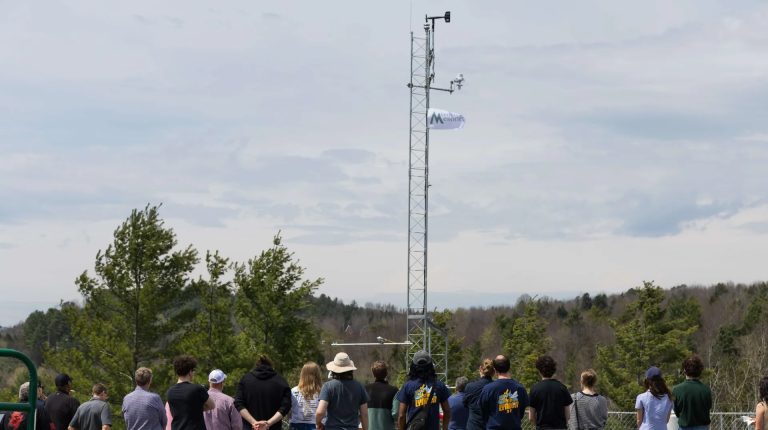
The University of Vermont has opened the first station in a planned statewide system of automated weather stations designed to improve extreme weather forecasting, flood response and agricultural planning.
The initiative, known as the Vermont Mesonet, aims to create a network of roughly 20 stations that will collect and transmit real-time meteorological and environmental data. The system is intended to address gaps in existing monitoring coverage, particularly in rural and mountainous areas where radar limitations can reduce forecasting accuracy.
Led by the university’s Water Resources Institute, the project is being developed in partnership with Vermont State University and other state and federal agencies.
The first station was launched in Lyndonville, Vermont, with support from the Leahy Institute for Rural Partnerships. Additional stations are expected to be installed across the state in the coming years.
Kirk Dombrowski, vice president for research and economic development at the University of Vermont, said the project responds directly to recent climate-related impacts in the state.
“The devastating flooding events we have recently experienced underscores the need for localized, actionable data to protect our rural communities and our economy,” he said.
Joshua Benes, associate director of research facilities and networks at the university’s Water Resources Institute, said the system will provide critical real-time inputs for forecasting and emergency management: “The Vermont Mesonet will send real-time data to the National Weather Service and emergency managers. This network will fill a major gap by providing the precise, local data needed to protect both.”
The National Weather Service in Burlington said the data will help improve short-term forecasting during storm events and support calibration of remote sensing tools.
“Meteorologists can use the data to calibrate estimates coming in from our remote sensing equipment,” said Gabriel Langbauer, meteorologist-in-charge at the Burlington office.
State officials also highlighted the potential benefits for agriculture, where timing and weather conditions strongly influence operations.
“Farmers live by the weather – it drives nearly every decision they make,” said Anson Tebbetts, Vermont Secretary of Agriculture. “Access to real-time weather data gives our farmers a critical edge to better predict, prepare and succeed.”
The network is expected to support broader resilience planning, including flood prediction, infrastructure management and utility operations, as well as academic research and education across the state.
Related news, Météo-France begins construction of France’s tallest weather radar tower in Sembadel