


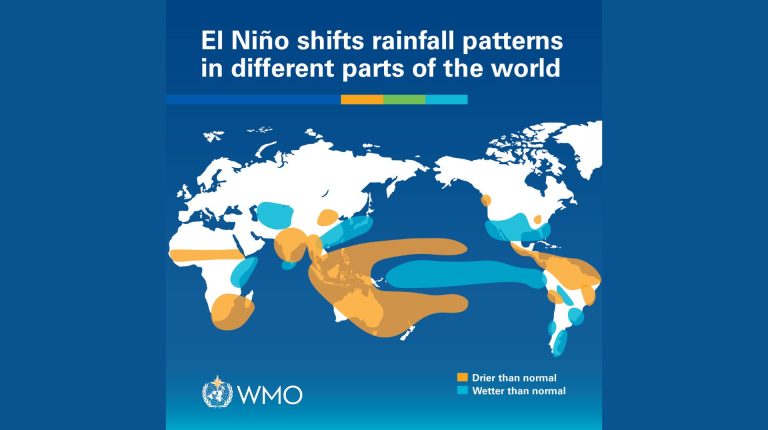
El Niño conditions are developing in the tropical Pacific and are expected to influence global temperature and rainfall patterns over the coming months, the World Meteorological Organization (WMO) has warned.
A new WMO El Niño/La Niña Update puts the likelihood of an El Niño event at 80% during June-August 2026, rising to near or above 90% probability that conditions will persist until at least November. Most forecast models suggest the event will be at least moderate and possibly strong.
Sea-surface temperatures in the central-eastern equatorial Pacific were approaching El Niño thresholds in late April to mid-May, with subsurface temperatures exceeding 6°C above average across the tropical Pacific – providing a substantial heat reservoir contributing to surface warming.
UN secretary-general António Guterres said, “El Niño conditions will pour fuel on the fire of a warming world. Impacts will hit even harder, travel even farther and cross borders with devastating speed. The only effective response is climate action equal to the crisis – ending the addiction to fossil fuels, accelerating the shift to renewables, protecting the most vulnerable and delivering early warning systems for all.”
WMO secretary-general Celeste Saulo said the organization would monitor conditions closely and inform governments, humanitarian agencies and climate-sensitive sectors. “We need to prepare for a potentially strong El Niño event – which will exacerbate drought and heavy rainfall and increase the risk of heatwaves both on land and in the ocean,” she said, noting that the 2023-24 El Niño was among the five strongest on record and contributed to record global temperatures in 2024.
El Niño typically brings increased rainfall to parts of southern South America, the southern USA, the Horn of Africa and central Asia, while driving drier conditions over Central America, northern South America, Australia, Indonesia and parts of southern Asia. During the boreal summer, it can fuel Pacific hurricanes while suppressing Atlantic hurricane formation – a factor behind NOAA’s forecast of a below-normal Atlantic hurricane season this year.
For the June-August period, WMO’s complementary Global Seasonal Climate Update projects above-normal temperatures across nearly all parts of the globe, raising risks of heat stress and accelerating drought development in areas where rainfall is reduced.
WMO noted that while climate change does not increase the frequency of El Niño events, a warmer ocean and atmosphere amplifies associated impacts by increasing available energy and moisture for extreme weather.
Related news, Record-level global temperatures expected to persist over next five years