


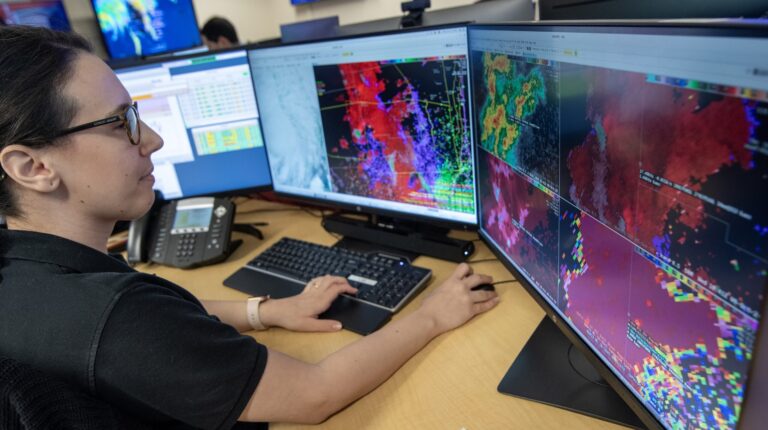
NOAA’s National Weather Service (NWS) has awarded two contracts to develop new cloud-based data and application services, marking a major step in modernizing its forecasting infrastructure.
The initiative will transition key capabilities of the Advanced Weather Interactive Processing System (AWIPS) – which integrates meteorological, hydrological, satellite and radar data – to the cloud. The move is intended to allow forecasters to create, visualize and distribute forecasts, warnings and advisories without being tied to a specific location.
US Secretary of Commerce Howard Lutnick said, “For far too long, American weather forecasters have relied on decades-old, hardwired technology to provide critical data to the American public. Under President Trump’s leadership, we are modernizing the National Weather Service’s operations using the cloud and our American tech stack.”
The cloud-based system is expected to provide greater flexibility for forecasters, including secure remote access to data and systems from multiple devices such as laptops and mobile phones. It will also enable staff to support other NWS offices more easily and support the future use of artificial intelligence and machine learning in forecasting.
NOAA administrator Neil Jacobs said the transition represents a significant upgrade to infrastructure first introduced in the 1990s. “This transition to cloud-based technology is a monumental improvement from the current structure,” he noted. “This upgrade will greatly improve the NWS mission by eliminating time spent downloading data to desktop workstations, while increasing flexibility through remote laptop accessibility.”
The new cloud architecture is designed to support operations across NWS’s network, which includes 122 Weather Forecast Offices, 13 River Forecast Centers, 21 Center Weather Service Units at major airport hubs and nine National Centers. It is also expected to support the integration of additional data sources and emerging technologies.
Two new systems will be developed as part of the program. The Hydrometeorological Interactive Virtual Environment (HIVE) will serve as the primary application platform for forecasters, replacing the legacy AWIPS system while maintaining existing operational capabilities.
The Centralized Integrated Real-Time Repository for Unified Services (CIRRUS) will act as a centralized cloud-based data repository, replacing fragmented legacy storage systems and enabling faster data access for NWS and external partners.
Development will take place in two phases. The first, due for completion by early 2027, will focus on data storage, visualization and the creation of key public-facing products. The second phase, scheduled for early 2028, will deliver full operational capability and enable the retirement of AWIPS.
In related news, Synoptic Data selected for NOAA ProTech 2.0 Weather Domain contract