


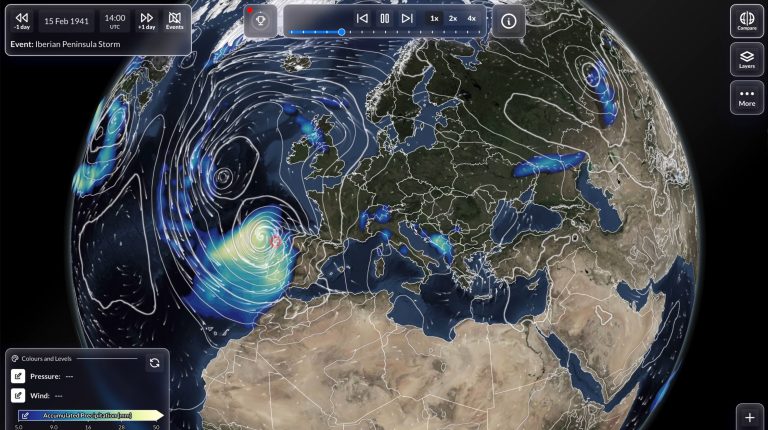
The Copernicus Climate Change Service has released a new application that allows users to explore historical weather conditions worldwide, using decades of reanalysis data.
Developed in collaboration with the European Centre for Medium-Range Weather Forecasts, the Weather Replay app enables users to revisit weather events hour by hour from January 1940 to near present day. The tool is powered by the ERA5 reanalysis dataset and ECMWF’s data infrastructure.
The platform allows users to select a specific date and location or explore a curated list of significant weather events, including storms, heat waves and cyclones. Conditions are visualized almost instantly, supported by cloud-based data systems and the same modeling framework used for operational weather forecasting.
Among the case studies included is a windstorm that struck the Iberian Peninsula in February 1941, bringing more than 50mm of rainfall within hours and wind gusts exceeding 150km/h. The app also recreates events such as Hurricane Katrina in 2005, the European heat wave of 2003 and Cyclone Nargis in 2008.
Users can control animations to move forward or backward in time and adjust playback speed, while sharing specific views via generated links. The platform also includes a comparison feature, allowing users to analyze two weather events side by side, such as recent heat waves in Scandinavia.
Weather Replay provides access to a range of meteorological variables, including surface temperature, precipitation, wind speed and mean sea-level pressure. Upper-air variables – such as wind and temperature at different atmospheric levels – are also available to help explain broader atmospheric dynamics.
Additional tools allow users to examine 48-hour time series data for selected locations, download datasets in CSV format and customize visualization settings such as color scales and resolution.
The application also links to related tools, including Thermal Trace, which focuses on long-term thermal comfort data. It forms part of a wider suite of applications developed through ECMWF’s data platform, alongside tools such as ERA Explorer and Climate Pulse.
In related news, AI models lag behind traditional systems in predicting extreme weather