

Close Menu
Meteorological Technology International
  • News
    • A-E
      • Agriculture
      • Automated Weather Stations
      • Aviation
      • Climate Measurement
      • Data
      • Developing Countries
      • Digital Applications
      • Early Warning Systems
      • Extreme Weather
    • G-P
      • Hydrology
      • Lidar
      • Lightning Detection
      • New Appointments
      • Nowcasting
      • Numerical Weather Prediction
      • Polar Weather
    • R-S
      • Radar
      • Rainfall
      • Remote Sensing
      • Renewable Energy
      • Satellites
      • Solar
      • Space Weather
      • Supercomputers
    • T-Z
      • Training
      • Transport
      • Weather Instruments
      • Wind
      • World Meteorological Organization
      • Meteorological Technology World Expo
  • Features
  • Online Magazines
    • January 2026
    • April 2025
    • January 2025
    • September 2024
    • April 2024
    • Archive Issues
    • Subscribe Free!
  • Opinion
  • Videos
  • Supplier Spotlight
  • Expo
LinkedIn X (Twitter) Facebook
  • Sign-up for Free Weekly E-Newsletter
  • Meet the Editors
  • Contact Us
  • Media Pack
LinkedIn Facebook
Subscribe
Meteorological Technology International
  • News
      • Agriculture
      • Automated Weather Stations
      • Aviation
      • Climate Measurement
      • Data
      • Developing Countries
      • Digital Applications
      • Early Warning Systems
      • Extreme Weather
      • Hydrology
      • Lidar
      • Lightning Detection
      • New Appointments
      • Nowcasting
      • Numerical Weather Prediction
      • Polar Weather
      • Radar
      • Rainfall
      • Remote Sensing
      • Renewable Energy
      • Satellites
      • Solar
      • Space Weather
      • Supercomputers
      • Training
      • Transport
      • Weather Instruments
      • Wind
      • World Meteorological Organization
      • Meteorological Technology World Expo
  • Features
  • Online Magazines
    1. April 2026
    2. January 2026
    3. September 2025
    4. April 2025
    5. January 2025
    6. September 2024
    7. April 2024
    8. January 2024
    9. Archive Issues
    10. Subscribe Free!
    Featured
    May 5, 2026

    In this Issue – April 2026

    By Web TeamMay 5, 2026
    Recent

    In this Issue – April 2026

    May 5, 2026

    In this Issue – January 2026

    November 27, 2025

    In this Issue – September 2025

    August 11, 2025
  • Opinion
  • Videos
  • Supplier Spotlight
  • Expo
Facebook LinkedIn
Subscribe
Meteorological Technology International
Climate Measurement

UK Met Office claims breakthrough on European winter predictions

Lawrence ButcherBy Lawrence ButcherJuly 31, 20202 Mins Read
Share LinkedIn Facebook Twitter Email
Share
LinkedIn Facebook Twitter Email

According to the UK Met Office, accurate prediction of the North Atlantic climate is a step closer following what it is billing as a major scientific breakthrough, which it says will facilitate longer-term prediction of North Atlantic pressure patterns – the key driving force behind winter weather in Europe and eastern North America.

Published in Nature, the study analyzed six decades of climate model data and suggests that decadal variations in North Atlantic atmospheric pressure patterns (known as the North Atlantic Oscillation) are highly predictable, enabling advanced warning of whether winters in the coming decade are likely to be stormy, warm and wet, or calm, cold and dry.

However, the study revealed that this predictable signal is much smaller than it should be in current climate models. Hence, 100 times more ensemble members are required to extract it, and additional steps are needed to balance the effects of winds and greenhouse gases. The team showed that, by taking these deficiencies into account, skillful predictions of extreme European winter decades are possible.

Lead author Dr Doug Smith, who heads decadal climate prediction research and development at the Met Office Hadley Centre, explained, “The message from this study is double-edged: climate is much more predictable than we previously thought, but there is a clear need to improve how models simulate regional changes.”

The Met office notes that improving model simulations will enhance the UK’s response, resilience and security against the effects of extreme weather and climate change – influencing future policy decisions to protect people’s lives, property and infrastructure.
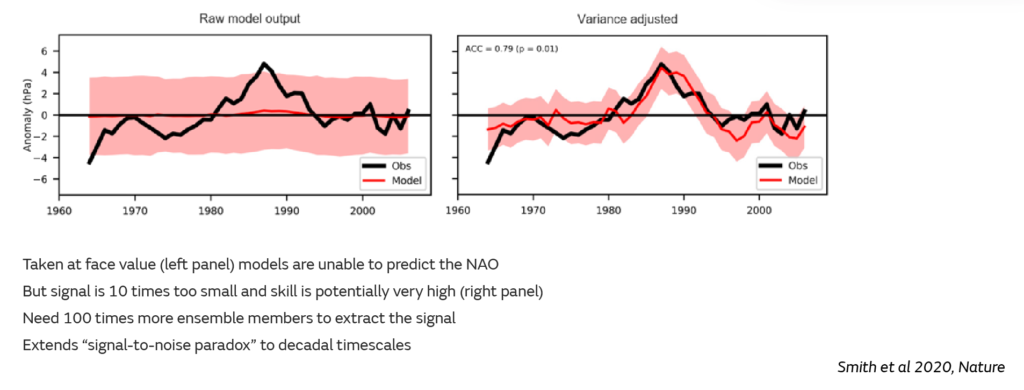
North Atlantic Oscillation: Forecast years 2 to 9
Previous ArticleSatellite telemetry eases remote data gathering for Scottish flood warnings
Next Article WMO to hold symposium on role of climate in relation to Covid-19

Read Similar Stories

Climate Measurement

Global warming reached 1.37°C in 2025 as heat accumulation hits record rate

June 12, 20263 Mins Read
Climate Measurement

Cambridge AI tool converts satellite archives into accessible Earth intelligence

June 10, 20262 Mins Read
Climate Measurement

ECMWF prepares release of new ORAS6 ocean reanalysis system

June 10, 20263 Mins Read
Latest News

NOAA’s SOLAR-1 satellite becomes operational, boosting space weather forecasting capability

June 16, 2026

Global warming reached 1.37°C in 2025 as heat accumulation hits record rate

June 12, 2026

NSF NCAR researchers develop advanced model for neighborhood-scale low-altitude wind prediction

June 11, 2026

Receive breaking stories and features in your inbox each week, for free


Enter your email address:


Supplier Spotlights
  • MicroStep-MIS
Getting in Touch
  • Contact Us / Advertise
  • Meet the Editors
  • Media Pack
  • Free Weekly E-Newsletter
Our Social Channels
  • Facebook
  • LinkedIn
© 2026 UKi Media & Events a division of UKIP Media & Events Ltd
  • Cookie Policy
  • Privacy Policy
  • Terms and Conditions
  • Notice and Takedown Policy

Type above and press Enter to search. Press Esc to cancel.