


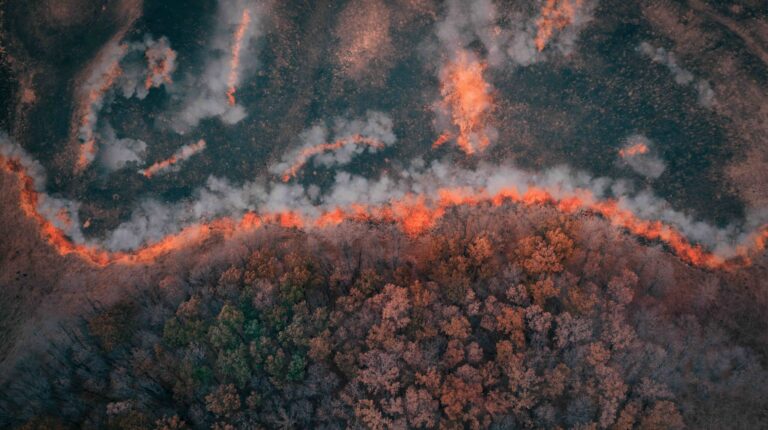
Researchers at the USC Viterbi School of Engineering have developed an artificial intelligence model capable of predicting wildfire spread in near real time by combining satellite data, terrain information and fire simulations.
The system builds on earlier work led by Assad Oberai, Hughes Professor of Aerospace and Mechanical Engineering, and the Computation and Data Driven Discovery (CD3) group. The updated model integrates multiple satellite data sources to improve accuracy and reduce uncertainty in forecasting fire behavior.
The research follows growing concern over increasingly intense wildfires, particularly in regions such as Southern California, where large-scale events have caused widespread damage in recent years.
“Due to changing climate we’re seeing more of these extremely intense fires — those that burn very fast and very bright,” said Oberai.
The model combines data from NASA’s VIIRS satellite system, which provides high-resolution thermal imagery, with observations from the GOES geostationary satellite, which updates every five minutes. While VIIRS offers detailed spatial data, GOES provides continuous temporal coverage, enabling more accurate estimation of when a fire begins.
“We’re still using data from VIIRS, but now we’re bringing in observations from a geostationary satellite, GOES, to obtain a more accurate measurement of the ignition time,” Oberai said. “That addition, and the fact that the new model accounts for terrain means that it makes better informed and therefore, more accurate predictions.”
By incorporating ignition timing, the model can better assess how quickly a fire is spreading. This information is critical for forecasting future behavior and supporting decision-making during active incidents.
“If you know how a fire has initially spread, you can make a more accurate prediction of where it’s going to go next,” Oberai said. “Ignition time is key to that understanding.”
The updated system also factors in terrain conditions, such as slope and elevation, which influence fire movement. In addition, it is trained on simulations of real wildfire events, enabling it to capture variations in weather, vegetation and topography.
According to the researchers, the model’s reconstructions closely match high-resolution infrared fire perimeter data collected by aircraft, indicating improved predictive performance.
“When it comes to effectively fighting a fire, this tool has the power to provide real-time estimates and a type of aerial view of what the fire looks like at any given instant,” Oberai said.
The team said the aim is to make the technology available to first responders and wildfire planners as fire seasons become longer and more severe.
Related news, European Commission sets out strategy to address growing wildfire risk