


Close Menu
Meteorological Technology International
  • News
    • A-E
      • Agriculture
      • Automated Weather Stations
      • Aviation
      • Climate Measurement
      • Data
      • Developing Countries
      • Digital Applications
      • Early Warning Systems
      • Extreme Weather
    • G-P
      • Hydrology
      • Lidar
      • Lightning Detection
      • New Appointments
      • Nowcasting
      • Numerical Weather Prediction
      • Polar Weather
    • R-S
      • Radar
      • Rainfall
      • Remote Sensing
      • Renewable Energy
      • Satellites
      • Solar
      • Space Weather
      • Supercomputers
    • T-Z
      • Training
      • Transport
      • Weather Instruments
      • Wind
      • World Meteorological Organization
      • Meteorological Technology World Expo
  • Features
  • Online Magazines
    • January 2026
    • April 2025
    • January 2025
    • September 2024
    • April 2024
    • Archive Issues
    • Subscribe Free!
  • Opinion
  • Videos
  • Supplier Spotlight
  • Expo
LinkedIn X (Twitter) Facebook
  • Sign-up for Free Weekly E-Newsletter
  • Meet the Editors
  • Contact Us
  • Media Pack
LinkedIn Facebook
Subscribe
Meteorological Technology International
  • News
      • Agriculture
      • Automated Weather Stations
      • Aviation
      • Climate Measurement
      • Data
      • Developing Countries
      • Digital Applications
      • Early Warning Systems
      • Extreme Weather
      • Hydrology
      • Lidar
      • Lightning Detection
      • New Appointments
      • Nowcasting
      • Numerical Weather Prediction
      • Polar Weather
      • Radar
      • Rainfall
      • Remote Sensing
      • Renewable Energy
      • Satellites
      • Solar
      • Space Weather
      • Supercomputers
      • Training
      • Transport
      • Weather Instruments
      • Wind
      • World Meteorological Organization
      • Meteorological Technology World Expo
  • Features
  • Online Magazines
    1. January 2026
    2. September 2025
    3. April 2025
    4. January 2025
    5. September 2024
    6. April 2024
    7. January 2024
    8. September 2023
    9. April 2023
    10. Archive Issues
    11. Subscribe Free!
    Featured
    November 27, 2025

    In this Issue – January 2026

    By Hazel KingNovember 27, 2025
    Recent

    In this Issue – January 2026

    November 27, 2025

    In this Issue – September 2025

    August 11, 2025

    In this Issue – April 2025

    April 15, 2025
  • Opinion
  • Videos
  • Supplier Spotlight
  • Expo
Facebook LinkedIn
Subscribe
Meteorological Technology International
Extreme Weather

Flooding in New York City’s Jamaica Bay caused by combination of landscape changes and sea-level rise, finds study

Elizabeth BakerBy Elizabeth BakerFebruary 24, 20233 Mins Read
Share LinkedIn Facebook Twitter Email
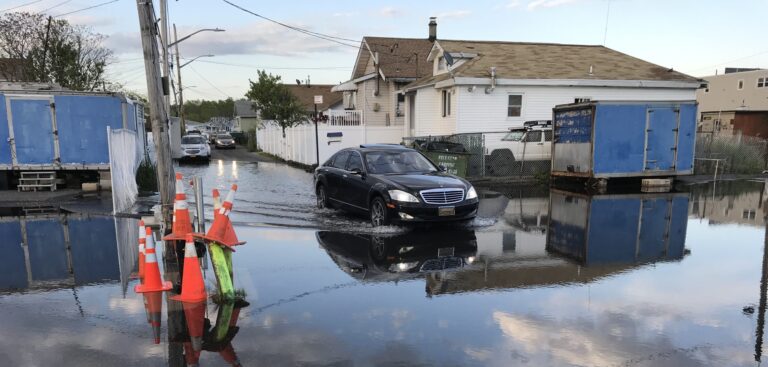
Jamica Bay. Credit Philip Orton
Share
LinkedIn Facebook Twitter Email

Historical dredging and wetland loss in New York City’s Jamaica Bay have increased high-tide flooding in the area, leading to thousands of homes experiencing damaging floods each year.

Jamaica Bay is an estuary that lies between Long Island and New York City’s Brooklyn and Queens boroughs. Over the past 150 years, landscape changes and sea level rise have increased high-tide levels in the bay by 55cm (1.8ft). As a result, hundreds of thousands of residents experience chronic, damaging floods.

Philip Orton, a physical oceanographer at the Stevens Institute of Technology and corresponding author of the study, said, “Some neighborhoods around Jamaica Bay flood about 60 times per year. This forces the community to make infrastructure changes, like putting backflow valves in sewers to prevent water from coming up during flooding events.”

Researchers used water level observations and digitized landscape maps that extend back to the 1870s to model the effects of sea level rise and land-use changes, including the extension of Rockaway Peninsula and the dredging and widening of the inlet, on high-tide flooding in the bay. They then compared modern flood risks to hypothetical scenarios in which humans did not alter the landscape.

In 2020, 15 of the 62 high-tide events that impacted Jamaica Bay were classified by NOAA as “minor” floods, resulting in flood advisories throughout the bay. According to the study, only two of the 15 minor flooding events that affected Jamaica Bay in 2020 would have occurred if there hadn’t been historical landscape changes in the bay, and only one of the 15 would have occurred without sea level rise.

Minor flooding events, often called nuisance flooding, are floods that result in minimal property damage but may pose a public threat or inconvenience. “Basically, when there is street flooding, it is considered a minor flooding event,” Orton said.

High-tide floods often fall under the category of “minor” floods, but chronic minor floods — such as those that residents face monthly around Jamaica Bay — can disrupt the livelihoods of the bay’s residents and cause infrastructure damage over the years.

“We thought that the main [flooding] problem was going to be that the inlet was deepened dramatically in the 1870s,” Orton said. “But it turns out that the destruction of the surrounding wetlands was also an important factor in the flooding dynamics of the estuary.”

The wetlands surrounding the bay had absorbed the tidewaters, reducing flooding by allowing the water to spread over a wider area. In the late 1800s, 46.5km2  (18 square miles), or 76%, of the total wetland area was lost due to erosion, inlet deepening and the creation of new urban spaces. Today, neighborhoods are built on top of the remaining wetlands.

“At many locations across the nation, high tides are getting higher thanks to sea level rise,” Orton said. “Many of the developed coastal lagoons throughout the country, and even throughout the world, are being hit with a growing number of high-tide flooding events.”

Restoring wetlands and marshes around the edges of Jamaica Bay could help reduce high-tide flooding, Orton said.

To view the complete study published in AGU’s Journal of Geophysical Research: Oceans, click here.

Previous ArticleNIWA crew witness “sobering” Antarctic ice loss first hand
Next Article Climate spiral threatens land carbon stores, finds NCAS

Read Similar Stories

Agriculture

Extreme heat posing significant risks to ecosystems and agriculture, FAO-WMO report warns

April 22, 20263 Mins Read
Extreme Weather

AI model improves real-time prediction of wildfire spread

April 16, 20263 Mins Read
Climate Measurement

Study identifies atmospheric trigger behind flash droughts in Puerto Rico

April 15, 20263 Mins Read
Latest News

WMO signals increasing likelihood of El Niño developing in 2026

April 24, 2026

Alabama partners with Climavision to expand weather radar coverage statewide

April 24, 2026

Extreme heat posing significant risks to ecosystems and agriculture, FAO-WMO report warns

April 22, 2026

Receive breaking stories and features in your inbox each week, for free


Enter your email address:


Supplier Spotlights
  • Raymetrics
Getting in Touch
  • Contact Us / Advertise
  • Meet the Editors
  • Media Pack
  • Free Weekly E-Newsletter
Our Social Channels
  • Facebook
  • LinkedIn
© 2026 UKi Media & Events a division of UKIP Media & Events Ltd
  • Cookie Policy
  • Privacy Policy
  • Terms and Conditions
  • Notice and Takedown Policy

Type above and press Enter to search. Press Esc to cancel.