



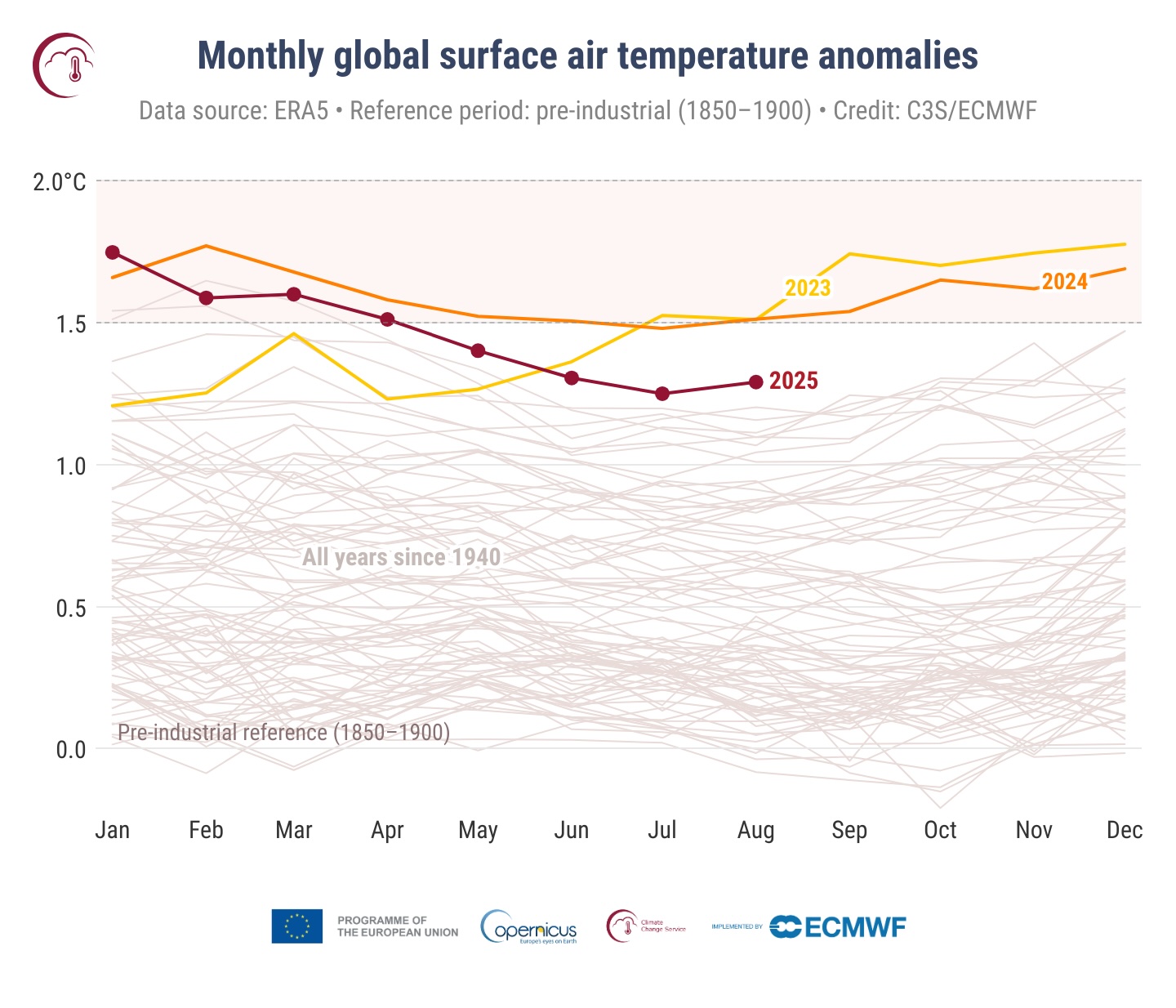
August 2025 was the third-warmest August globally, with an average surface air temperature of 16.60 °C, 0.49°C above the 1991-2020 average for August and 1.29°C above the estimated 1850-1900 average used to define the pre-industrial level, according to the Copernicus Climate Change Service (C3S).
The 12-month period of September 2024-August 2025 was 0.64°C above the 1991-2020 average and 1.52°C above the pre-industrial level. It was 0.22°C cooler than the two warmest Augusts on record, in 2023 and 2024.
Samantha Burgess, strategic lead for climate at ECMWF which implements the C3S, said, “In southwest Europe, the month brought the third major heatwave of the summer, accompanied by exceptional wildfires. With the world’s oceans also remaining unusually warm, these events underline not only the urgency of reducing emissions but also the critical need to adapt to more frequent and intense climate extremes.”
The highlights from the findings of August’s bulletins include:
Temperature in Europe and other regions
The average temperature over European land for August 2025 was 19.46°C, 0.30°C above the 1991-2020 average for August, leaving the month outside the 10 warmest Augusts in the data record.
Western Europe experienced the most pronounced above-average air temperatures, with the Iberian Peninsula and southwest France particularly affected by heatwave conditions.
Outside Europe, temperatures were mostly above average across Siberia, parts of Antarctica, China, the Korean Peninsula, Japan and the Middle East.
Temperatures were mostly below average over most of Australia and mixed conditions occurred across North America, South America and Africa.
Sea surface temperature
The average sea surface temperature (SST) for August 2025 over 60°S–60°N was 20.82°C, the third-highest value on record for the month, 0.16°C below the August 2023 record.
Most of the North Pacific saw much above-average SSTs, with record highs reached in some areas. In contrast, SSTs were close to or below the 1991-2020 average in the central and eastern equatorial Pacific.
Around Europe, there were still record-high SSTs across an area of the North Atlantic to the west of France and the UK. SSTs across the Mediterranean were mixed and much less extreme than in August 2024.
Seasonal highlights
The global-average temperature for the boreal summer 2025 (June to August) was the third highest on record at 0.47°C above the 1991-2020 average, and cooler only than the boreal summers of 2023 and 2024.
Temperatures around the world were mostly above average, especially in the northern hemisphere. The largest positive anomalies were recorded over Asia, while notable negative anomalies occurred over South America and Australia.
Europe had its fourth-warmest summer season on record at 0.90°C above the 1991-2020 average.
Summer temperatures were above average across almost all the European continent, the only exception being some parts of eastern Europe. They were most above average over western parts of Europe, southeast Europe and Türkiye.