

Close Menu
Meteorological Technology International
  • News
    • A-E
      • Agriculture
      • Automated Weather Stations
      • Aviation
      • Climate Measurement
      • Data
      • Developing Countries
      • Digital Applications
      • Early Warning Systems
      • Extreme Weather
    • G-P
      • Hydrology
      • Lidar
      • Lightning Detection
      • New Appointments
      • Nowcasting
      • Numerical Weather Prediction
      • Polar Weather
    • R-S
      • Radar
      • Rainfall
      • Remote Sensing
      • Renewable Energy
      • Satellites
      • Solar
      • Space Weather
      • Supercomputers
    • T-Z
      • Training
      • Transport
      • Weather Instruments
      • Wind
      • World Meteorological Organization
      • Meteorological Technology World Expo
  • Features
  • Online Magazines
    • January 2026
    • April 2025
    • January 2025
    • September 2024
    • April 2024
    • Archive Issues
    • Subscribe Free!
  • Opinion
  • Videos
  • Supplier Spotlight
  • Expo
LinkedIn X (Twitter) Facebook
  • Sign-up for Free Weekly E-Newsletter
  • Meet the Editors
  • Contact Us
  • Media Pack
LinkedIn Facebook
Subscribe
Meteorological Technology International
  • News
      • Agriculture
      • Automated Weather Stations
      • Aviation
      • Climate Measurement
      • Data
      • Developing Countries
      • Digital Applications
      • Early Warning Systems
      • Extreme Weather
      • Hydrology
      • Lidar
      • Lightning Detection
      • New Appointments
      • Nowcasting
      • Numerical Weather Prediction
      • Polar Weather
      • Radar
      • Rainfall
      • Remote Sensing
      • Renewable Energy
      • Satellites
      • Solar
      • Space Weather
      • Supercomputers
      • Training
      • Transport
      • Weather Instruments
      • Wind
      • World Meteorological Organization
      • Meteorological Technology World Expo
  • Features
  • Online Magazines
    1. April 2026
    2. January 2026
    3. September 2025
    4. April 2025
    5. January 2025
    6. September 2024
    7. April 2024
    8. January 2024
    9. Archive Issues
    10. Subscribe Free!
    Featured
    May 5, 2026

    In this Issue – April 2026

    By Web TeamMay 5, 2026
    Recent

    In this Issue – April 2026

    May 5, 2026

    In this Issue – January 2026

    November 27, 2025

    In this Issue – September 2025

    August 11, 2025
  • Opinion
  • Videos
  • Supplier Spotlight
  • Expo
Facebook LinkedIn
Subscribe
Meteorological Technology International
Extreme Weather

Heatwave fuels Arctic wildfires and sea ice retreat

Lawrence ButcherBy Lawrence ButcherAugust 5, 20203 Mins Read
Share LinkedIn Facebook Twitter Email
Share
LinkedIn Facebook Twitter Email

Exceptional and prolonged heat in Siberia has fueled unprecedented Arctic fires, with high carbon emissions, the World Meteorological Organization (WMO) has said, adding that at the same time, rapidly decreasing sea ice coverage has been reported along the Russian Arctic coast.

As a result of this confluence of conditions, the northernmost inhabited Arctic town, Longyearbyen, on the Norwegian archipelago of Svalbard, saw a new record temperature of 21.7°C on July 25, compared with the July average of 5.9°C, according to Norway’s national meteorological service.

The WMO’s data shows that temperatures in Siberia have been more than 5°C above average from January to June, and in June up to 10°C above average. A temperature of 38°C was recorded in the Russian town of Verkhoyansk on June 20, and temperatures in parts of Siberia the week beginning July 19 again topped 30°C.

The organization stated that observations show the prolonged heat is related to a vast blocking pressure system and a persistent northward swing of the jet stream, enabling warm air into the region. Nevertheless, it said such extreme heat would have been almost impossible without the influence of human-caused climate change, according to a rapid attribution analysis by a team of leading climate scientists.

“The Arctic is heating more than twice as fast as the global average, impacting local populations and ecosystems and with global repercussions. “What happens in the Arctic does not stay in the Arctic. Because of teleconnections, the poles influence weather and climate conditions in lower latitudes where hundreds of millions of people live,” said WMO secretary-general Petteri Taalas.

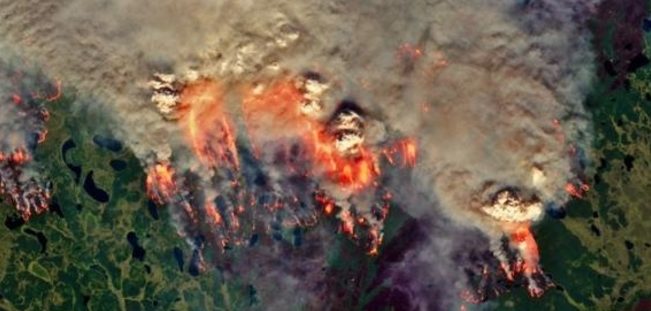
Satellite images from Europe’s Sentinel 3 satellites showed that the wildfires currently affecting Siberia inside and outside the Arctic Circle cover a width of about 800km. The fire front of the northernmost currently active Arctic wildfire reached over the 71.6N, less than 8km from the Arctic Ocean.

The WMO noted that July 2020 has witnessed an escalation in Arctic fires previously unseen in the EU Copernicus Atmosphere Monitoring Service Global Fire Assimilation System data. The fires have been particularly intense in Russia’s Sakha Republic and Chukotka Autonomous Okrug in the far northeast of Siberia, both of which have been experiencing much warmer-than-usual conditions over the past months. Russian authorities have also declared that there is an extreme fire hazard throughout the Khanty-Mansiysk Autonomous Okrug – Yugra, in western Siberia.

The Siberian heatwave has accelerated ice retreat along the Arctic Russian coast, most notably since late June, leading to very low sea ice extent in the Laptev and Barents Seas. However, in contrast, the other areas of the Arctic seas appear to be near the 1981 to 2010 average for this time of year.

The WMO noted that such contrasts serve as prominent examples of the larger variations that occur for sea ice extent on the regional scale, in comparison with the Arctic Ocean as a whole.

Previous ArticleWMO to hold symposium on role of climate in relation to Covid-19
Next Article Contract awarded for CO2  monitoring satellites

Read Similar Stories

Nowcasting

Colorado State University and Nvidia partner to extend severe storm prediction lead times

June 2, 20262 Mins Read
Climate Measurement

WMO warns El Niño is developing with 80% certainty, urges preparation

June 2, 20263 Mins Read
Developing Countries

Tropical cyclones threaten energy security in Bangladesh, study finds

May 29, 20262 Mins Read
Latest News

NOAA’s SOLAR-1 satellite becomes operational, boosting space weather forecasting capability

June 16, 2026

Global warming reached 1.37°C in 2025 as heat accumulation hits record rate

June 12, 2026

NSF NCAR researchers develop advanced model for neighborhood-scale low-altitude wind prediction

June 11, 2026

Receive breaking stories and features in your inbox each week, for free


Enter your email address:


Supplier Spotlights
  • Campbell Scientific
Getting in Touch
  • Contact Us / Advertise
  • Meet the Editors
  • Media Pack
  • Free Weekly E-Newsletter
Our Social Channels
  • Facebook
  • LinkedIn
© 2026 UKi Media & Events a division of UKIP Media & Events Ltd
  • Cookie Policy
  • Privacy Policy
  • Terms and Conditions
  • Notice and Takedown Policy

Type above and press Enter to search. Press Esc to cancel.