


Close Menu
Meteorological Technology International
  • News
    • A-E
      • Agriculture
      • Automated Weather Stations
      • Aviation
      • Climate Measurement
      • Data
      • Developing Countries
      • Digital Applications
      • Early Warning Systems
      • Extreme Weather
    • G-P
      • Hydrology
      • Lidar
      • Lightning Detection
      • New Appointments
      • Nowcasting
      • Numerical Weather Prediction
      • Polar Weather
    • R-S
      • Radar
      • Rainfall
      • Remote Sensing
      • Renewable Energy
      • Satellites
      • Solar
      • Space Weather
      • Supercomputers
    • T-Z
      • Training
      • Transport
      • Weather Instruments
      • Wind
      • World Meteorological Organization
      • Meteorological Technology World Expo
  • Features
  • Online Magazines
    • January 2026
    • April 2025
    • January 2025
    • September 2024
    • April 2024
    • Archive Issues
    • Subscribe Free!
  • Opinion
  • Videos
  • Supplier Spotlight
  • Expo
LinkedIn X (Twitter) Facebook
  • Sign-up for Free Weekly E-Newsletter
  • Meet the Editors
  • Contact Us
  • Media Pack
LinkedIn Facebook
Subscribe
Meteorological Technology International
  • News
      • Agriculture
      • Automated Weather Stations
      • Aviation
      • Climate Measurement
      • Data
      • Developing Countries
      • Digital Applications
      • Early Warning Systems
      • Extreme Weather
      • Hydrology
      • Lidar
      • Lightning Detection
      • New Appointments
      • Nowcasting
      • Numerical Weather Prediction
      • Polar Weather
      • Radar
      • Rainfall
      • Remote Sensing
      • Renewable Energy
      • Satellites
      • Solar
      • Space Weather
      • Supercomputers
      • Training
      • Transport
      • Weather Instruments
      • Wind
      • World Meteorological Organization
      • Meteorological Technology World Expo
  • Features
  • Online Magazines
    1. April 2026
    2. January 2026
    3. September 2025
    4. April 2025
    5. January 2025
    6. September 2024
    7. April 2024
    8. January 2024
    9. Archive Issues
    10. Subscribe Free!
    Featured
    May 5, 2026

    In this Issue – April 2026

    By Web TeamMay 5, 2026
    Recent

    In this Issue – April 2026

    May 5, 2026

    In this Issue – January 2026

    November 27, 2025

    In this Issue – September 2025

    August 11, 2025
  • Opinion
  • Videos
  • Supplier Spotlight
  • Expo
Facebook LinkedIn
Subscribe
Meteorological Technology International
Extreme Weather

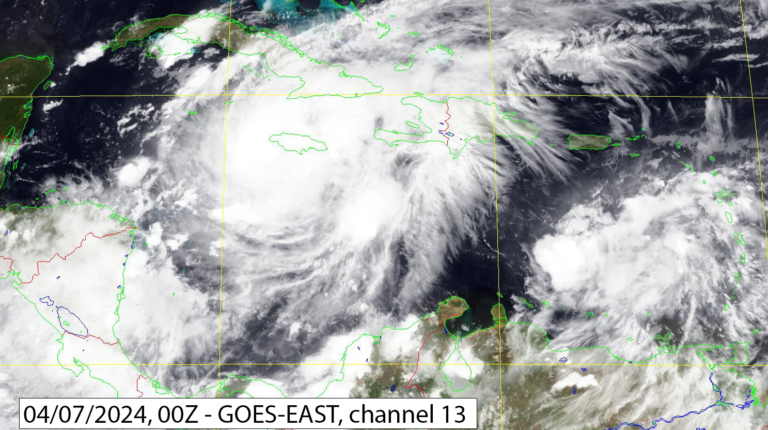
Space Park Leicester and NCEO capture real-time images of Hurricane Beryl

Hazel KingBy Hazel KingJuly 16, 20242 Mins Read
Share LinkedIn Facebook Twitter Email
Credit: National Centre for Earth Observation (NCEO)
Share
LinkedIn Facebook Twitter Email

In a significant advancement for real-time environmental monitoring and disaster response, Space Park Leicester, in collaboration with the National Centre for Earth Observation (NCEO), has successfully utilized its advanced satellite system to capture near real-time images of Hurricane Beryl.

The hurricane ripped across the Caribbean with winds of 240km/h (150mph) and, peaking at Category 5 on the Saffir-Simpson scale on July 2, was the earliest Category 5 system recorded since the scale was first introduced in 1974.

Space Park Leicester’s cutting-edge capability, part of a larger initiative funded by UK Research and Innovation’s (UKRI) World Class Laboratories scheme, demonstrates the potential of satellite technology to provide critical insights and support during natural disasters.

Advanced satellite data acquisition

The University of Leicester’s space and Earth observation hub is equipped with a state-of-the-art satellite data acquisition system known as EUMETCast which leverages two new 1.8m dishes mounted on the facility’s roof to receive data from the Hotbird 13G satellite.

Commenting on the system, Dr David Moore, NCEO scientist, School of Physics and Astronomy, University of Leicester, said, “The EUMETCast system is an integral part of the European Organisation for the Exploitation of Meteorological Satellites (EUMETSAT) network, providing a continuous stream of meteorological and climate data using standard digital video broadcast (DVB) technology.”

Rapid data processing

The received data is processed by two high-performance workstations that decrypt and perform initial analyses. A third workstation, dedicated to visualization, converts the data into interactive, user-friendly images and animations, offering dynamic visual insights into weather patterns and atmospheric conditions.

Moore added, “The EUMETCast system excels in delivering data within a short timeframe, often within three hours and in many cases within just one hour of collection. This rapid data acquisition and processing are pivotal for responding to dynamic environmental events.

“During Hurricane Beryl, Space Park Leicester’s satellite dishes are receiving timely imagery, enabling detailed monitoring and analysis of the storm’s development and trajectory.”

The imagery and data acquired from EUMETCast at Space Park Leicester will provide invaluable support for global disaster response. By analyzing satellite data in near real time, experts at the NCEO can rapidly assess the scale and impact of natural disasters.

Moore continued, “Data acquired from EUMETCast will be used for ocean monitoring, atmospheric composition and land applications, allowing scientists across NCEO institutes to provide a rapid analysis and response to events such as hurricanes, wildfires and floods.”

Previous ArticleUKCEH opens meteorological office in Ghana
Next Article WMO Bulletin highlights hazards and impacts of sand and dust storms

Read Similar Stories

Nowcasting

Colorado State University and Nvidia partner to extend severe storm prediction lead times

June 2, 20262 Mins Read
Climate Measurement

WMO warns El Niño is developing with 80% certainty, urges preparation

June 2, 20263 Mins Read
Developing Countries

Tropical cyclones threaten energy security in Bangladesh, study finds

May 29, 20262 Mins Read
Latest News

VIDEO: Sentinel-6 satellite detects El Niño precursor in Pacific

June 4, 2026

New forecasting framework targets solar-limb flare blind spot

June 4, 2026

Colorado State University and Nvidia partner to extend severe storm prediction lead times

June 2, 2026

Receive breaking stories and features in your inbox each week, for free


Enter your email address:


Supplier Spotlights
  • ZOGLAB Microsystem Co., Ltd
Getting in Touch
  • Contact Us / Advertise
  • Meet the Editors
  • Media Pack
  • Free Weekly E-Newsletter
Our Social Channels
  • Facebook
  • LinkedIn
© 2026 UKi Media & Events a division of UKIP Media & Events Ltd
  • Cookie Policy
  • Privacy Policy
  • Terms and Conditions
  • Notice and Takedown Policy

Type above and press Enter to search. Press Esc to cancel.