


Close Menu
Meteorological Technology International
  • News
    • A-E
      • Agriculture
      • Automated Weather Stations
      • Aviation
      • Climate Measurement
      • Data
      • Developing Countries
      • Digital Applications
      • Early Warning Systems
      • Extreme Weather
    • G-P
      • Hydrology
      • Lidar
      • Lightning Detection
      • New Appointments
      • Nowcasting
      • Numerical Weather Prediction
      • Polar Weather
    • R-S
      • Radar
      • Rainfall
      • Remote Sensing
      • Renewable Energy
      • Satellites
      • Solar
      • Space Weather
      • Supercomputers
    • T-Z
      • Training
      • Transport
      • Weather Instruments
      • Wind
      • World Meteorological Organization
      • Meteorological Technology World Expo
  • Features
  • Online Magazines
    • January 2026
    • April 2025
    • January 2025
    • September 2024
    • April 2024
    • Archive Issues
    • Subscribe Free!
  • Opinion
  • Videos
  • Supplier Spotlight
  • Expo
LinkedIn X (Twitter) Facebook
  • Sign-up for Free Weekly E-Newsletter
  • Meet the Editors
  • Contact Us
  • Media Pack
LinkedIn Facebook
Subscribe
Meteorological Technology International
  • News
      • Agriculture
      • Automated Weather Stations
      • Aviation
      • Climate Measurement
      • Data
      • Developing Countries
      • Digital Applications
      • Early Warning Systems
      • Extreme Weather
      • Hydrology
      • Lidar
      • Lightning Detection
      • New Appointments
      • Nowcasting
      • Numerical Weather Prediction
      • Polar Weather
      • Radar
      • Rainfall
      • Remote Sensing
      • Renewable Energy
      • Satellites
      • Solar
      • Space Weather
      • Supercomputers
      • Training
      • Transport
      • Weather Instruments
      • Wind
      • World Meteorological Organization
      • Meteorological Technology World Expo
  • Features
  • Online Magazines
    1. April 2026
    2. January 2026
    3. September 2025
    4. April 2025
    5. January 2025
    6. September 2024
    7. April 2024
    8. January 2024
    9. Archive Issues
    10. Subscribe Free!
    Featured
    May 5, 2026

    In this Issue – April 2026

    By Web TeamMay 5, 2026
    Recent

    In this Issue – April 2026

    May 5, 2026

    In this Issue – January 2026

    November 27, 2025

    In this Issue – September 2025

    August 11, 2025
  • Opinion
  • Videos
  • Supplier Spotlight
  • Expo
Facebook LinkedIn
Subscribe
Meteorological Technology International
Polar Weather

ESA’s Arctic weather satellite passes environmental test for orbit

Elizabeth BakerBy Elizabeth BakerMarch 15, 20243 Mins Read
Share LinkedIn Facebook Twitter Email
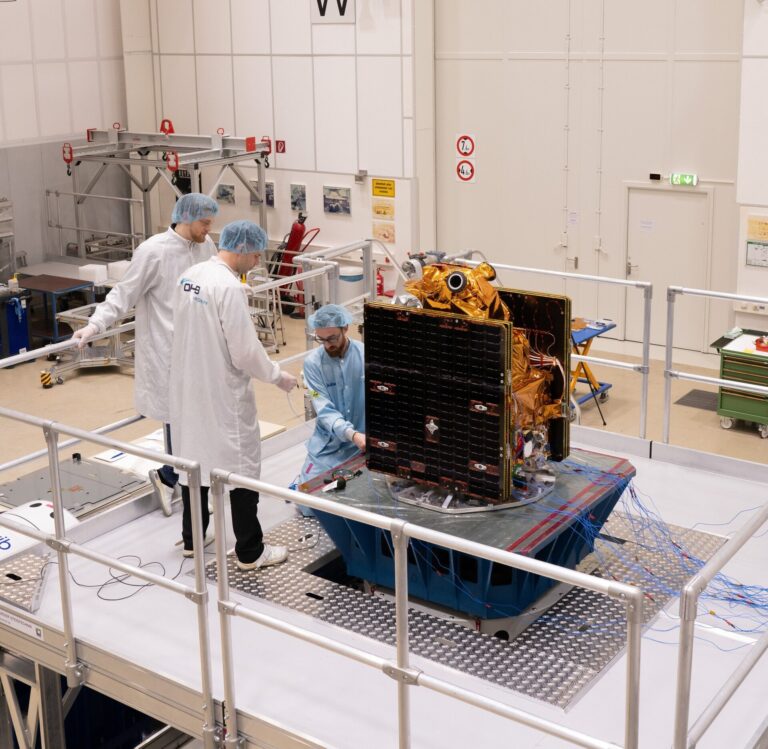
ESA researchers work on the Arctic weather satellite.
Credit ESA
Share
LinkedIn Facebook Twitter Email

ESA’s Arctic weather satellite has passed its environmental test campaign – meaning that the satellite has been declared fit for liftoff and its life in space.

Instrumentation

This new satellite, which is slated for launch in June 2024, has been designed to show how it can improve weather forecasts in the Arctic – a region that currently lacks data for accurate short-term forecasts.

The Arctic weather satellite is equipped with a 19-channel cross-track scanning microwave radiometer, which benefits from the heritage technology of the microwave sounder developed for the MetOp Second Generation satellites. The instrument will provide high-resolution humidity and temperature soundings of the atmosphere in all weather conditions.

Successful tests

The set of final tests was carried out at industrial equipment supplier Industrieanlagen-Betriebsgesellschaft (IABG) in Germany and included positioning the satellite on a shaker to simulate the vibrations it will have to endure during liftoff, and enclosing it in a thermal vacuum chamber where it was exposed to the extreme swings in temperature that it will experience as it orbits Earth. The satellite is now being shipped back to Sweden for a last few checks before it is packed up and ready for shipment to the Vandenberg launch site in California.

Developing the Arctic weather satellite

The prototype Arctic weather satellite has been developed and built on a very tight schedule of just 36 months and on a tight budget.

Ville Kangas, Arctic weather satellite project manager at ESA, said, “This last testing program is extremely important to make sure that the satellite is robust enough to survive launch and the harshness of the space environment. I am extremely happy to say that everything went very well and I extend my thanks to IABG and OHB Sweden for their diligent work.”

Ville added, “Led by our prime contractor, OHB in Sweden, over 30 companies have been involved in the development of the mission. I think I can speak for everyone in saying how thrilled we are to see the satellite fit and well and ready for its next steps.”

The satellite is the forerunner of a potential constellation of satellites, called EPS-Sterna, that ESA would build for Eumetsat if this prototype Arctic weather satellite works well. The EPS-Sterna mission is envisioned as a constellation of six microsatellites in three orbital planes to supply an almost constant stream of temperature and humidity data from every location on Earth.

This would, for the first time, enable very short-range weather forecasting, or ‘nowcasting’, in the Arctic. The set of six microsatellites would be replenished three times. While the Arctic is the focus, meteorologists will also use the constellation to improve weather forecasts globally.

To watch ESA’s video on the development of the Arctic weather satellite, ahead of testing in orbit, click here.

Previous ArticleMeteoSwiss makes ICON climate and weather model publicly available
Next Article VIDEO: Preparing ESA’s Arctic weather satellite for environmental testing

Read Similar Stories

Climate Measurement

Cambridge AI tool converts satellite archives into accessible Earth intelligence

June 10, 20262 Mins Read
Oceans

VIDEO: Sentinel-6 satellite detects El Niño precursor in Pacific

June 4, 20262 Mins Read
Solar

New forecasting framework targets solar-limb flare blind spot

June 4, 20262 Mins Read
Latest News

Global warming reached 1.37°C in 2025 as heat accumulation hits record rate

June 12, 2026

NSF NCAR researchers develop advanced model for neighborhood-scale low-altitude wind prediction

June 11, 2026

Cambridge AI tool converts satellite archives into accessible Earth intelligence

June 10, 2026

Receive breaking stories and features in your inbox each week, for free


Enter your email address:


Supplier Spotlights
  • ELDES S.r.l.
Getting in Touch
  • Contact Us / Advertise
  • Meet the Editors
  • Media Pack
  • Free Weekly E-Newsletter
Our Social Channels
  • Facebook
  • LinkedIn
© 2026 UKi Media & Events a division of UKIP Media & Events Ltd
  • Cookie Policy
  • Privacy Policy
  • Terms and Conditions
  • Notice and Takedown Policy

Type above and press Enter to search. Press Esc to cancel.