


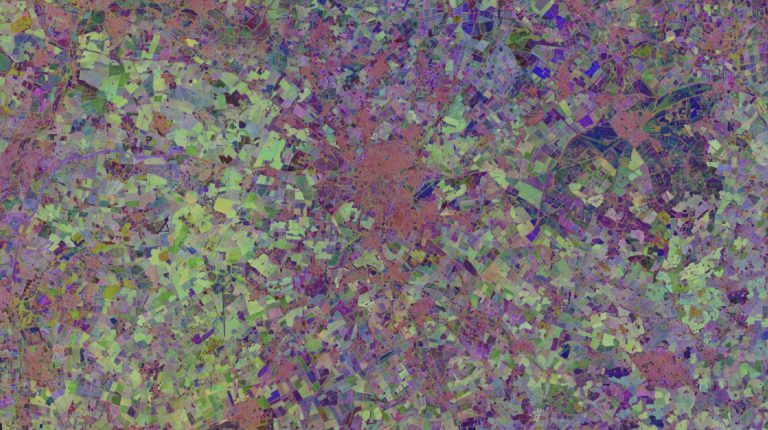
A team led by the University of Cambridge has developed an AI model that converts millions of European Space Agency satellite images into a format readily usable by researchers, potentially transforming how scientists monitor environmental change from space.
Tessera, a foundation model presented at the IEEE/CVF Conference on Computer Vision and Pattern Recognition in Boulder, Colorado, on June 6, processes petabytes of satellite data to recognize patterns and track how they change over time. For every 10m-by-10m area of land, the model produces a sequence of 128 numbers – known as an embedding – that encodes landscape characteristics. These are stored in a freely accessible database called GeoTessera.
The tool can be applied to reveal crop patterns, habitat loss, deforestation and the environmental impacts of conflict. Tessera also addresses a persistent problem in satellite data analysis: cloud cover. Using an image recognition algorithm called Barlow Twins, the model examines multiple cloud-free images of the same scene captured throughout the year, learning to identify a landscape’s underlying characteristics and fill in gaps caused by cloud-covered images.
“Our goal is to support ecologists, agricultural scientists and policy makers through distilled Earth observation on demand. We provide this with no barriers or paywalls. It’s Earth intelligence for all,” said Srinivasan Keshav, professor at Cambridge’s department of computer science and technology and one of Tessera’s lead investigators.
The model draws on data from ESA‘s Copernicus Sentinel-1 and Sentinel-2 satellites and was tested in real-world applications including tree species mapping in Germany, farmland classification in Austria and rainforest canopy analysis in Borneo. In all tests, Tessera matched or outperformed rival models, including Google DeepMind’s AlphaEarth.
Cambridge forest ecologist David Coomes is already using Tessera to monitor land designated for protection in Cumbria, in partnership with the Endangered Landscapes and Seascape Programme. The project could provide the UK government with a means of measuring the effectiveness of farming subsidies and conservation investments.
Julia Jones, co-chair of the Chief Scientist’s Group of the UK’s statutory nature conservation bodies and a professor at Bangor University, described the tool as a significant advance for conservation decision-making: “With a relatively small amount of training data, anyone can make a habitat map highlighting the features that interest them and explore change over time.”
Tessera currently offers global coverage for 2024 and regional coverage from 2017 to the present.
Related news, AI model improves real-time prediction of wildfire spread