


Close Menu
Meteorological Technology International
  • News
    • A-E
      • Agriculture
      • Automated Weather Stations
      • Aviation
      • Climate Measurement
      • Data
      • Developing Countries
      • Digital Applications
      • Early Warning Systems
      • Extreme Weather
    • G-P
      • Hydrology
      • Lidar
      • Lightning Detection
      • New Appointments
      • Nowcasting
      • Numerical Weather Prediction
      • Polar Weather
    • R-S
      • Radar
      • Rainfall
      • Remote Sensing
      • Renewable Energy
      • Satellites
      • Solar
      • Space Weather
      • Supercomputers
    • T-Z
      • Training
      • Transport
      • Weather Instruments
      • Wind
      • World Meteorological Organization
      • Meteorological Technology World Expo
  • Features
  • Online Magazines
    • January 2026
    • April 2025
    • January 2025
    • September 2024
    • April 2024
    • Archive Issues
    • Subscribe Free!
  • Opinion
  • Videos
  • Supplier Spotlight
  • Expo
LinkedIn X (Twitter) Facebook
  • Sign-up for Free Weekly E-Newsletter
  • Meet the Editors
  • Contact Us
  • Media Pack
LinkedIn Facebook
Subscribe
Meteorological Technology International
  • News
      • Agriculture
      • Automated Weather Stations
      • Aviation
      • Climate Measurement
      • Data
      • Developing Countries
      • Digital Applications
      • Early Warning Systems
      • Extreme Weather
      • Hydrology
      • Lidar
      • Lightning Detection
      • New Appointments
      • Nowcasting
      • Numerical Weather Prediction
      • Polar Weather
      • Radar
      • Rainfall
      • Remote Sensing
      • Renewable Energy
      • Satellites
      • Solar
      • Space Weather
      • Supercomputers
      • Training
      • Transport
      • Weather Instruments
      • Wind
      • World Meteorological Organization
      • Meteorological Technology World Expo
  • Features
  • Online Magazines
    1. April 2026
    2. January 2026
    3. September 2025
    4. April 2025
    5. January 2025
    6. September 2024
    7. April 2024
    8. January 2024
    9. Archive Issues
    10. Subscribe Free!
    Featured
    May 5, 2026

    In this Issue – April 2026

    By Web TeamMay 5, 2026
    Recent

    In this Issue – April 2026

    May 5, 2026

    In this Issue – January 2026

    November 27, 2025

    In this Issue – September 2025

    August 11, 2025
  • Opinion
  • Videos
  • Supplier Spotlight
  • Expo
Facebook LinkedIn
Subscribe
Meteorological Technology International
Wind

NSF NCAR researchers develop advanced model for neighborhood-scale low-altitude wind prediction

Alex PackBy Alex PackJune 11, 20263 Mins Read
Share LinkedIn Facebook Twitter Email
NSF NCAR researchers develop advanced model for neighborhood-scale low-altitude wind prediction.
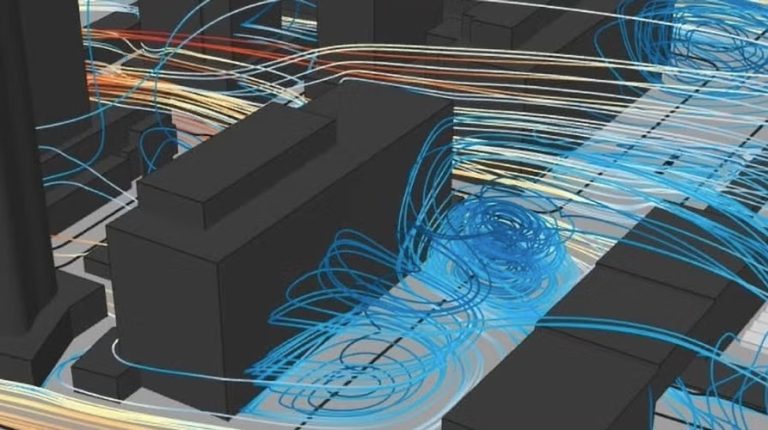
NSF NCAR researchers are working on capturing winds at exceptionally high resolution, revealing wind gusts and eddies along individual streets and around corners. Image credit: NSF NCAR
Share
LinkedIn Facebook Twitter Email

Researchers at the US National Science Foundation National Center for Atmospheric Research (NSF NCAR) are developing a new model to predict low-altitude winds with improved accuracy and granularity.

The capability would provide decision-makers and emergency responders with neighborhood-level insights, enabling them to better prepare for and respond to complications caused by wind events, such as wildfires and power disruptions.

Current weather models lack the resolution to capture key features of the local topography that can influence near-surface winds. For predictions to be accurate at the neighborhood scale, man-made structures and natural elements such as buildings and trees must be accurately modeled.

Over the next five years, NSF NCAR researchers will collaborate with researchers at the University of Kentucky. To model near-surface winds with great accuracy, the team is primarily leveraging two tools: a model called FastEddy that is being developed at NSF NCAR and observations obtained with a fleet of uncrewed aircraft systems (UAS) owned by the University of Kentucky.

James Pinto, NSF NCAR scientist and principal investigator of the project, said, “One of our goals is to enable support for real-time wildland firefighting as well as pinpoint what parts of the energy distribution network are most likely to be impacted by a high-wind event to inform more strategic power shutoffs.”

He added that the research enables the team to “simulate the influence of a collection of buildings or a canopy of trees on low-altitude winds and turbulence in real time.”

The project is titled LEAP-HI: Advancing Precision Neighborhood Scale Weather Forecasting with Autonomous Aircraft Systems and Adaptive Microscale Models. It is funded through NSF’s Leading Engineering for America’s Prosperity, Health, and Infrastructure (LEAP-HI) program.

FastEddy is a model that predicts temperature, humidity and winds at resolutions so fine that it can capture swirling pockets of wind. It can use either idealized wind conditions or real-world forecast outputs to drive the simulations, which are run on the Derecho supercomputer at the NSF NCAR-Wyoming Supercomputer Center.

Small errors in the mode and forecast data can have a significant impact when predicting low-altitude winds in real-world simulations. It is hoped that utilizing the model in conjunction with UAS observations will remedy this.

The UAS measurements will be combined with the micronetwork of turbulence sensors distributed across the University of Kentucky’s flight facility to better predict wind and turbulence.

The FastEddy model simulations will be evaluated against the observations. If differences between the predictions and observations still exist, the new observations will be used to tweak the inputs and parameters that drive FastEddy and further improve its predictions.

The research team hopes that the research will lead to the accurate prediction of low-altitude wind to a resolution within two meters. Once the researchers have established the technique to improve the accuracy of the simulations, they will perform additional testing at other locations with more complex terrain and land surface characteristics.

This type of prediction tool is also highly sought after in the emerging urban air mobility (UAM) industry. As government agencies and private companies look at developing UAM operations that could move people and cargo within urban environments via drones and air taxis, the FastEddy model could help guide infrastructure planning, operational efficiency and safety.

Related, FT Technologies’ wind sensor deployed in storm-chasing research

Previous ArticleCambridge AI tool converts satellite archives into accessible Earth intelligence

Read Similar Stories

Weather Instruments

FT Technologies’ wind sensor deployed in storm-chasing research

February 11, 20263 Mins Read
Lidar

DNV completes IEC classification of ZX 300e wind lidar

February 6, 20262 Mins Read
Weather Instruments

Vaisala unveils new wind lidar with improved performance

September 10, 20251 Min Read
Latest News

NSF NCAR researchers develop advanced model for neighborhood-scale low-altitude wind prediction

June 11, 2026

Cambridge AI tool converts satellite archives into accessible Earth intelligence

June 10, 2026

ECMWF prepares release of new ORAS6 ocean reanalysis system

June 10, 2026

Receive breaking stories and features in your inbox each week, for free


Enter your email address:


Supplier Spotlights
  • Meteorage
Getting in Touch
  • Contact Us / Advertise
  • Meet the Editors
  • Media Pack
  • Free Weekly E-Newsletter
Our Social Channels
  • Facebook
  • LinkedIn
© 2026 UKi Media & Events a division of UKIP Media & Events Ltd
  • Cookie Policy
  • Privacy Policy
  • Terms and Conditions
  • Notice and Takedown Policy

Type above and press Enter to search. Press Esc to cancel.