


Close Menu
Meteorological Technology International
  • News
    • A-E
      • Agriculture
      • Automated Weather Stations
      • Aviation
      • Climate Measurement
      • Data
      • Developing Countries
      • Digital Applications
      • Early Warning Systems
      • Extreme Weather
    • G-P
      • Hydrology
      • Lidar
      • Lightning Detection
      • New Appointments
      • Nowcasting
      • Numerical Weather Prediction
      • Polar Weather
    • R-S
      • Radar
      • Rainfall
      • Remote Sensing
      • Renewable Energy
      • Satellites
      • Solar
      • Space Weather
      • Supercomputers
    • T-Z
      • Training
      • Transport
      • Weather Instruments
      • Wind
      • World Meteorological Organization
      • Meteorological Technology World Expo
  • Features
  • Online Magazines
    • January 2026
    • April 2025
    • January 2025
    • September 2024
    • April 2024
    • Archive Issues
    • Subscribe Free!
  • Opinion
  • Videos
  • Supplier Spotlight
  • Expo
LinkedIn X (Twitter) Facebook
  • Sign-up for Free Weekly E-Newsletter
  • Meet the Editors
  • Contact Us
  • Media Pack
LinkedIn Facebook
Subscribe
Meteorological Technology International
  • News
      • Agriculture
      • Automated Weather Stations
      • Aviation
      • Climate Measurement
      • Data
      • Developing Countries
      • Digital Applications
      • Early Warning Systems
      • Extreme Weather
      • Hydrology
      • Lidar
      • Lightning Detection
      • New Appointments
      • Nowcasting
      • Numerical Weather Prediction
      • Polar Weather
      • Radar
      • Rainfall
      • Remote Sensing
      • Renewable Energy
      • Satellites
      • Solar
      • Space Weather
      • Supercomputers
      • Training
      • Transport
      • Weather Instruments
      • Wind
      • World Meteorological Organization
      • Meteorological Technology World Expo
  • Features
  • Online Magazines
    1. April 2026
    2. January 2026
    3. September 2025
    4. April 2025
    5. January 2025
    6. September 2024
    7. April 2024
    8. January 2024
    9. Archive Issues
    10. Subscribe Free!
    Featured
    May 5, 2026

    In this Issue – April 2026

    By Web TeamMay 5, 2026
    Recent

    In this Issue – April 2026

    May 5, 2026

    In this Issue – January 2026

    November 27, 2025

    In this Issue – September 2025

    August 11, 2025
  • Opinion
  • Videos
  • Supplier Spotlight
  • Expo
Facebook LinkedIn
Subscribe
Meteorological Technology International
Satellites

Ice mounds in craters on Mars provide new insights into its past climate

Dan SymondsBy Dan SymondsMarch 31, 20223 Mins Read
Share LinkedIn Facebook Twitter Email
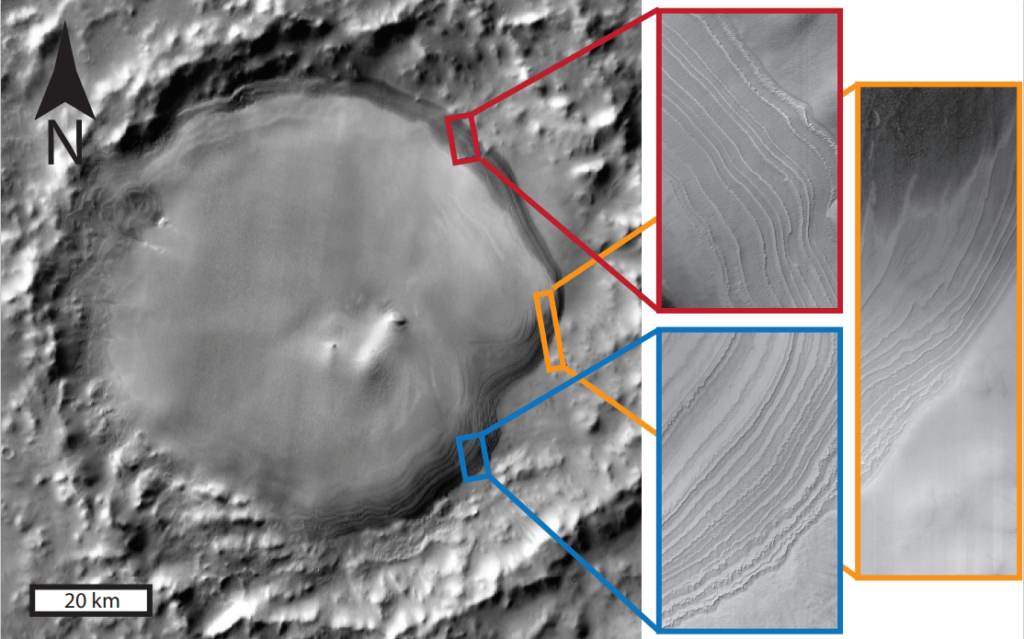
Layered ice in Burroughs crater on Mars, with imagery from THEMIS (left) and HiRISE (right panels) - Credit: Sori et al./Geophysical Research Letters
Share
LinkedIn Facebook Twitter Email

A study by Purdue University in Indiana believes that newly discovered deposits of layered ice in craters scattered around Mars’s southern hemisphere provide insights into how the planet’s orientation controlled its climate over the past four million years.

According to the researchers, the findings help to understand what controlled Mars’s past climate, which is essential for predicting when the planet could have been habitable.

Ice deposits on Mars reflect a combination of temperature, hydrology and planetary dynamics, as they do on Earth. The planet’s tilt and orbit impact temperature and sunlight on the surface, which contribute to climate. Thicker, more pure ice layers generally reflect cold periods with more ice accumulation, while thin, dusty layers were likely warmer and less able to build up ice.

The new study matches these ice layers to the tilt of Mars’s axis and its orbital precession, or how the planet’s elliptical orbit rotates around the sun over time, with unprecedented resolution and confidence.

The findings give scientists insight into how Mars’s climate has changed over time. While the study is limited to the recent past, establishing these climate-orbit relationships helps scientists understand Martian climate deeper in the past, which could help pinpoint periods of potential habitability.

“It was unexpected how cleanly those patterns matched to the orbital cycles,” said lead study author Michael Sori, a planetary scientist at Purdue University. “It was just such a perfect match, as good as you can ask for.”

Previously, Martian climate scientists have focused on polar ice caps, which span hundreds of kilometers. But these deposits are old and may have lost ice over time, losing fine details that are necessary to confidently establish connections between the planet’s orientation and motion and its climate.

Sori and his colleagues turned to ice mounds in craters, just tens of kilometers wide but much fresher and potentially less complicated. After scouring much of the southern hemisphere, they pinpointed Burroughs crater, 74km wide, that has “exceptionally well-preserved” layers visible from NASA HiRISE imagery, Sori said.

The researchers analyzed the layers’ thicknesses and shapes and found they had strikingly similar patterns to two important Martian orbital dynamics, the tilt of Mars’s axis and orbital precession, over the last 4-5 million years.

The findings improve on previous research, which used Mars’s polar ice records of climate to establish tentative connections to orbit. But those records were too “noisy,” or complicated, to confidently connect the two. Younger, cleaner crater ice preserves less complicated climate records, which the researchers used to match climate changes to orbital precession and tilt with a high level of precision.

To view the full study published in the AGU journal Geophysical Research Letters, click here.

Previous ArticleVaisala to provide weather intelligence services for Volkswagen Group vehicles
Next Article Met Office to increase heatwave thresholds for some areas of the UK

Read Similar Stories

Oceans

VIDEO: Sentinel-6 satellite detects El Niño precursor in Pacific

June 4, 20262 Mins Read
Solar

New forecasting framework targets solar-limb flare blind spot

June 4, 20262 Mins Read
Satellites

SMILE mission launches to study Earth’s magnetic shield and space weather

May 20, 20263 Mins Read
Latest News

ECMWF prepares release of new ORAS6 ocean reanalysis system

June 10, 2026

Stephen Ettinger named UCAR CFO

June 8, 2026

IKEA uses 20 years of solar data to identify Sweden’s sunniest square meter

June 8, 2026

Receive breaking stories and features in your inbox each week, for free


Enter your email address:


Supplier Spotlights
  • Meteomatics AG
Getting in Touch
  • Contact Us / Advertise
  • Meet the Editors
  • Media Pack
  • Free Weekly E-Newsletter
Our Social Channels
  • Facebook
  • LinkedIn
© 2026 UKi Media & Events a division of UKIP Media & Events Ltd
  • Cookie Policy
  • Privacy Policy
  • Terms and Conditions
  • Notice and Takedown Policy

Type above and press Enter to search. Press Esc to cancel.