


Close Menu
Meteorological Technology International
  • News
    • A-E
      • Agriculture
      • Automated Weather Stations
      • Aviation
      • Climate Measurement
      • Data
      • Developing Countries
      • Digital Applications
      • Early Warning Systems
      • Extreme Weather
    • G-P
      • Hydrology
      • Lidar
      • Lightning Detection
      • New Appointments
      • Nowcasting
      • Numerical Weather Prediction
      • Polar Weather
    • R-S
      • Radar
      • Rainfall
      • Remote Sensing
      • Renewable Energy
      • Satellites
      • Solar
      • Space Weather
      • Supercomputers
    • T-Z
      • Training
      • Transport
      • Weather Instruments
      • Wind
      • World Meteorological Organization
      • Meteorological Technology World Expo
  • Features
  • Online Magazines
    • January 2026
    • April 2025
    • January 2025
    • September 2024
    • April 2024
    • Archive Issues
    • Subscribe Free!
  • Opinion
  • Videos
  • Supplier Spotlight
  • Expo
LinkedIn X (Twitter) Facebook
  • Sign-up for Free Weekly E-Newsletter
  • Meet the Editors
  • Contact Us
  • Media Pack
LinkedIn Facebook
Subscribe
Meteorological Technology International
  • News
      • Agriculture
      • Automated Weather Stations
      • Aviation
      • Climate Measurement
      • Data
      • Developing Countries
      • Digital Applications
      • Early Warning Systems
      • Extreme Weather
      • Hydrology
      • Lidar
      • Lightning Detection
      • New Appointments
      • Nowcasting
      • Numerical Weather Prediction
      • Polar Weather
      • Radar
      • Rainfall
      • Remote Sensing
      • Renewable Energy
      • Satellites
      • Solar
      • Space Weather
      • Supercomputers
      • Training
      • Transport
      • Weather Instruments
      • Wind
      • World Meteorological Organization
      • Meteorological Technology World Expo
  • Features
  • Online Magazines
    1. April 2026
    2. January 2026
    3. September 2025
    4. April 2025
    5. January 2025
    6. September 2024
    7. April 2024
    8. January 2024
    9. Archive Issues
    10. Subscribe Free!
    Featured
    May 5, 2026

    In this Issue – April 2026

    By Web TeamMay 5, 2026
    Recent

    In this Issue – April 2026

    May 5, 2026

    In this Issue – January 2026

    November 27, 2025

    In this Issue – September 2025

    August 11, 2025
  • Opinion
  • Videos
  • Supplier Spotlight
  • Expo
Facebook LinkedIn
Subscribe
Meteorological Technology International
Satellites

MetOp-SG weather and climate satellite ships to Kourou

Elizabeth BakerBy Elizabeth BakerJune 11, 20253 Mins Read
Share LinkedIn Facebook Twitter Email
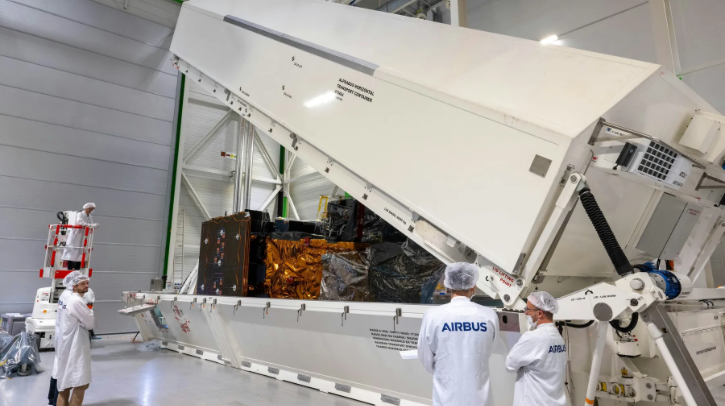
Technicians in labcoats with the word "Airbus" watch a satellite being packed.
Share
LinkedIn Facebook Twitter Email

The first of the Airbus-built MetOp-SG weather and climate monitoring satellites has left Toulouse cleanrooms and is now en-route for Kourou, French Guiana, on board the Canopée. The MetOp Second Generation-A1 satellite, built for the European Organisation for the Exploitation of Meteorological Satellites (EUMETSAT), is expected to launch in August 2025 on board an Ariane 6 rocket.

MetOp-SG program

The MetOp-SG program consists of six satellites in total. The three successive pairs are made up of an A-type and a B-type satellite, which carry a host of different but complementary instruments. MetOp-SG A satellites have instruments for atmospheric sounding and imaging; and MetOp-SG B include instruments for microwave imaging and radar observations. They will ensure the continuity of critical MetOp series data into the mid-2040s.

The MetOp-SG A1 payload includes the Infrared Atmospheric Sounding Interferometer – Next Generation (IASI-NG), which will provide data for weather forecasting, pollution monitoring and climate research. The solution was developed in partnership between Airbus and the French space agency CNES.

It also includes METimage (a visible and infrared imager) developed in partnership with the German Space Agency (DLR), the microwave sounder (built by Airbus in Portsmouth in the UK), the radio occultation sounder, and the multi-viewing, multi-channel, multi-polarisation imager – an entirely new instrument designed to enhance the monitoring of aerosols and cloud properties.

The satellite also carries the Airbus-built Copernicus Sentinel-5 mission – the ultraviolet, visible, near-infrared and short-wave infrared sounder – which will deliver detailed measurements of atmospheric composition and trace gases.

Key partners
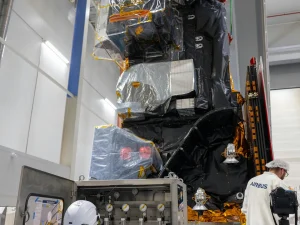
MetOp Second Generation satellites have been developed through partnerships between EUMETSAT and the European Space Agency (ESA), the European Union’s Copernicus program, the French space agency (CNES), DLR and an industrial consortium led by Airbus Defence and Space.

The A series satellites are being built by Airbus in Toulouse, France, while the B series are under construction in Friedrichshafen in southern Germany. The nominal operational lifetime of each MetOp-SG satellite is 7.5 years, ensuring full operational coverage over a 21-year period.

Ariane 6 is a program developed within the framework of the European Space Agency. As prime contractor and design authority for the launcher, ArianeGroup is responsible for development and production alongside its industrial partners. Arianespace, the launch service provider, will oversee launch operations from the Guiana Space Centre, including the integration and deployment of the MetOp-SG A1 satellite into orbit.

Marc Steckling, head of earth observation, science and space exploration at Airbus Defence and Space, said, “The MetOp Second Generation (SG) satellites will further enhance Europe’s leading position in meteorological analysis from space, and help deliver even more accurate weather forecasting to benefit everyone on Earth. Having designed and manufactured all three of the first generation MetOp satellites we are truly looking forward to the successful launch of the first in this vital series that will watch over our planet.”

In related news, NOAA’s GOES-19 satellite, the final satellite in its GOES-R Series, recently begun operations as GOES East. Read the full story here

Previous ArticleOPINION: How will AI weather forecasts make maximum impacts for users?
Next Article Japan deploys lidar ceilometer and a microwave radiometer to improve climate models

Read Similar Stories

Oceans

VIDEO: Sentinel-6 satellite detects El Niño precursor in Pacific

June 4, 20262 Mins Read
Solar

New forecasting framework targets solar-limb flare blind spot

June 4, 20262 Mins Read
Satellites

SMILE mission launches to study Earth’s magnetic shield and space weather

May 20, 20263 Mins Read
Latest News

VIDEO: Sentinel-6 satellite detects El Niño precursor in Pacific

June 4, 2026

New forecasting framework targets solar-limb flare blind spot

June 4, 2026

Colorado State University and Nvidia partner to extend severe storm prediction lead times

June 2, 2026

Receive breaking stories and features in your inbox each week, for free


Enter your email address:


Supplier Spotlights
  • Synoptic Data PBC
Getting in Touch
  • Contact Us / Advertise
  • Meet the Editors
  • Media Pack
  • Free Weekly E-Newsletter
Our Social Channels
  • Facebook
  • LinkedIn
© 2026 UKi Media & Events a division of UKIP Media & Events Ltd
  • Cookie Policy
  • Privacy Policy
  • Terms and Conditions
  • Notice and Takedown Policy

Type above and press Enter to search. Press Esc to cancel.