


Close Menu
Meteorological Technology International
  • News
    • A-E
      • Agriculture
      • Automated Weather Stations
      • Aviation
      • Climate Measurement
      • Data
      • Developing Countries
      • Digital Applications
      • Early Warning Systems
      • Extreme Weather
    • G-P
      • Hydrology
      • Lidar
      • Lightning Detection
      • New Appointments
      • Nowcasting
      • Numerical Weather Prediction
      • Polar Weather
    • R-S
      • Radar
      • Rainfall
      • Remote Sensing
      • Renewable Energy
      • Satellites
      • Solar
      • Space Weather
      • Supercomputers
    • T-Z
      • Training
      • Transport
      • Weather Instruments
      • Wind
      • World Meteorological Organization
      • Meteorological Technology World Expo
  • Features
  • Online Magazines
    • January 2026
    • April 2025
    • January 2025
    • September 2024
    • April 2024
    • Archive Issues
    • Subscribe Free!
  • Opinion
  • Videos
  • Supplier Spotlight
  • Expo
LinkedIn X (Twitter) Facebook
  • Sign-up for Free Weekly E-Newsletter
  • Meet the Editors
  • Contact Us
  • Media Pack
LinkedIn Facebook
Subscribe
Meteorological Technology International
  • News
      • Agriculture
      • Automated Weather Stations
      • Aviation
      • Climate Measurement
      • Data
      • Developing Countries
      • Digital Applications
      • Early Warning Systems
      • Extreme Weather
      • Hydrology
      • Lidar
      • Lightning Detection
      • New Appointments
      • Nowcasting
      • Numerical Weather Prediction
      • Polar Weather
      • Radar
      • Rainfall
      • Remote Sensing
      • Renewable Energy
      • Satellites
      • Solar
      • Space Weather
      • Supercomputers
      • Training
      • Transport
      • Weather Instruments
      • Wind
      • World Meteorological Organization
      • Meteorological Technology World Expo
  • Features
  • Online Magazines
    1. April 2026
    2. January 2026
    3. September 2025
    4. April 2025
    5. January 2025
    6. September 2024
    7. April 2024
    8. January 2024
    9. Archive Issues
    10. Subscribe Free!
    Featured
    May 5, 2026

    In this Issue – April 2026

    By Web TeamMay 5, 2026
    Recent

    In this Issue – April 2026

    May 5, 2026

    In this Issue – January 2026

    November 27, 2025

    In this Issue – September 2025

    August 11, 2025
  • Opinion
  • Videos
  • Supplier Spotlight
  • Expo
Facebook LinkedIn
Subscribe
Meteorological Technology International
Space Weather

BoM begins upgrade of space weather observation network

Dan SymondsBy Dan SymondsJune 24, 20222 Mins Read
Share LinkedIn Facebook Twitter Email
Share
LinkedIn Facebook Twitter Email
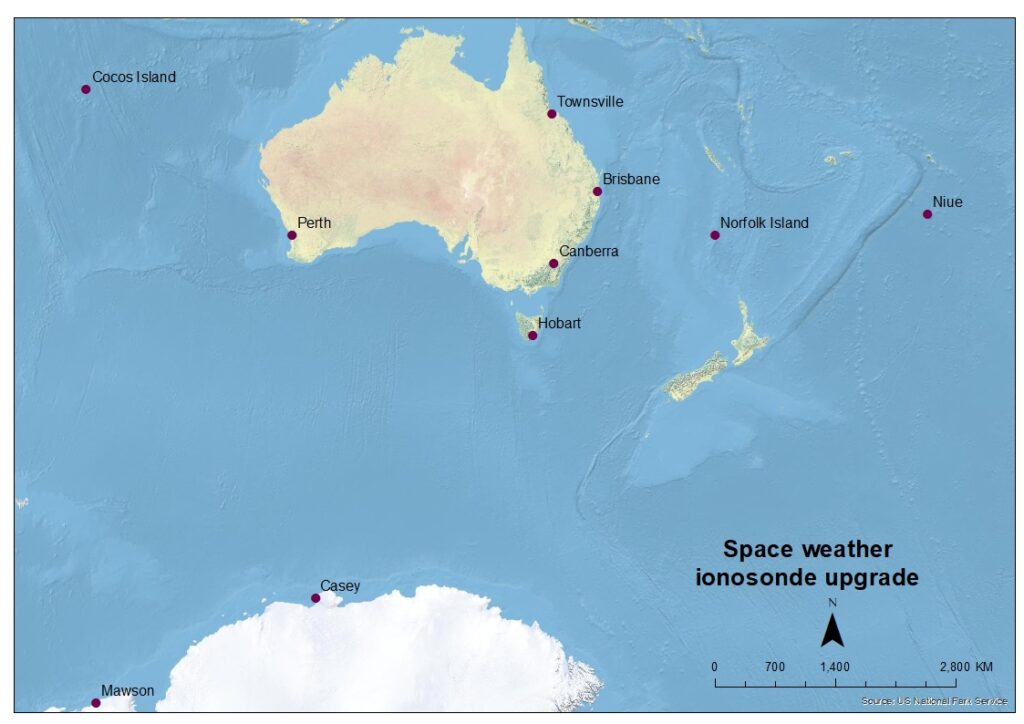
Ionosondes project map – credit: BoM

Work is underway on a major upgrade to Australia’s space weather observation network with works completed at the Bureau of Meteorology’s (BoM) Townsville ionosonde site.

The work at the Townsville site is the first of 10 upgrades to be delivered on BoM’s ionosonde network across Australia.

An ionosonde is a high-frequency radar that sends short pulses of radio energy into the ionosphere. The information collected is used to identify key variations in the ionosphere and understand the potential impacts to high-frequency radio communication services or operations.

The upgrades to Australia’s ionosonde network will provide more resilient, secure and reliable observations for space weather.

Space weather forecasts and observations conducted by the Bureau are crucial to the operations of Australia’s space, aviation, energy, defense and telecommunications industries. BoM’s information assists these industries in assessing their exposure to risks to their operations from potential space weather conditions.

Additionally, Australia’s location in the Southern Hemisphere, combined with clear skies, low noise and low light interference means it is uniquely placed to contribute to the international space community.

Upgrades to the remaining ionosondes will be rolled out over the next two years. BoM has ionosondes in Townsville, Bribie Island, Canberra, Cocos Islands, Hobart, Norfolk Island, Perth, Niue, Casey (Antarctica), Mawson (Antarctica).

Previous ArticleWMO Covid-19 Research Task Team issues recommendations
Next Article WMO Executive Council approves early warning and greenhouse gas initiatives

Read Similar Stories

Solar

New forecasting framework targets solar-limb flare blind spot

June 4, 20262 Mins Read
Satellites

SMILE mission launches to study Earth’s magnetic shield and space weather

May 20, 20263 Mins Read
Space Weather

Northumbria University secures £4m to study Earth’s radiation belts

April 16, 20262 Mins Read
Latest News

Global warming reached 1.37°C in 2025 as heat accumulation hits record rate

June 12, 2026

NSF NCAR researchers develop advanced model for neighborhood-scale low-altitude wind prediction

June 11, 2026

Cambridge AI tool converts satellite archives into accessible Earth intelligence

June 10, 2026

Receive breaking stories and features in your inbox each week, for free


Enter your email address:


Supplier Spotlights
  • Geolux d.o.o.
Getting in Touch
  • Contact Us / Advertise
  • Meet the Editors
  • Media Pack
  • Free Weekly E-Newsletter
Our Social Channels
  • Facebook
  • LinkedIn
© 2026 UKi Media & Events a division of UKIP Media & Events Ltd
  • Cookie Policy
  • Privacy Policy
  • Terms and Conditions
  • Notice and Takedown Policy

Type above and press Enter to search. Press Esc to cancel.