


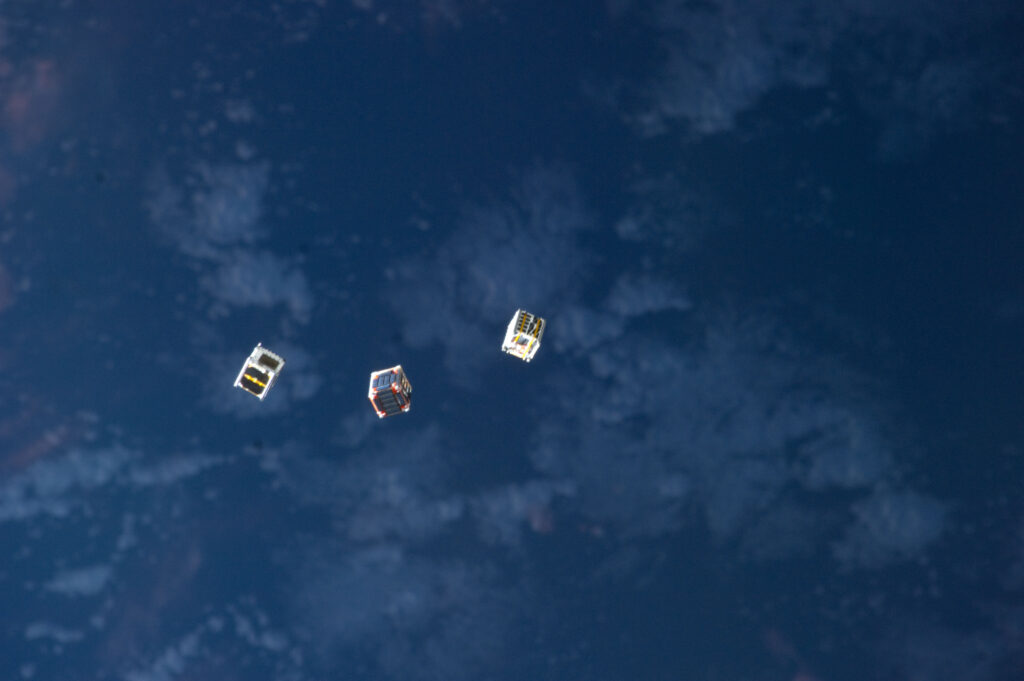
NASA’s Heliophysics Flight Opportunities in Research and Technology (H-FORT) program has unveiled four CubeSat missions as part of a first-generation testbed to advance space weather innovation through small satellites.
Working in cooperation with NASA’s Space Weather Science Application initiative, the CubIXSS, SunCET, DYNAGLO and WindCube missions will provide a faster and cheaper way to develop new technologies thanks in part to their small size compared with traditional large space missions.
A recent NASA-commissioned report prepared by the Johns Hopkins University Applied Physics Laboratory identified key observing ‘gaps’ that must be filled to enable more reliable space weather forecasts.
Jim Spann, space weather lead at NASA, said, “We’re taking advantage of gains in small spacecraft technology to fill some of these critical gaps and evaluate how that advances our understanding of space weather and enables improvement of forecasting capabilities.”
The CubeSat Imaging X-Ray Solar Spectrometer (CubIXSS) mission will study the origins of hot plasma in solar flares and active regions. CubIXSS will perform soft x-ray spectroscopy of coronal emissions using a new approach that provides unprecedented spectral coverage while still providing adequate spatial resolution to distinguish emissions from different flares and active regions. Variations of soft x-ray emissions are a significant driver of changes in Earth’s upper atmosphere, including the ionosphere and thermosphere. These variations are caused by changes on the sun, including impulsive events such as solar flares as well as more gradual processes such as the evolution and rotation of active regions. CubIXSS will quantify soft x-ray variability from all these sources, providing crucial and currently unavailable information on the solar input to Earth’s upper atmosphere and its impact on near-Earth space.
The Sun Coronal Ejection Tracker (SunCET) mission will examine the dominant physical mechanisms that accelerate coronal mass ejections (CME), huge clouds of solar plasma and magnetic fields that escape the sun after some solar eruptions. These physical mechanisms operate largely in the sun’s middle corona, a region that has historically been under-observed. SunCET will have a novel simultaneous, high-dynamic-range detector that can resolve the low and middle corona from the surface of the sun out to four solar radii. This is critical for tracking the emergence of CMEs, which are a key driver of severe space weather. One of the greatest limitations of our current CME-forecasting capability is the lack of physical understanding of how CMEs are accelerated. Measurements from SunCET will help improve space weather forecasting to protect our technology and assets in space.
The DYNamics Atmosphere GLObal-Connection (DYNAGLO) CubeSat mission fills a crucial observation gap in the ionosphere-thermosphere region. DYNAGLO will be the first of its kind, providing global thermosphere gravity wave measurements and allowing their characteristics to be correlated with known gravity wave sources. This mission will help to understand how atmospheric gravity waves, caused by variations in the densities of different pockets of air, contribute to the energy and momentum balance in the thermosphere. Its observations will complement NASA’s upcoming Atmospheric Waves Experiment and help fill the ‘thermosphere gap’ in measurements between 75 and 250 miles (about 120-400km), allowing NASA to study in unprecedented detail how terrestrial weather shapes space weather from below.
WindCube will study the influence of thermospheric winds on Earth’s ionosphere using an advanced, small-form-factor interferometer. Thermospheric winds respond to changes in the magnetosphere and are critically important for understanding the behavior of the ionosphere across a large range of latitudes and spatial scales. By examining these relationships, WindCube will enable improved modeling of the ionosphere and its associated space weather impacts.
The Heliophysics Division within NASA’s Science Mission Directorate will fund the CubeSat investigations, its mission operations and the launch. Wallops Flight Facility manages the CubeSat missions, and the Launch Services Program at NASA’s Kennedy Space Center in Florida manages the launch service.