


Close Menu
Meteorological Technology International
  • News
    • A-E
      • Agriculture
      • Automated Weather Stations
      • Aviation
      • Climate Measurement
      • Data
      • Developing Countries
      • Digital Applications
      • Early Warning Systems
      • Extreme Weather
    • G-P
      • Hydrology
      • Lidar
      • Lightning Detection
      • New Appointments
      • Nowcasting
      • Numerical Weather Prediction
      • Polar Weather
    • R-S
      • Radar
      • Rainfall
      • Remote Sensing
      • Renewable Energy
      • Satellites
      • Solar
      • Space Weather
      • Supercomputers
    • T-Z
      • Training
      • Transport
      • Weather Instruments
      • Wind
      • World Meteorological Organization
      • Meteorological Technology World Expo
  • Features
  • Online Magazines
    • January 2026
    • April 2025
    • January 2025
    • September 2024
    • April 2024
    • Archive Issues
    • Subscribe Free!
  • Opinion
  • Videos
  • Supplier Spotlight
  • Expo
LinkedIn X (Twitter) Facebook
  • Sign-up for Free Weekly E-Newsletter
  • Meet the Editors
  • Contact Us
  • Media Pack
LinkedIn Facebook
Subscribe
Meteorological Technology International
  • News
      • Agriculture
      • Automated Weather Stations
      • Aviation
      • Climate Measurement
      • Data
      • Developing Countries
      • Digital Applications
      • Early Warning Systems
      • Extreme Weather
      • Hydrology
      • Lidar
      • Lightning Detection
      • New Appointments
      • Nowcasting
      • Numerical Weather Prediction
      • Polar Weather
      • Radar
      • Rainfall
      • Remote Sensing
      • Renewable Energy
      • Satellites
      • Solar
      • Space Weather
      • Supercomputers
      • Training
      • Transport
      • Weather Instruments
      • Wind
      • World Meteorological Organization
      • Meteorological Technology World Expo
  • Features
  • Online Magazines
    1. April 2026
    2. January 2026
    3. September 2025
    4. April 2025
    5. January 2025
    6. September 2024
    7. April 2024
    8. January 2024
    9. Archive Issues
    10. Subscribe Free!
    Featured
    May 5, 2026

    In this Issue – April 2026

    By Web TeamMay 5, 2026
    Recent

    In this Issue – April 2026

    May 5, 2026

    In this Issue – January 2026

    November 27, 2025

    In this Issue – September 2025

    August 11, 2025
  • Opinion
  • Videos
  • Supplier Spotlight
  • Expo
Facebook LinkedIn
Subscribe
Meteorological Technology International
Space Weather

World’s first ground-based sun-Earth space monitoring network reaches completion

Elizabeth BakerBy Elizabeth BakerMarch 24, 20253 Mins Read
Share LinkedIn Facebook Twitter Email
The Chinese Meridian Project (CMP) Phase II has reached completion and national acceptance.
Share
LinkedIn Facebook Twitter Email

The Chinese Meridian Project (CMP) Phase II has reached completion and national acceptance. This project reportedly represents the world’s first comprehensive ground-based monitoring network spanning the entire sun-Earth space environment, extending from the solar atmosphere to near-Earth space.

With construction starting in 2019, CMP Phase II established a ‘two vertical, two horizontal’ double-cross monitoring network along the 100°E and 120°E longitudes and the 30°N and 40°N latitudes. By integrating 16 new observation stations with the original 15 CMP Phase I stations, the project enables unprecedented 3D monitoring of space weather phenomena, from solar eruptions to Earth’s atmospheric responses.

Innovative technology

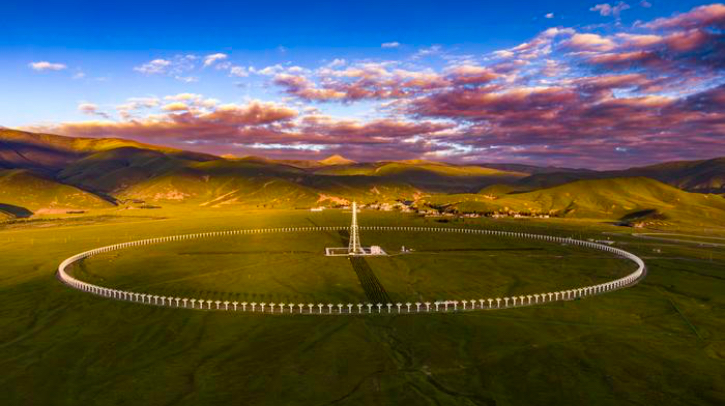
According to the researchers, CMP Phase II features several key technological advances. First, the Daocheng Radio Telescope (DART), a ring-shaped array, captures 3D coronal tomography with a 10-solar-radius field of view, enabling exceptional tracking of solar activity. Second, a metastable helium lidar array enables continuous height-resolved detection of atmospheric metastable helium within a height range of 200-1,000km.

Third, the project includes the world’s first tristatic incoherent scatter radar system, which employs phased array technology to perform ionospheric computed tomography (CT) scanning and 3D imaging over distances of thousands of kilometers. Fourth, the Chinese Dual Auroral Radar Network (CN-DARN), a mid-latitude high-frequency radar array, achieves 24/7 observation of ionospheric dynamics across Asia, covering over 4,000km meridionally and 10,000km zonally. Finally, the project features China’s first facility dedicated to reconstructing 3D solar wind structures, enhancing predictions of the interplanetary environment.

Predicting geomagnetic storms

Since its trial phase, CMP Phase II has reported high reliability. Notably, it captured the May 2024 super geomagnetic storm, providing real-time, high-precision data crucial to understanding atmospheric responses to the space environment.

Wang Chi, principal investigator of CMP Phase II, said, “By unifying global-scale monitoring, we are building a critical shield against space weather threats and offering innovative solutions to global scientific challenges.”

Building on this success, China is launching the International Meridian Circle Program (IMCP) – a 180° longitude monitoring chain, extending from 120°E to 60°W, enabling continuous, all-latitude observation of space weather. This initiative will address transnational challenges such as solar storms and geomagnetic disruptions.

In related news, NASA’s AWE (Atmospheric Waves Experiment) researchers on board the International Space Station recently released the mission’s first trove of scientific data, crucial to investigating how and why subtle changes in Earth’s atmosphere cause disturbances, as well as how these atmospheric disturbances affect technological systems on the ground and in space. Click here to read the full story.

Previous ArticleNASA atmospheric wave-studying mission releases data from first 3,000 orbits
Next Article The Weather Company deploys forecast software tool from JCSDA and UCAR

Read Similar Stories

Solar

New forecasting framework targets solar-limb flare blind spot

June 4, 20262 Mins Read
Satellites

SMILE mission launches to study Earth’s magnetic shield and space weather

May 20, 20263 Mins Read
Climate Measurement

Cloud measurement campaign targets improved climate model accuracy

May 20, 20263 Mins Read
Latest News

VIDEO: Sentinel-6 satellite detects El Niño precursor in Pacific

June 4, 2026

New forecasting framework targets solar-limb flare blind spot

June 4, 2026

Colorado State University and Nvidia partner to extend severe storm prediction lead times

June 2, 2026

Receive breaking stories and features in your inbox each week, for free


Enter your email address:


Supplier Spotlights
  • Adolf Thies GmbH & Co. KG
Getting in Touch
  • Contact Us / Advertise
  • Meet the Editors
  • Media Pack
  • Free Weekly E-Newsletter
Our Social Channels
  • Facebook
  • LinkedIn
© 2026 UKi Media & Events a division of UKIP Media & Events Ltd
  • Cookie Policy
  • Privacy Policy
  • Terms and Conditions
  • Notice and Takedown Policy

Type above and press Enter to search. Press Esc to cancel.