


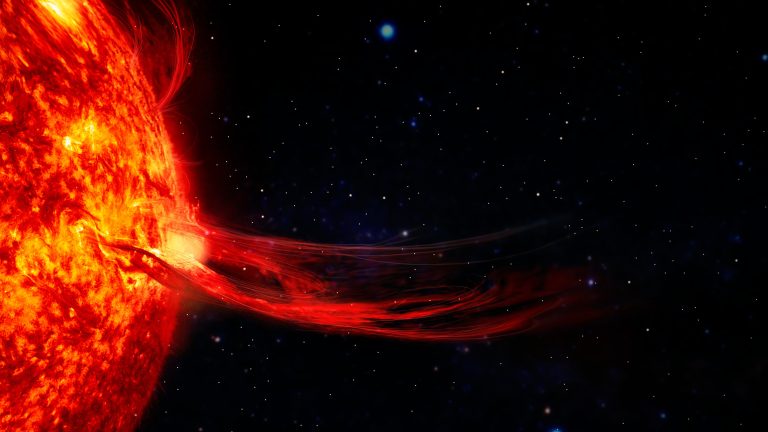
Research co-authored by Lancaster University and published in Nature suggests the potential effects of extreme space weather on Earth may be larger than previously thought.
Space weather, caused by fluctuating electric fields in Earth’s magnetic field and upper atmosphere, can disrupt technologies on and around Earth. Extreme geomagnetic storms – temporary disturbances in the plasma and magnetic field around the Earth – are among the less frequent but more severe forms of space weather, capable of disrupting global satellite communications, causing extensive power outages and increasing radiation exposure for astronauts and pilots.
For decades, scientists have believed there is an upper limit to how Earth’s upper atmosphere responds to solar wind strength, with electric currents widely understood to level off beyond a certain point. The new research suggests this apparent limit is an illusion caused by uncertainty in solar wind strength measurements, meaning solar storms could have far worse technological effects than previously believed.
The study, Regression to the mean can explain saturation of geomagnetic storms, was led by Dr Nithin Sivadas of NASA’s Goddard Space Flight Center and co-authored by Dr Maria Walach of Lancaster’s School of Physics and Astronomy.
The solar wind is a continuous stream of hot gases flowing from the Sun that can strengthen during solar eruptions. Most solar wind measurements of extreme events are taken by spacecraft at Lagrange Point 1, roughly a million miles closer to the Sun than Earth, meaning the solar wind that actually reaches Earth is likely weaker due to a regression-to-the-mean effect. The researchers say this has made it appear, when averaging observations across many events, that strong solar winds do not produce correspondingly strong currents.
Using more than a million solar wind measurements from Earth-orbiting NASA spacecraft positioned close to the planet, the team found a direct relationship between solar wind strength and upper-atmosphere currents, suggesting Earth’s response continues to increase with solar wind strength rather than leveling off, with potential impacts on technology increasing accordingly.
Walach said Earth’s magnetic field generally protects against space weather effects, which often appear only as minor glitches or aurora, though extreme cases can cause satellites to fall from orbit or disrupt communication and GPS signals.
“If there is no upper limit to our planet’s response to the solar wind, modeling for extreme cases needs to take this into account and we should be vigilant of space weather effects,” Walach said. “Fortunately, these very extreme cases are rare, but this also means we have limited data to work with and only time will tell what happens at the very extreme one-in-a-thousand-year kind of event.”
Sivadas added, “We usually assume the truth may be around its measurement. But probability theory says it leans one way. That’s why space weather risks appear underestimated,” he said.
In related news, NASA’s SunRISE mission switches to SpaceX Falcon Heavy launch vehicle