


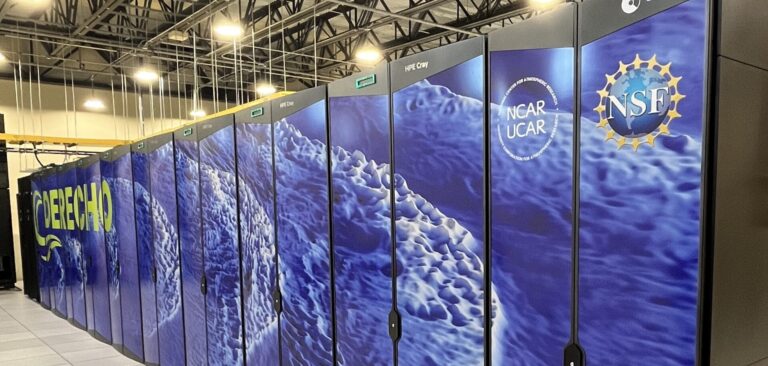
The National Center for Atmospheric Research (NCAR) has commenced operations with its newest supercomputer, named Derecho. It will provide scientists across the USA with a major tool to advance understanding of the atmosphere and other Earth system processes, including wildfires, hurricanes and other phenomena.
Derecho is a 19.87-petaflops system, giving it the theoretical ability to perform 19.87 quadrillion calculations per second. That is about 3.5 times faster than the previous NCAR supercomputer, Cheyenne. Derecho is also the first NCAR supercomputer to include a significant number of graphics processing units (GPUs), with 382 NVIDIA A100 GPUs providing 20% of its computing capability. Derecho was built by Hewlett Packard Enterprise (HPE).
US scientists are starting to use Derecho to study phenomena ranging from wildfires and hurricanes to solar storms. Their findings will help protect society from environmental disasters, lead to more reliable projections of long-term weather patterns, and improve weather and climate predictions that are needed by vulnerable communities and critical sectors of the economy such as agriculture and transportation.
The new supercomputer is so energy efficient it will use only about 40% more electricity than Cheyenne – which is itself highly energy efficient – despite being so much faster. This is partly because GPUs can deliver more computing power for less energy than traditional CPUs, and they are also particularly effective for newly developed AI and machine learning techniques.
Derecho will initially be used for a set of 15 projects by scientists at NCAR as well as at universities across the USA. These comprise the Accelerated Scientific Discovery (ASD) program, which provides a unique opportunity for large-scale computational projects to have nearly exclusive use of new NCAR high-performance computing systems for a few months. Derecho will be open to additional projects by the scientific community later this summer.
Some of the ASD projects include:
Climate change in the West and the Arctic. Scientists are applying a technique known as downscaling to create an ensemble of detailed computer simulations showing how climate is likely to change at very fine scales across the western USA. This novel approach will help reduce uncertainties about future climate and provide researchers with an important data set at a time of unprecedented water shortages, fire weather conditions and heat extremes.
Geoengineering. To potentially offset global warming, scientists are looking into methods such as injecting particles into the stratosphere to reduce incoming solar radiation. Such efforts to artificially cool the planet, however, may have unintended consequences on Earth’s climate. A team of scientists will run advanced climate models to assess the influence of climate change on showers and thunderstorms in South America and determine how stratospheric injection might influence those storms.
Hurricanes. As scientists seek to improve hurricane forecasts, a major question is the influence of sea spray droplets on these powerful storms. Derecho’s GPUs will be used to better understand the movement of airborne droplets and the extent to which they can be carried aloft in extreme conditions.
Wildfires and air quality. Wildfire smoke has a major impact on air quality, both locally and on areas far downwind. By running a specialized, high-resolution computer model capable of capturing wildfire-chemistry-atmosphere interactions, one research team will examine emissions and plume rise from the massive 2020 California fires, gaining a complete picture of wildfire smoke generation, transportation and evolution.
Space weather. Solar storms can have far-reaching impacts on Earth, affecting communications and navigation systems or disrupting the power grid. Major solar eruptions often originate from active regions composed of several bipolar sunspot groups that interact with each other. A project using Derecho’s GPUs will simulate a 2011 event in which opposite polarities collided and formed a powerful solar flare. The investigation will focus on the build-up and release of magnetic energy.
Long-range prediction. One project will use a data-driven, deep learning approach with Derecho’s GPUs to create a 100-member ensemble of subseasonal forecasts of global precipitation and temperature. The research can help lead to improved predictions of rainfall patterns and heatwaves several weeks in advance.