


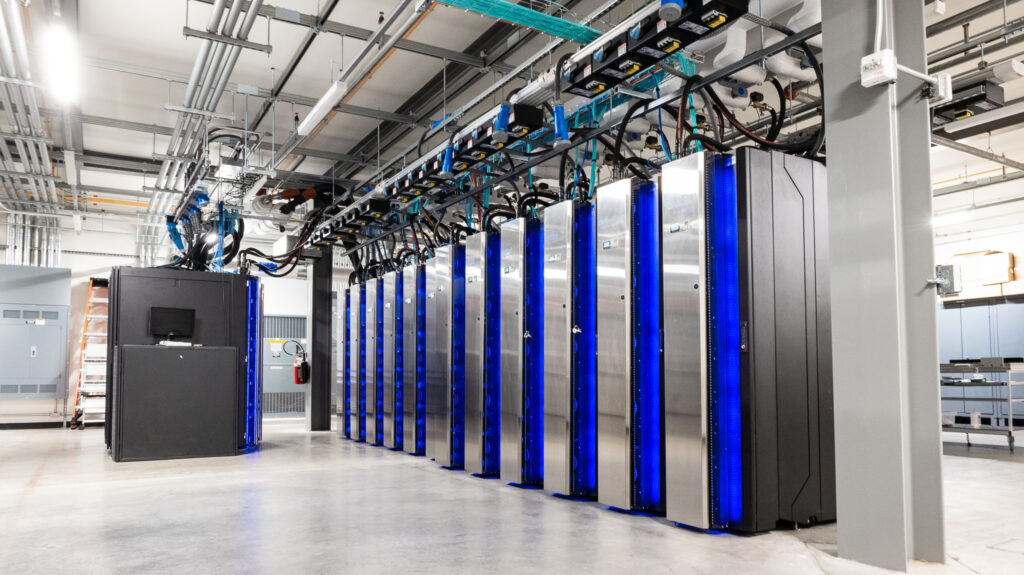
The US National Oceanic and Atmospheric Administration (NOAA) has inaugurated its newest weather and climate Hewlett Packard Enterprise (HPE) Cray supercomputers in Virginia and Arizona.
Supplied by General Dynamics Information Technology (GDIT), the new supercomputers provide a significant upgrade to computing capacity, storage space and interconnect speed of the US Weather and Climate Operational Supercomputing System.
Gina M Raimondo, US secretary of commerce, said, “Accurate weather and climate predictions are critical to informing public safety, supporting local economies and addressing the threat of climate change. Through strategic and sustained investments, the US is reclaiming a global top spot in high-performance computing to provide more accurate and timely climate forecasts to the public.”
Rick Spinrad, NOAA administrator, said, “More computing power will enable NOAA to provide the public with more detailed weather forecasts further in advance. Today’s supercomputer implementation is the culmination of years of hard work by incredible teams across NOAA — everyone should be proud of this accomplishment.”
Enhanced computing and storage capacity will enable NOAA to deploy higher-resolution models to better capture small-scale features such as severe thunderstorms, more realistic model physics to better capture the formation of clouds and precipitation, and a larger number of individual model simulations to better quantify model certainty. The result is even better forecasts and warnings to support public safety and the national economy.
Ken Graham, director of NOAA’s National Weather Service (NWS), added, “This is a big day for NOAA and the state of weather forecasting. Researchers are developing new ensemble-based forecast models at record speed, and now we have the computing power needed to implement many of these substantial advancements to improve weather and climate prediction.”
The new supercomputers will facilitate an upgrade to the US Global Forecast System (GFS) this autumn and the launch of a new hurricane forecast model called the Hurricane Analysis and Forecast System (HAFS), slated to be in operation for the 2023 hurricane season pending tests and evaluation.
In addition, the new supercomputers will enable NOAA’s Environmental Modeling Center — a division of the National Weather Service’s National Centers for Environmental Prediction — to implement other new applications created by model developers across the USA under the Unified Forecast System over the next five years.
The twin HPE Cray supercomputers, called Dogwood and Cactus, are named after the flora native to their geographic locations of Manassas, Virginia, and Phoenix, Arizona, respectively. They replace NOAA’s previous Cray and IBM supercomputers in Reston, Virginia, and Orlando, Florida. The computers serve as a primary and a backup for seamless transfer of operations from one system to another.
Each supercomputer operates at a speed of 12.1 petaflops, three times faster than NOAA’s former system. Coupled with NOAA’s research and development supercomputers in West Virginia, Tennessee, Mississippi and Colorado, which have a combined capacity of 18 petaflops, the supercomputing capacity supporting NOAA’s new operational prediction and research is now 42 petaflops.
According to GDIT, Dogwood and Cactus are currently ranked as the 49th and 50th fastest computers in the world by TOP500.
Under the initial eight-year contract with a two-year optional renewal, GDIT designed and serves as owner/operator of the computers with the responsibility to maintain them and provide all supplies and services, including labor, facilities and computing components.
Kevin Connell, GDIT vice president and general manager for science and engineering, said, “Timely and accurate weather forecasts protect every American citizen, every segment of the economy and play an increasingly important role in emergency preparedness and response to severe weather events. With triple the computing capacity of NOAA’s current system, GDIT’s WCOSS supercomputers will enable future upgrades to the National Weather Service’s models that are essential for accurate and timely forecasts and warnings to protect life and property and enhance the American economy. We are proud to support NOAA on this mission-critical program.”