Close Menu
Meteorological Technology International
  • News
    • A-E
      • Agriculture
      • Automated Weather Stations
      • Aviation
      • Climate Measurement
      • Data
      • Developing Countries
      • Digital Applications
      • Early Warning Systems
      • Extreme Weather
    • G-P
      • Hydrology
      • Lidar
      • Lightning Detection
      • New Appointments
      • Nowcasting
      • Numerical Weather Prediction
      • Polar Weather
    • R-S
      • Radar
      • Rainfall
      • Remote Sensing
      • Renewable Energy
      • Satellites
      • Solar
      • Space Weather
      • Supercomputers
    • T-Z
      • Training
      • Transport
      • Weather Instruments
      • Wind
      • World Meteorological Organization
      • Meteorological Technology World Expo
  • Features
  • Online Magazines
    • January 2026
    • April 2025
    • January 2025
    • September 2024
    • April 2024
    • Archive Issues
    • Subscribe Free!
  • Opinion
  • Videos
  • Supplier Spotlight
  • Expo
LinkedIn X (Twitter) Facebook
  • Sign-up for Free Weekly E-Newsletter
  • Meet the Editors
  • Contact Us
  • Media Pack
LinkedIn Facebook
Subscribe
Meteorological Technology International
  • News
      • Agriculture
      • Automated Weather Stations
      • Aviation
      • Climate Measurement
      • Data
      • Developing Countries
      • Digital Applications
      • Early Warning Systems
      • Extreme Weather
      • Hydrology
      • Lidar
      • Lightning Detection
      • New Appointments
      • Nowcasting
      • Numerical Weather Prediction
      • Polar Weather
      • Radar
      • Rainfall
      • Remote Sensing
      • Renewable Energy
      • Satellites
      • Solar
      • Space Weather
      • Supercomputers
      • Training
      • Transport
      • Weather Instruments
      • Wind
      • World Meteorological Organization
      • Meteorological Technology World Expo
  • Features
  • Online Magazines
    1. January 2026
    2. September 2025
    3. April 2025
    4. January 2025
    5. September 2024
    6. April 2024
    7. January 2024
    8. September 2023
    9. April 2023
    10. Archive Issues
    11. Subscribe Free!
    Featured
    November 27, 2025

    In this Issue – January 2026

    By Hazel KingNovember 27, 2025
    Recent

    In this Issue – January 2026

    November 27, 2025

    In this Issue – September 2025

    August 11, 2025

    In this Issue – April 2025

    April 15, 2025
  • Opinion
  • Videos
  • Supplier Spotlight
  • Expo
Facebook LinkedIn
Subscribe
Meteorological Technology International
Weather Instruments

National Geographic team installs highest weather station in the tropical Andes

Dan SymondsBy Dan SymondsAugust 9, 20223 Mins Read
Share LinkedIn Facebook Twitter Email
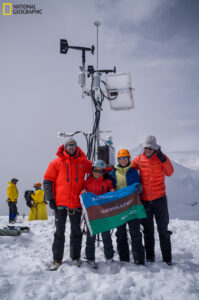
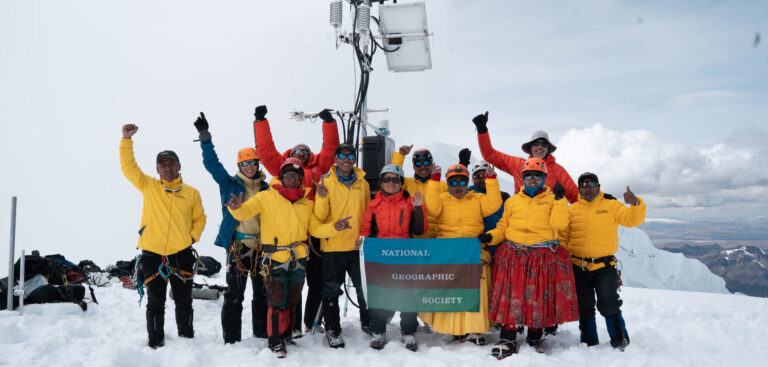
The team celebrates in front of the weather station on Ausangate. Credit: Justen Bruns/National Geographic
Share
LinkedIn Facebook Twitter Email

Explorers from the National Geographic Society have placed a weather station just below the summit of Nevado Ausangate in Peru at 6,349m, making it the highest weather station in the tropical Andes.

The installation is part of the 2022 National Geographic and Rolex Amazon Perpetual Planet Expedition, a two-year exploration of the Amazon River Basin spanning the Andes to the Atlantic.

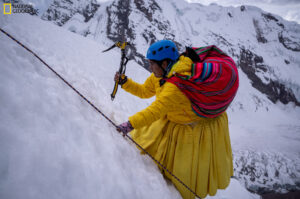
The tropical high Andes of southern Peru contain essential water towers that support nature and human communities from the glacier margins to the Amazon basin. National Geographic explorers Baker Perry and Tom Matthews, supported by a local Peruvian Quechua team and female Bolivian climbing experts ‘the Cholitas Escaladoras’, worked together to climb Nevado Ausangate – the highest peak in southern Peru – to investigate important meteorological processes driving the climate and glacier behavior and to install a weather station near its peak.

Perry said, “Nevado Ausangate is one of the most critical mountains in the high Andes as it serves as the primary freshwater source for Andean and downstream ecosystems. It is essential that we use weather observations from the highest peaks in the world to better understand the impacts that climate change is having on local and global communities. The changes happening on Ausangate are especially important in understanding the fluctuations and adaptations of the entire Amazon River Watershed.”

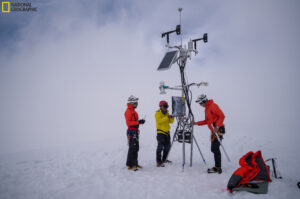
The new weather station collects near-real-time meteorological data including temperature, precipitation, humidity, radiation and snow depth, all of which will aid local governments and the international scientific community in observing the impacts of climate change on critical water resources that affect local communities.

The expedition team also conducted in-situ monitoring of the atmosphere and analyzed snow-pack properties, obtaining direct measurements of snow water equivalent from the snowpack. As part of the snow assessment, the team collected samples to screen for microplastics in this remote region. If present, it would likely indicate long-distance atmospheric transport.

Local organizations and institutions including Universidad Nacional de San Antonio de Abad del Cusco (UNSAAC), Servicio Nacional de Meteorología e Hidrología (SENAMHI) del Perú and Universidad Mayor de San Andrés (Bolivia) were all partners in the expedition.

The Nevado Ausangate weather station complements the highest weather station installed in the southern and western hemispheres, near the summit of the Tupungato Volcano in Chile. The combination of the two stations provides critical data to study climate-glacier interactions in the accumulation zone and characterize the extreme climate at the highest elevations in the Andes.

This work builds on previous Perpetual Planet Expeditions to install weather stations in high mountain environments, including to Mount Logan in 2022 as well as to Mount Everest in 2019 and 2022, both of which were led by Perry and Matthews. Rolex supports these expeditions as part of its Perpetual Planet initiative.
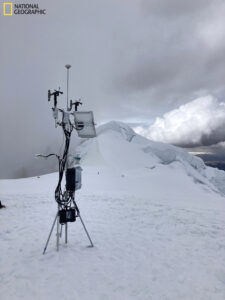
The weather station on Ausangate. Credit: Baker Perry/National Geographic
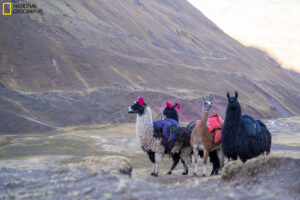
Llamas carrying equipment toward the base camp. This land belongs to the community of Chillca. Credit: Ruthmery Pillco Huarcaya/National Geographic
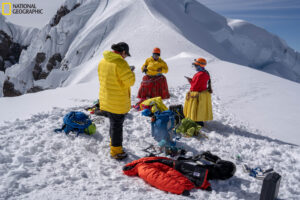
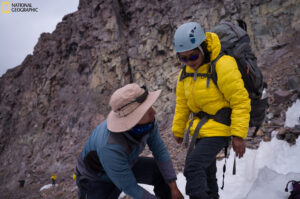
Team Bolivia: Laura (Master student) , Cecilia y Senovia (cholitas escaladoras). Getting equipment ready to sample the ice pit in the Ausangate summit. Credit: Ruthmery Pillco Huarcaya/National Geographic
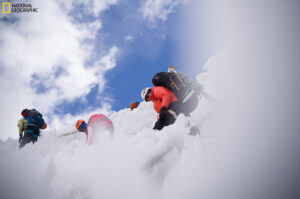
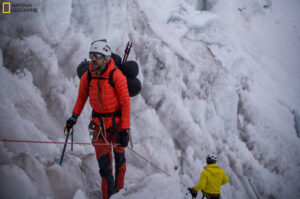
National Geographic Explorer Baker Perry and Senobia Llusco climb towards Nevado Ausangate’s summit. Credit Justen Bruns/National Geographic
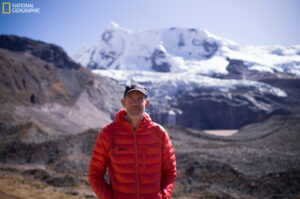
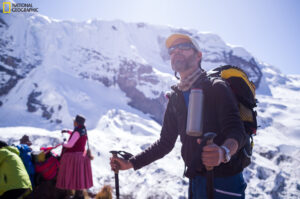
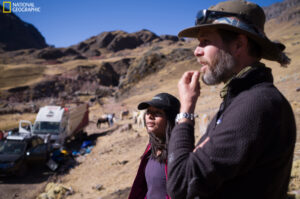
National Geographic Explorer Baker Perry at Nevado Ausangate base camp. Credit Justen Bruns/National Geographic
The team works on the weather station at Ausangate. L to R: Tom Matthews, Sandro Arias, Baker Perry. Credit Justen Bruns/National Geographic
The team poses in front of the weather station at Ausangate. L to R: Tom Matthews, Ruthmery Pillco Huarcaya, Heather Guy, Baker Perry. Credit Justen Bruns/National Geographic
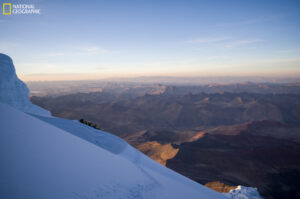
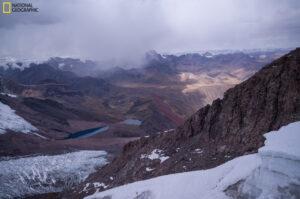
Local porters from the Ausangate Valley admire the view below Nevado Ausangate’s summit. Credit Justen Bruns/National Geographic
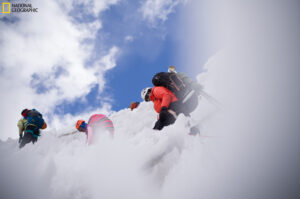
National Geographic Explorer Tom Matthews climbs towards Nevado Ausangate’s summit. Credit Justen Bruns/National Geographic
National Geographic Explorer Baker Perry and Senobia Llusco climb towards Nevado Ausangate’s summit. Credit Justen Bruns/National Geographic
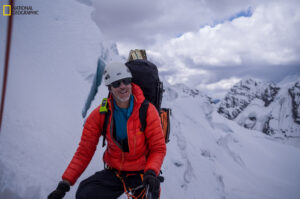
National Geographic Explorer Baker Perry above high camp on Nevado Ausangate, Peru. Credit Justen Bruns/National Geographic
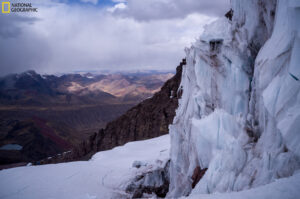
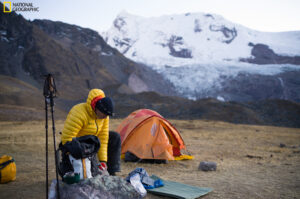
A view en-route to Nevado Ausangate high camp. Credit Justen Bruns/National Geographic
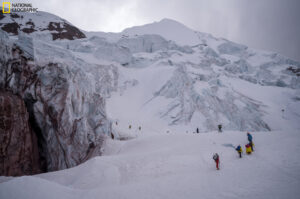
The team makes their way to high camp on Ausangate. Credit Justen Bruns/National Geographic
A view from below Nevado Ausangate high camp. Credit Justen Bruns/National Geographic
Senobia Llusco climbing to high camp on Ausangate. Credit Justen Bruns/National Geographic
Adrian Ccahuana and National Geographic Explorer Ruthmery Pillco Huarcaya prepare to climb to high camp. Credit Justen Bruns/National Geographic
National Geographic Explorer Thomas Peschak on the approach hike to high camp. Credit Justen Bruns/National Geographic
National Geographic Explorer Baker Perry preparing for the climb from base camp to high camp on Ausangate. Credit Justen Bruns/National Geographic
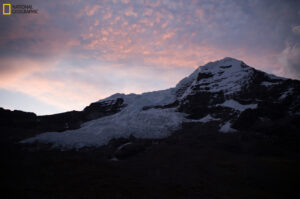
A view of Nevado Ausangate from base camp. Credit Justen Bruns/National Geographic
National Geographic Explorers Thomas Peschack and Ruthmery Pillco Huarcaya look at the route towards Nevado Ausangate. Credit: Justen Bruns/National Geographic


Previous ArticleBoM completes upgrade of Halls Creek weather radar
Next Article Singaporean agencies to share GNSS-derived moisture data to improve weather monitoring capabilities

Read Similar Stories

Radar

EWR Radar Systems wins US Air Force contract for portable Doppler radar support

April 20, 20262 Mins Read
Climate Measurement

China inaugurates 27th national climate observatory in Hebei

April 9, 20262 Mins Read
Solar

Mauna Loa Solar Observatory reopens to support Artemis II mission

April 8, 20262 Mins Read
Latest News

WMO signals increasing likelihood of El Niño developing in 2026

April 24, 2026

Alabama partners with Climavision to expand weather radar coverage statewide

April 24, 2026

Extreme heat posing significant risks to ecosystems and agriculture, FAO-WMO report warns

April 22, 2026

Receive breaking stories and features in your inbox each week, for free


Enter your email address:


Supplier Spotlights
  • ELDES S.r.l.
Getting in Touch
  • Contact Us / Advertise
  • Meet the Editors
  • Media Pack
  • Free Weekly E-Newsletter
Our Social Channels
  • Facebook
  • LinkedIn
© 2026 UKi Media & Events a division of UKIP Media & Events Ltd
  • Cookie Policy
  • Privacy Policy
  • Terms and Conditions
  • Notice and Takedown Policy

Type above and press Enter to search. Press Esc to cancel.