


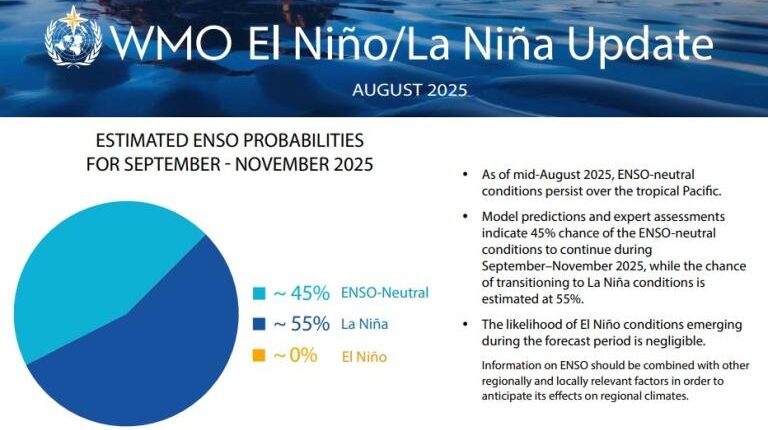
The latest World Meteorological Organization (WMO) El Niño/La Niña update predicts that the La Niña climate pattern may return to affect weather from September onward, although temperatures are still expected to be above average for much of the world.
Neutral conditions (neither El Niño or La Niña) have persisted since March 2025, with sea surface temperature anomalies remaining near average across the equatorial Pacific. However, these conditions may gradually make way for La Niña conditions to emerge in the coming months, potentially starting in September 2025, the update reports.
According to the latest forecasts from the WMO Global Producing Centres for Seasonal Prediction, there is a 55% chance for sea surface temperatures in the equatorial Pacific to cool to La Niña levels, and a 45% chance for them to remain at El Niño-Southern Oscillation (ENSO)-neutral levels during the upcoming September-November 2025 period.
For October-December 2025, the likelihood of La Niña conditions slightly increases to about 60%. There is little chance of El Niño developing during September-December, the report states.
“Seasonal forecasts for El Niño and La Niña and their associated impacts on our weather are an important climate intelligence tool,” said WMO secretary-general Celeste Saulo. “They translate into millions of dollars of economic savings for key sectors like agriculture, energy, health and transport, and have saved thousands of lives when used to guide preparedness and response actions.”
While the ENSO is a key driver of global climate patterns, it is not the only factor shaping the Earth’s climate, according to WMO. To provide a more comprehensive climate outlook, the organization also issues regular Global Seasonal Climate Updates (GSCU), which consider the influence of key climate variability patterns, such as the North Atlantic Oscillation, the Arctic Oscillation and the Indian Ocean Dipole.
The updates also monitor the global and regional anomalies of surface temperature and precipitation and their evolution over the upcoming season. The global updates inform more tailored and localized outlooks issued by WMO regional centers and national members.
The latest update says that for September to November, temperatures are expected to be above normal in much of the northern hemisphere and large parts of the southern hemisphere.
For more information, visit the WMO website.
In related news, the WMO has added a new chapter on image velocimetry to its Guide to Hydrological Practice, providing information to its members on the benefits of these innovative cost-effective methods for measuring rivers and streams