


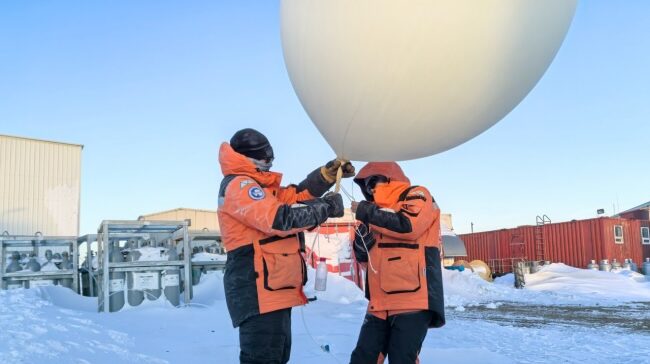
China’s research icebreaker Xuelong has returned after a 160-day Antarctic expedition, completing meteorological research activities during a voyage covering more than 34,000 nautical miles.
The mission formed part of China’s 42nd Antarctic expedition and included extensive atmospheric and weather observations at Zhongshan Station and Great Wall Station.
During the expedition, the meteorological team carried out routine observations of cloud cover, visibility and weather conditions, alongside measurements of temperature, humidity, air pressure, wind speed and direction, radiation and sunshine. Monitoring of greenhouse and reactive gases was also conducted to support ongoing climate and atmospheric research.
The team also undertook two experimental observation programs aimed at improving data accuracy and coverage. The first focused on vertical atmospheric profiling using drones equipped with sensors to collect data up to an altitude of 1,500m. These measurements included ozone, carbon dioxide, black carbon and particle size. The drone-based observations were combined with data from microwave radiometers, wind-measuring lidar systems and weather balloons to analyze atmospheric conditions at different altitudes.
The second experiment used China’s BeiDou navigation system to test a horizontal-drift sounding method. This approach enables a single weather balloon to collect continuous data during ascent, horizontal drift and descent, improving the efficiency of data collection.
According to the expedition team, the data gathered will support research into climate prediction, ozone layer dynamics and atmospheric processes, and contribute to aviation meteorology and safety in the Antarctic region.
The mission also aimed to enhance China’s polar meteorological observation capabilities, including improvements to monitoring systems used in extreme environments.
The meteorological team is expected to continue collecting observational data during the winter-over period, contributing to long-term datasets used in Antarctic research and global climate studies.
In related news, China inaugurates 27th national climate observatory in Hebei