


Meteorological Technology International
  • News
    • A-E
      • Agriculture
      • Automated Weather Stations
      • Aviation
      • Climate Measurement
      • Data
      • Developing Countries
      • Digital Applications
      • Early Warning Systems
      • Extreme Weather
    • G-P
      • Hydrology
      • Lidar
      • Lightning Detection
      • New Appointments
      • Nowcasting
      • Numerical Weather Prediction
      • Polar Weather
    • R-S
      • Radar
      • Rainfall
      • Remote Sensing
      • Renewable Energy
      • Satellites
      • Solar
      • Space Weather
      • Supercomputers
    • T-Z
      • Training
      • Transport
      • Weather Instruments
      • Wind
      • World Meteorological Organization
      • Meteorological Technology World Expo
  • Features
  • Online Magazines
    • January 2026
    • April 2025
    • January 2025
    • September 2024
    • April 2024
    • Archive Issues
    • Subscribe Free!
  • Opinion
  • Videos
  • Supplier Spotlight
  • Expo
LinkedIn Twitter Facebook
  • Sign-up for Free Weekly E-Newsletter
  • Meet the Editors
  • Contact Us
  • Media Pack
LinkedIn Facebook
Subscribe
Meteorological Technology International
  • News
      • Agriculture
      • Automated Weather Stations
      • Aviation
      • Climate Measurement
      • Data
      • Developing Countries
      • Digital Applications
      • Early Warning Systems
      • Extreme Weather
      • Hydrology
      • Lidar
      • Lightning Detection
      • New Appointments
      • Nowcasting
      • Numerical Weather Prediction
      • Polar Weather
      • Radar
      • Rainfall
      • Remote Sensing
      • Renewable Energy
      • Satellites
      • Solar
      • Space Weather
      • Supercomputers
      • Training
      • Transport
      • Weather Instruments
      • Wind
      • World Meteorological Organization
      • Meteorological Technology World Expo
  • Features
  • Online Magazines
    1. January 2026
    2. September 2025
    3. April 2025
    4. January 2025
    5. September 2024
    6. April 2024
    7. January 2024
    8. September 2023
    9. April 2023
    10. Archive Issues
    11. Subscribe Free!
    Featured
    November 27, 2025

    In this Issue – January 2026

    By Hazel KingNovember 27, 2025
    Recent

    In this Issue – January 2026

    November 27, 2025

    In this Issue – September 2025

    August 11, 2025

    In this Issue – April 2025

    April 15, 2025
  • Opinion
  • Videos
  • Supplier Spotlight
  • Expo
Facebook LinkedIn
Subscribe
Meteorological Technology International
Satellites

AI tool uses weather satellite data to map ocean currents in near real time

Alex PackBy Alex PackApril 14, 20263 Mins Read
Share LinkedIn Facebook Twitter Email
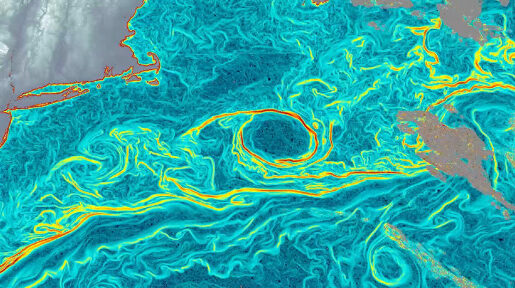
A visualization of the information provided by the Scripps Institution of Oceanography GOFlow AI tool that uses weather satellite data to map ocean currents in near real time.
Image: Luc Lenain/Scripps Institution of Oceanography.
Share
LinkedIn Facebook Twitter Email

Researchers have developed a new deep learning-based method to measure ocean surface currents using data from existing weather satellites, offering higher-resolution insights into interactions between the ocean and atmosphere.

The approach, known as GOFlow (Geostationary Ocean Flow), analyzes thermal imagery from geostationary weather satellites to track how ocean surface temperature patterns evolve over time. By applying artificial intelligence, the system can infer the movement of underlying currents at a much finer temporal and spatial scale than traditional methods.

The study, published in Nature Geoscience, was led by scientists from the UC San Diego Scripps Institution of Oceanography and collaborating institutions.

Ocean currents play a critical role in global weather and climate systems, influencing heat distribution, carbon exchange and atmospheric processes. However, capturing their behavior at small scales and high frequency has remained a challenge. Conventional satellite methods typically revisit the same location every 10 days or so, while ship-based measurements and coastal radar systems are limited in coverage.

GOFlow addresses this gap by using weather satellite imagery captured as frequently as every five minutes. A neural network is trained to recognize how temperature patterns shift in response to ocean currents, using high-resolution simulations as a reference. The system then applies this learning to real satellite data to generate hourly current maps.

“Weather satellites have been observing the ocean surface for years,” said Luc Lenain, oceanographer at Scripps Institution of Oceanography. “The breakthrough was learning how to turn that time-lapse into hourly maps of currents by tracking how temperature patterns bend, stretch and move from one hour to the next.”

The method was validated against ship-based measurements and conventional satellite observations in the Gulf Stream region. Researchers said the results matched existing data while providing significantly more detail on smaller, rapidly changing features such as eddies and boundary layers.

These small-scale processes are important for vertical mixing in the ocean, which had previously only been documented in computer simulations.

“This opens a range of exciting possibilities in physical oceanography that, until now, were largely accessible only through simulations,” Lenain said.  “Using GOFlow, we can now measure key signatures of these small, intense currents using real observations rather than relying almost entirely on simulations. This opens the door to testing long-standing ideas about how the ocean takes up heat and carbon.”

Because the method works with existing geostationary satellites it does not require new instruments to be launched into space. Over time, GOFlow could be incorporated directly into weather forecasts and climate models, and may ultimately help improve forecasts by resolving rapidly evolving currents that influence air-sea exchange, marine debris transportation and ocean ecosystems.

Cloud cover remains a limitation, as it can obscure thermal imagery. The team is working to combine additional satellite data sources to improve coverage and expand the system for global use.

The project was supported by grants from the Office of Naval Research, NASA and the European Research Council.

Related news, AAC Clyde Space wins €76.3m contract for EPS-Sterna satellite instruments

Previous ArticleNew tool speeds up climate model evaluation

Read Similar Stories

Climate Measurement

New tool speeds up climate model evaluation

April 13, 20262 Mins Read
Climate Measurement

China inaugurates 27th national climate observatory in Hebei

April 9, 20262 Mins Read
Data

NASA tests high-resolution weather model for launch operations

April 7, 20262 Mins Read
Latest News

AI tool uses weather satellite data to map ocean currents in near real time

April 14, 2026

New tool speeds up climate model evaluation

April 13, 2026

China inaugurates 27th national climate observatory in Hebei

April 9, 2026

Receive breaking stories and features in your inbox each week, for free


Enter your email address:


Supplier Spotlights
  • Reuniwatt
Getting in Touch
  • Contact Us / Advertise
  • Meet the Editors
  • Media Pack
  • Free Weekly E-Newsletter
Our Social Channels
  • Facebook
  • LinkedIn
© 2025 UKi Media & Events a division of UKIP Media & Events Ltd
  • Cookie Policy
  • Privacy Policy
  • Terms and Conditions
  • Notice and Takedown Policy

Type above and press Enter to search. Press Esc to cancel.

We use cookies on our website to give you the most relevant experience by remembering your preferences and repeat visits. By clicking “Accept”, you consent to the use of ALL the cookies.
Cookie settingsACCEPT
Manage consent

Privacy Overview

This website uses cookies to improve your experience while you navigate through the website. Out of these, the cookies that are categorized as necessary are stored on your browser as they are essential for the working of basic functionalities of the website. We also use third-party cookies that help us analyze and understand how you use this website. These cookies will be stored in your browser only with your consent. You also have the option to opt-out of these cookies. But opting out of some of these cookies may affect your browsing experience.
Necessary
Always Enabled

Necessary cookies are absolutely essential for the website to function properly. These cookies ensure basic functionalities and security features of the website, anonymously.

CookieDurationDescription
cookielawinfo-checbox-analytics11 monthsThis cookie is set by GDPR Cookie Consent plugin. The cookie is used to store the user consent for the cookies in the category "Analytics".
cookielawinfo-checbox-functional11 monthsThe cookie is set by GDPR cookie consent to record the user consent for the cookies in the category "Functional".
cookielawinfo-checbox-others11 monthsThis cookie is set by GDPR Cookie Consent plugin. The cookie is used to store the user consent for the cookies in the category "Other.
cookielawinfo-checkbox-necessary11 monthsThis cookie is set by GDPR Cookie Consent plugin. The cookies is used to store the user consent for the cookies in the category "Necessary".
cookielawinfo-checkbox-performance11 monthsThis cookie is set by GDPR Cookie Consent plugin. The cookie is used to store the user consent for the cookies in the category "Performance".
viewed_cookie_policy11 monthsThe cookie is set by the GDPR Cookie Consent plugin and is used to store whether or not user has consented to the use of cookies. It does not store any personal data.

Functional

Functional cookies help to perform certain functionalities like sharing the content of the website on social media platforms, collect feedbacks, and other third-party features.

Performance

Performance cookies are used to understand and analyze the key performance indexes of the website which helps in delivering a better user experience for the visitors.

Analytics

Analytical cookies are used to understand how visitors interact with the website. These cookies help provide information on metrics the number of visitors, bounce rate, traffic source, etc.

Advertisement

Advertisement cookies are used to provide visitors with relevant ads and marketing campaigns. These cookies track visitors across websites and collect information to provide customized ads.

Others

Other uncategorized cookies are those that are being analyzed and have not been classified into a category as yet.

SAVE & ACCEPT
Powered by