


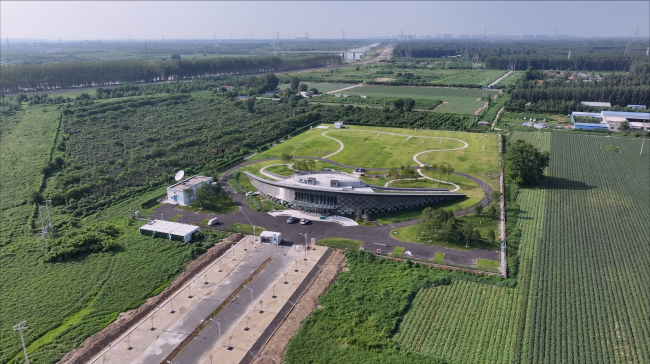
Xiong’an National Climate Observatory was officially inaugurated on April 1 in Xiong’an New Area, Hebei. The facility – China’s 27th national climate observatory – will transmit basic meteorological observation data in real time to the TianQing meteorological big data cloud platform, supporting climate monitoring and assessment, high-resolution forecasting, early warning and sector-specific meteorological services.
National climate observatories in China are ground-based, comprehensive stations designed for long-term, continuous and integrated observation of the climate system and its interactions. They also serve as platforms for scientific research, collaboration and talent development.
The new observatory is expected to support regional priorities in Xiong’an, including ecological protection of Baiyangdian Lake, urban safety operations and the development of emerging sectors such as the low-altitude economy, all of which require higher-precision and continuous climate observations.
The facility operates under a structure of one main station and eight auxiliary stations. The main station is supported by auxiliary stations in Rongcheng, Anxin, Dawang, Zhaili, Laohetou, Zangang, Maozhou and the Dianqu wetland area. This network is designed to cover the region’s urban and rural geographies, covering key ecological zones such as urban areas, forests, wetlands and farmland.
Following its launch, the observatory will focus on ground-based baseline climate observation, basic meteorological observation and surface-layer flux monitoring.
Research activities will include integrated ground-space-air observation, adaptive observation experiments linked to numerical weather prediction needs, and studies of boundary layer structure, turbulence and energy exchange across different surface types. The facility will also examine the impact of rapid urbanization on weather, climate and the ecological environment.
These efforts are intended to strengthen support for climate resource analysis, climate change monitoring and disaster risk identification.
The observatory builds on recent developments in Xiong’an’s “smart meteorology” framework, including the establishment and integration of a “One Brain, Three Networks” system. This includes a meteorological data platform, observation networks, a ubiquitous sensing network and an Internet of Things-based meteorological system. Together, these form an integrated ground-space-air monitoring network covering climate, radiation, atmospheric composition and ecosystem observations.
“We will deepen the application of observation data and forecast products in key industries, key areas and key scenarios, and continuously enhance our capabilities in meteorological disaster risk monitoring and early warning, ecological meteorological support and urban operation services,” said Guo Yitao, deputy director of the observatory.
Related news, Unmanned Antarctica atmospheric observation experiment advances in China