



Meteorological Technology International
  • News
    • A-E
      • Agriculture
      • Automated Weather Stations
      • Aviation
      • Climate Measurement
      • Data
      • Developing Countries
      • Digital Applications
      • Early Warning Systems
      • Extreme Weather
    • G-P
      • Hydrology
      • Lidar
      • Lightning Detection
      • New Appointments
      • Nowcasting
      • Numerical Weather Prediction
      • Polar Weather
    • R-S
      • Radar
      • Rainfall
      • Remote Sensing
      • Renewable Energy
      • Satellites
      • Solar
      • Space Weather
      • Supercomputers
    • T-Z
      • Training
      • Transport
      • Weather Instruments
      • Wind
      • World Meteorological Organization
      • Meteorological Technology World Expo
  • Features
  • Online Magazines
    • January 2026
    • April 2025
    • January 2025
    • September 2024
    • April 2024
    • Archive Issues
    • Subscribe Free!
  • Opinion
  • Videos
  • Supplier Spotlight
  • Expo
LinkedIn Twitter Facebook
  • Sign-up for Free Weekly E-Newsletter
  • Meet the Editors
  • Contact Us
  • Media Pack
LinkedIn Facebook
Subscribe
Meteorological Technology International
  • News
      • Agriculture
      • Automated Weather Stations
      • Aviation
      • Climate Measurement
      • Data
      • Developing Countries
      • Digital Applications
      • Early Warning Systems
      • Extreme Weather
      • Hydrology
      • Lidar
      • Lightning Detection
      • New Appointments
      • Nowcasting
      • Numerical Weather Prediction
      • Polar Weather
      • Radar
      • Rainfall
      • Remote Sensing
      • Renewable Energy
      • Satellites
      • Solar
      • Space Weather
      • Supercomputers
      • Training
      • Transport
      • Weather Instruments
      • Wind
      • World Meteorological Organization
      • Meteorological Technology World Expo
  • Features
  • Online Magazines
    1. January 2026
    2. September 2025
    3. April 2025
    4. January 2025
    5. September 2024
    6. April 2024
    7. January 2024
    8. September 2023
    9. April 2023
    10. Archive Issues
    11. Subscribe Free!
    Featured
    November 27, 2025

    In this Issue – January 2026

    By Hazel KingNovember 27, 2025
    Recent

    In this Issue – January 2026

    November 27, 2025

    In this Issue – September 2025

    August 11, 2025

    In this Issue – April 2025

    April 15, 2025
  • Opinion
  • Videos
  • Supplier Spotlight
  • Expo
Facebook LinkedIn
Subscribe
Meteorological Technology International
Features

EXCLUSIVE INTERVIEW: Mausumi Dikpati, NSF NCAR senior scientist

Alex PackBy Alex PackMarch 5, 20265 Mins Read
Share LinkedIn Facebook Twitter Email
Mausumi Dikpati, NSF NCAR senior scientist.
Share
LinkedIn Facebook Twitter Email

From disrupted GPS signals to risks for satellites and astronauts, severe space weather can have far-reaching consequences. But researchers from the US National Science Foundation National Center for Atmospheric Research (NSF NCAR) and Southwest Research Institute (SwRI), have developed a tool with huge potential to mitigate these impacts. Mausumi Dikpati, the senior scientist who led the team, discusses how PINNBARDS (PINN-Based Active Regions Distribution Simulator), a newly developed physics-informed, AI-enabled modeling framework, could transform forecasting by predicting flare-producing solar active regions weeks before they emerge

Your new tool, PINNBARDS, is described as enabling the first steps toward space-weather forecasting weeks in advance rather than hours. What key scientific or technological breakthrough made this longer forecasting horizon possible?

Major space-weather events are driven by large, complex solar active regions. Once these regions appear at the sun’s surface, eruptions can follow within hours, leaving little time to prepare. The breakthrough behind PINNBARDS is that it allows us to look before these regions appear. Large active regions take weeks to rise from beneath the sun’s surface, and PINNBARDS reconstructs the hidden magnetic conditions that can be fed to a physical model, which controls where and when they will emerge. By translating the observed surface magnetic patterns into physically consistent internal magnetic states, the physical model can be run forward in time, providing weeks of advance warning instead of hours. That shift, from reacting after emergence to anticipating it before it happens, is what enables the longer forecasting horizon.

How does integrating AI with physics-based models improve predictive reliability compared with either approach used on its own?

AI alone is powerful but ultimately statistical – it can recognize patterns but does not obey the laws of physics. Physics-based models, on the other hand, are reliable only if they are started from accurate initial conditions, which have long been missing. PINNBARDS combines the two: AI extracts hidden physical information from observations, and physics ensures that the reconstruction of magnetic state-vectors by PINNBARDS is physically consistent, and hence can forecast realistically. This hybrid approach provides accurate initialization and accurate predictions, making forecasts more reliable than either AI or physics models used on their own.

The system reconstructs subsurface magnetic conditions beneath the sun’s surface. What observational data feeds into the model, and how confident are you that these reconstructions accurately represent the sun’s internal magnetic dynamics?

PINNBARDS uses solar surface magnetograms – synoptic maps of the sun’s magnetic field. Large-scale, organized magnetic patterns seen at the surface must originate less-turbulent, deeper inside the sun, where magnetic structures are more stable. Physics-based models have already shown that such subsurface magnetic structures can explain major historical storms, like the ‘Halloween storms’ in 2003, as well as recent ‘Mother’s Day storms.’ What PINNBARDS brings here as a breakthrough is the ability to run these models in a data-driven way, anchored directly to observations. My recent case studies (in preparation for the next publication) show that the reconstructed subsurface magnetic states successfully predict the emergence of flare-prone active regions, giving us strong confidence that the method captures the sun’s internal magnetic dynamics realistically.
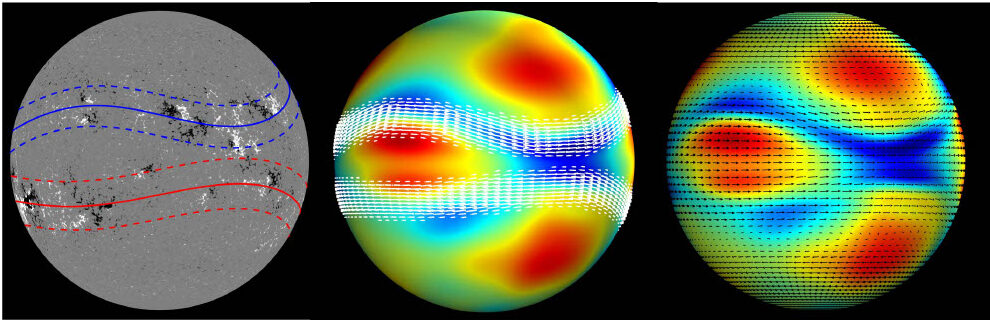
The left figure shows solar observations of two warped toroid patterns (derived from SDO/HMI magnetograms) in the southern and northern hemispheres. PINN-derived results (center) show magnetic vectors (white arrows) overlaid on bulges (red) and depressions (blue) match with observed toroidal bands. The velocity field is marked with black arrows in the right image. These results provide clues about the global sources of active regions that produce space weather, which can impact our technical society.

If forecasting active regions weeks ahead becomes operational, what would be the most immediate benefits for industries and agencies that rely on space-weather alerts, such as satellite operators, power grid managers or human spaceflight programs?

Severe space-weather events can disrupt satellites, GPS, communications, power grids and human spaceflight. With only hours of warning, operators have limited options. Weeks-ahead forecasts would allow agencies and industries to plan protective actions well in advance, such as adjusting satellite operations, delaying launches or preparing power-grid safeguards. For example, the May 2024 Mother’s Day solar storms disrupted GPS-dependent precision agriculture. With weeks of advance notice, many of these impacts could be reduced or avoided altogether.

What are the next research or technical steps required to move PINNBARDS from a research demonstration to a tool that could eventually support operational space-weather forecasting?

The next step is to transition from case studies to routine forecasting. This includes producing daily, updated forecasts that identify when and where large, flare-prone active regions are likely to emerge weeks in advance, as well as identifying quieter periods when space-weather risk is low. Both types of information are valuable: early warnings help mitigate hazards, while forecasts of quiet intervals help operators safely plan launches and infrastructure activities. Continued validation, automation and collaboration with operational forecasting centers will be key to making PINNBARDS an operational tool.

Previous ArticleSynoptic Data selected for NOAA ProTech 2.0 Weather Domain contract
Next Article R M Young to host webinar on engineering behind ResponseOne-Pro weather station

Read Similar Stories

Meteorological Technology World Expo

EXPO INTERVIEW: Rodica Nitu, international cryosphere and polar infrastructure expert

October 16, 20255 Mins Read
Meteorological Technology World Expo

EXPO INTERVIEW: Øysten Godøy, Norwegian Meteorological Institute

October 15, 20256 Mins Read
Satellites

FEATURE: NISAR satellite case study

August 21, 202511 Mins Read
Latest News

Chongqing expands AI-powered weather services to improve warning times

March 5, 2026

R M Young to host webinar on engineering behind ResponseOne-Pro weather station

March 5, 2026

EXCLUSIVE INTERVIEW: Mausumi Dikpati, NSF NCAR senior scientist

March 5, 2026

Receive breaking stories and features in your inbox each week, for free


Enter your email address:


Supplier Spotlights
  • Raymetrics
Getting in Touch
  • Contact Us / Advertise
  • Meet the Editors
  • Media Pack
  • Free Weekly E-Newsletter
Our Social Channels
  • Facebook
  • LinkedIn
© 2025 UKi Media & Events a division of UKIP Media & Events Ltd
  • Cookie Policy
  • Privacy Policy
  • Terms and Conditions
  • Notice and Takedown Policy

Type above and press Enter to search. Press Esc to cancel.

We use cookies on our website to give you the most relevant experience by remembering your preferences and repeat visits. By clicking “Accept”, you consent to the use of ALL the cookies.
Cookie settingsACCEPT
Manage consent

Privacy Overview

This website uses cookies to improve your experience while you navigate through the website. Out of these, the cookies that are categorized as necessary are stored on your browser as they are essential for the working of basic functionalities of the website. We also use third-party cookies that help us analyze and understand how you use this website. These cookies will be stored in your browser only with your consent. You also have the option to opt-out of these cookies. But opting out of some of these cookies may affect your browsing experience.
Necessary
Always Enabled

Necessary cookies are absolutely essential for the website to function properly. These cookies ensure basic functionalities and security features of the website, anonymously.

CookieDurationDescription
cookielawinfo-checbox-analytics11 monthsThis cookie is set by GDPR Cookie Consent plugin. The cookie is used to store the user consent for the cookies in the category "Analytics".
cookielawinfo-checbox-functional11 monthsThe cookie is set by GDPR cookie consent to record the user consent for the cookies in the category "Functional".
cookielawinfo-checbox-others11 monthsThis cookie is set by GDPR Cookie Consent plugin. The cookie is used to store the user consent for the cookies in the category "Other.
cookielawinfo-checkbox-necessary11 monthsThis cookie is set by GDPR Cookie Consent plugin. The cookies is used to store the user consent for the cookies in the category "Necessary".
cookielawinfo-checkbox-performance11 monthsThis cookie is set by GDPR Cookie Consent plugin. The cookie is used to store the user consent for the cookies in the category "Performance".
viewed_cookie_policy11 monthsThe cookie is set by the GDPR Cookie Consent plugin and is used to store whether or not user has consented to the use of cookies. It does not store any personal data.

Functional

Functional cookies help to perform certain functionalities like sharing the content of the website on social media platforms, collect feedbacks, and other third-party features.

Performance

Performance cookies are used to understand and analyze the key performance indexes of the website which helps in delivering a better user experience for the visitors.

Analytics

Analytical cookies are used to understand how visitors interact with the website. These cookies help provide information on metrics the number of visitors, bounce rate, traffic source, etc.

Advertisement

Advertisement cookies are used to provide visitors with relevant ads and marketing campaigns. These cookies track visitors across websites and collect information to provide customized ads.

Others

Other uncategorized cookies are those that are being analyzed and have not been classified into a category as yet.

SAVE & ACCEPT
Powered by