


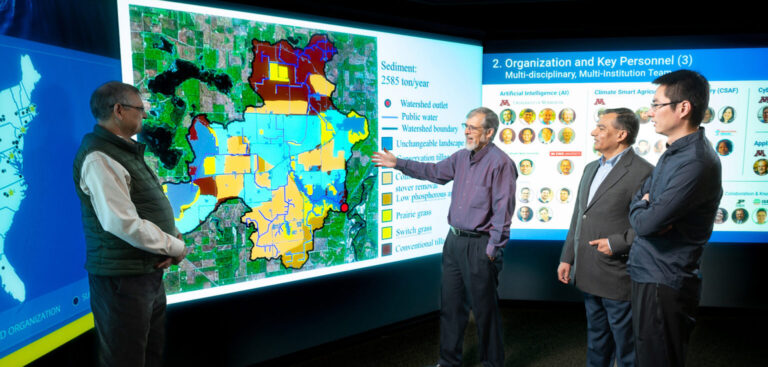
The University of Minnesota Twin Cities will lead a new National Artificial Intelligence Research Institute, funded by a US$20m grant over five years from the National Science Foundation (NSF) and the US Department of Agriculture’s (USDA) National Institute of Food and Agriculture (NIFA).
Researchers at the AI Institute for Climate-Land Interactions, Mitigation, Adaptation, Tradeoffs and Economy (AI-CLIMATE) aim to leverage artificial intelligence (AI) to create more climate-smart practices that will absorb and store carbon while simultaneously boosting the economy in the agriculture and forestry industries.
The new institute is one of seven new NSF- and NIFA-funded AI Institutes announced and is part of a larger federal initiative – totaling nearly US$500m – to bolster collaborative artificial intelligence research across the country.
AI-CLIMATE is a joint effort between the University of Minnesota Twin Cities College of Science and Engineering; Minnesota Robotics Institute; Data Science Institute; College of Food, Agricultural and Natural Resource Sciences; and the Office of the Vice President for Research. It will also bring together scientists and engineers from across the country, including national experts on artificial intelligence and climate-smart agriculture and forestry from Cornell University, Colorado State University, Delaware State University, Purdue University, and North Carolina State University. The researchers will collaborate with the American Indian Higher Education Consortium (AIHEC) and the tribal nations it represents.
“One of the driving factors of climate effects is carbon emissions,” said Shashi Shekhar, director of the institute and a professor in the University of Minnesota Department of Computer Science and Engineering. “By 2050, the US aims to have net-zero carbon emissions, and one of the most promising ways to do this is using natural systems like forestry and agriculture as ‘carbon sinks.’”
Farms and forests can be used as carbon sinks, which pull more carbon dioxide out of the atmosphere than they release. Farmers and foresters may be rewarded for doing this through carbon markets, or systems in which property owners can sell “carbon credits” – equal to the amount of carbon dioxide their farm or forest has sequestered – to companies trying to offset their carbon emissions. However, with current technology, it’s both difficult and expensive for farmers and foresters to accurately measure how much carbon they’ve sequestered.
Using new AI techniques like deep learning and knowledge-guided machine learning, researchers at the AI-CLIMATE institute are improving accuracy and lowering the cost of accounting for carbon and greenhouse gases in farms and forests, ultimately making the process more accessible for more people.
“When farmers touch, smell and look at the soil, they can tell if it’s carbon-rich or not,” Shekhar said. “But they can’t manually survey thousands of acres of land every year. We’re developing easy-to-use tools where we can show all of these measurements and images of the soil to an AI neural network and let it figure it out for us, saving farmers and foresters time, energy, and money.”
The goals of AI-CLIMATE directly intersect with what other federal programs are doing to further develop climate-smart agriculture. In 2022, the US Department of Agriculture announced that it would be investing US$3.1bn to support farmers, ranchers and private forest landowners through its Partnerships for Climate-Smart Commodities project.
Dionne Toombs, acting director of NIFA, said, “In the tradition of USDA National Institute of Food and Agriculture investments, this new institute leverages the scientific power of US land-grant universities, informed by close partnership with farmers, producers, educators and innovators to address the grand challenge of rising greenhouse gas concentrations and associated climate change. This innovative center will address the urgent need to counter climate-related threats, lower greenhouse gas emissions, grow the American workforce, and increase new rural opportunities.”
Margaret Martonosi, assistant director for computer and information science and engineering at NSF, said, “Foundational research in AI and machine learning has never been more critical to the understanding, creation and deployment of AI-powered systems that deliver transformative solutions across our society. These recent awards, as well as our AI Institutes ecosystem as a whole, represent our active efforts in addressing national economic and social priorities that hinge on our nation’s AI capability and leadership.”
To find out more about how farmers and agronomists are adapting to the impact of climate change to ensure future food security, read Helen Norman’s report in the April 2023 issue of Meteorological Technology International. To view the magazine in full, click here.