


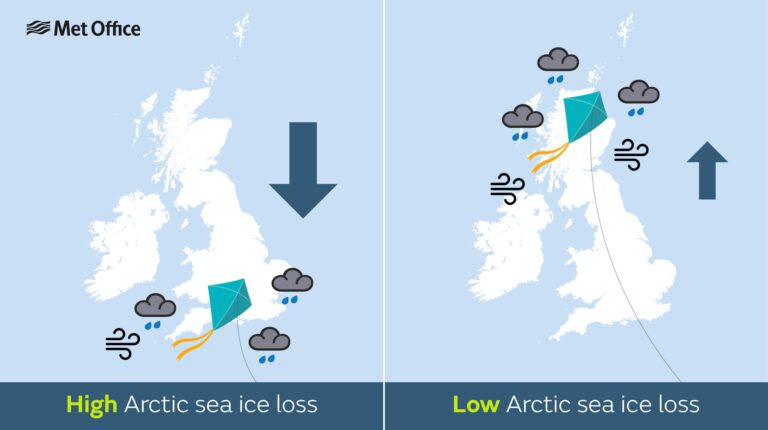
A new study by scientists from the University of Exeter and the UK Met Office has revealed that the loss of Arctic sea ice could have a significant effect on winter weather patterns across Great Britain and Ireland.
Published in the Quarterly Journal of the Royal Meteorological Society, the research highlights how a “tug-of-war” between Arctic sea-ice loss and global temperature rise could influence the strength and position of the Atlantic jet stream, one of the key drivers of winter weather in northwestern Europe.
The study found that extensive sea-ice loss could lead to a weakening and southward shift of the jet stream, producing weaker, slower-moving storms that are more likely to affect southern parts of Britain. In contrast, if sea-ice loss is more moderate relative to global warming, the result could be stronger and more frequent storms over northern Britain and Ireland.
Lead author Dr Steph Hay said, “The daily winter weather of Britain and Ireland is mainly driven by the Atlantic jet stream, whose future position and strength is influenced by the difference in temperature between the tropics and the Arctic. This means that the opposing influences of sea-ice loss and lower-latitude warming will shape changes to our winter weather: understanding which will dominate is crucial for determining future climate of the region.”
Co-author Dr Ed Blockley from the Met Office added, “The Arctic is warming around three times faster than the global average in response to climate change, and this is driving a significant reduction in Arctic sea-ice cover. As a near-Arctic nation, it is very important for us to understand how changes in the Arctic might impact our weather and climate.”
The study, The Impact of Arctic Sea-Ice Loss on Winter Weather in the British Isles, was supported by the UK government’s International Science Partnerships Fund through the Met Office’s Advancing Arctic Capabilities (AAC) program.
In related news, Met Office makes “huge leap forward” in space weather monitoring