


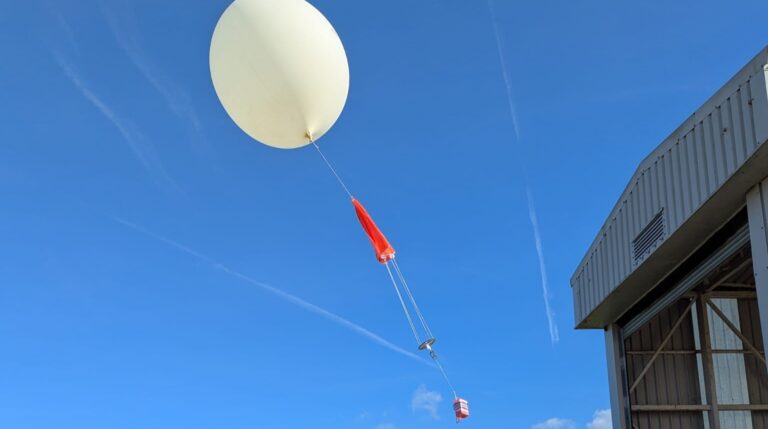
Scientists in the UK and the Netherlands have launched into the atmosphere a new type of radiation monitor designed to improve space weather forecasting.
On October 17, radiation sensors developed by the University of Surrey were attached to weather balloons and released from Met Office sites in Camborne and Lerwick in the UK, and from Dutch forecasters KNMI’s site in De Bilt in the Netherlands. The balloons climbed to more than 100,000ft feet, capturing live observations on radiation levels through the atmosphere as they moved toward the stratosphere.
The launches mark a proof-of-concept phase in a project to enhance models that predict radiation changes during space weather events. Data from the flights will be compared with readings from ground-based instruments installed earlier this year at Camborne.
Future launches will take place during space weather events to further enhance radiation models and improve understanding of how space weather influences radiation levels from high in the atmosphere to ground level.
Met Office senior space weather manager Krista Hammond explained how the project will aid future operations: “Space weather monitoring is still in its infancy compared to meteorology, so this project will provide a huge leap forward in terms of our understanding of how space weather events impact radiation levels through the Earth’s atmosphere.”
The compact SAIRA-B detectors, built by the University of Surrey, build on technology already used on commercial aircraft. Professor Keith Ryden, director of the Surrey Space Centre, said the lighter system is designed for rapid balloon deployment, and reaches altitudes more than twice those of typical commercial aircraft.
Importance of gathering space weather information
The project is part of the Space Weather Instrumentation, Measurement, Modelling and Risk (SWIMMR) program, funded by the UK government and managed by the Science and Technology Facilities Council (STFC) RAL Space.
According to the Met Office, SWIMR has been vital for UK forecasting and preparedness, funding projects around hazard mitigation, GPS protect and innovative research projects.
Professor Ian McCrea, SWIMMR program lead at STFC RAL Space, said, “It is very pleasing to see these launches happening, especially with the international collaborative element involving our Dutch partners. This work combines two SWIMMR instrument development projects by coordinating balloon-borne radiation sensors with ground-based neutron monitors.
“The results will contribute to broader monitoring and prediction capabilities for radiation effects on aviation, demonstrating how SWIMMR’s multiple components work together to deliver an integrated space weather capability for the UK.”
A recent value report found that the Met Office’s space weather capability will deliver around £600m (US$802m) of value to the UK energy industry over the next 10 years, underlining the important of timely and accurate space weather information.
In related news, Met Office reports improved accuracy in maritime forecasting