


Close Menu
Meteorological Technology International
  • News
    • A-E
      • Agriculture
      • Automated Weather Stations
      • Aviation
      • Climate Measurement
      • Data
      • Developing Countries
      • Digital Applications
      • Early Warning Systems
      • Extreme Weather
    • G-P
      • Hydrology
      • Lidar
      • Lightning Detection
      • New Appointments
      • Nowcasting
      • Numerical Weather Prediction
      • Polar Weather
    • R-S
      • Radar
      • Rainfall
      • Remote Sensing
      • Renewable Energy
      • Satellites
      • Solar
      • Space Weather
      • Supercomputers
    • T-Z
      • Training
      • Transport
      • Weather Instruments
      • Wind
      • World Meteorological Organization
      • Meteorological Technology World Expo
  • Features
  • Online Magazines
    • January 2026
    • April 2025
    • January 2025
    • September 2024
    • April 2024
    • Archive Issues
    • Subscribe Free!
  • Opinion
  • Videos
  • Supplier Spotlight
  • Expo
LinkedIn X (Twitter) Facebook
  • Sign-up for Free Weekly E-Newsletter
  • Meet the Editors
  • Contact Us
  • Media Pack
LinkedIn Facebook
Subscribe
Meteorological Technology International
  • News
      • Agriculture
      • Automated Weather Stations
      • Aviation
      • Climate Measurement
      • Data
      • Developing Countries
      • Digital Applications
      • Early Warning Systems
      • Extreme Weather
      • Hydrology
      • Lidar
      • Lightning Detection
      • New Appointments
      • Nowcasting
      • Numerical Weather Prediction
      • Polar Weather
      • Radar
      • Rainfall
      • Remote Sensing
      • Renewable Energy
      • Satellites
      • Solar
      • Space Weather
      • Supercomputers
      • Training
      • Transport
      • Weather Instruments
      • Wind
      • World Meteorological Organization
      • Meteorological Technology World Expo
  • Features
  • Online Magazines
    1. January 2026
    2. September 2025
    3. April 2025
    4. January 2025
    5. September 2024
    6. April 2024
    7. January 2024
    8. September 2023
    9. April 2023
    10. Archive Issues
    11. Subscribe Free!
    Featured
    November 27, 2025

    In this Issue – January 2026

    By Hazel KingNovember 27, 2025
    Recent

    In this Issue – January 2026

    November 27, 2025

    In this Issue – September 2025

    August 11, 2025

    In this Issue – April 2025

    April 15, 2025
  • Opinion
  • Videos
  • Supplier Spotlight
  • Expo
Facebook LinkedIn
Subscribe
Meteorological Technology International
Climate Measurement

Cellular masts could lead to more accurate rainfall predictions

Lawrence ButcherBy Lawrence ButcherNovember 13, 20203 Mins Read
Share LinkedIn Facebook Twitter Email
Share
LinkedIn Facebook Twitter Email

Rain showers that can develop into downpours with the potential to cause flooding are difficult to predict. However, a novel technique identified by researchers from WUR (Wageningen University & Research), KNMI ( the Dutch national meteorological institute) and weather radar specialists Deltares looks set to improve the accuracy of such forecasts.

The group has been using the signal strength of commercial transmitter masts for cell service to precisely measure the precipitation between two points, but also to develop a forecast for several hours.

Ruben Imhoff of the Wageningen Hydrology and Quantitative Water Management Group collaborated with colleagues from KNMI and Deltares to discover how they might deduce the intensity of rainfall between two masts based on the commercial microwave links (CMLs) between the towers. These CMLs are the radio wave signals used by mobile phone traffic.

“Communication companies are interested in as clear a signal as possible. But we are considering the precise opposite,” explained Imhoff. “The attenuation of the signal may be caused by the intensity of the rainfall between two masts. The more intense the precipitation, the more scrambled our data is bounced back. We map these disruptions and translate them into the intensity of precipitation, as well as into short-term forecasts, also known as nowcasting.”

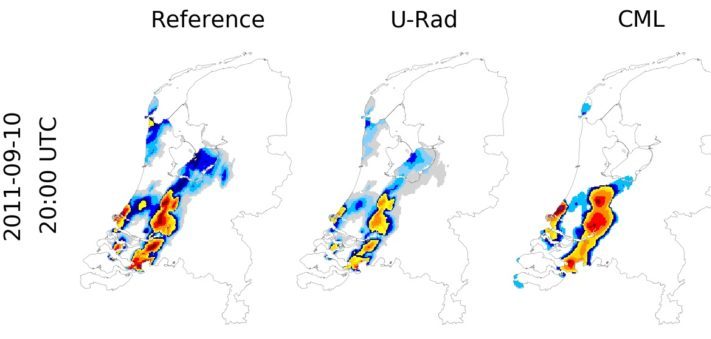
The research team compared data from the KNMI precipitation radars (as used by the Buienradar app and website) with the data obtained from the towers on 12 rainy days. “The results pleasantly surprised us,” remarked Imhoff. “The CML method proves to work fairly well, even during heavy rainfall.” Occasionally, the rain forecast was found to be better than the radar forecast, especially during heavy showers. “However, you must take into consideration that the radar products were not corrected for deviations. Radars too can be improved, and this is currently underway,” he noted.

These findings raise the question of whether CML provides an alternative to radar, which gives a precise overview per square kilometer, including over bodies of water. Imhoff summarized, “Radar provides a stable overview of a large area. Radio wave signals are dense, spaced approximately half a kilometer apart in urban centers, but less so in rural areas. Moreover, the precipitation radar refreshes every five minutes, while the CML data is recorded 15 minutes apart. Increasing the frequency to every five minutes could improve the data. CMLs are a valuable addition to radar data in the Netherlands. These combined images may be used for nowcasting, for example, to predict localized showers.”

The same approach could also be used with new 5G towers, which are even more densely spaced, and, as such, provide more accurate data. However, the researchers don’t yet know how this will work out, as it is unclear how well the CML system works with the higher transmission frequencies employed by 5G. A research proposal for this issue is pending.

The CML system may prove to be particularly useful in countries lacking precipitation radars but with transmitter towers in the urban areas. The KNMI and WUR intend to investigate whether this method may provide short-term forecasts in Nigeria and Sri Lanka.

Previous ArticleThe meteorological legacy of the First World War
Next Article Australian Bureau of Meteorology releases latest biennial report

Read Similar Stories

Climate Measurement

WMO signals increasing likelihood of El Niño developing in 2026

April 24, 20263 Mins Read
Radar

Alabama partners with Climavision to expand weather radar coverage statewide

April 24, 20262 Mins Read
Data

Atmospheric G2 secures Japan weather forecasting license

April 21, 20262 Mins Read
Latest News

WMO signals increasing likelihood of El Niño developing in 2026

April 24, 2026

Alabama partners with Climavision to expand weather radar coverage statewide

April 24, 2026

Extreme heat posing significant risks to ecosystems and agriculture, FAO-WMO report warns

April 22, 2026

Receive breaking stories and features in your inbox each week, for free


Enter your email address:


Supplier Spotlights
  • Raymetrics
Getting in Touch
  • Contact Us / Advertise
  • Meet the Editors
  • Media Pack
  • Free Weekly E-Newsletter
Our Social Channels
  • Facebook
  • LinkedIn
© 2026 UKi Media & Events a division of UKIP Media & Events Ltd
  • Cookie Policy
  • Privacy Policy
  • Terms and Conditions
  • Notice and Takedown Policy

Type above and press Enter to search. Press Esc to cancel.