


Close Menu
Meteorological Technology International
  • News
    • A-E
      • Agriculture
      • Automated Weather Stations
      • Aviation
      • Climate Measurement
      • Data
      • Developing Countries
      • Digital Applications
      • Early Warning Systems
      • Extreme Weather
    • G-P
      • Hydrology
      • Lidar
      • Lightning Detection
      • New Appointments
      • Nowcasting
      • Numerical Weather Prediction
      • Polar Weather
    • R-S
      • Radar
      • Rainfall
      • Remote Sensing
      • Renewable Energy
      • Satellites
      • Solar
      • Space Weather
      • Supercomputers
    • T-Z
      • Training
      • Transport
      • Weather Instruments
      • Wind
      • World Meteorological Organization
      • Meteorological Technology World Expo
  • Features
  • Online Magazines
    • January 2026
    • April 2025
    • January 2025
    • September 2024
    • April 2024
    • Archive Issues
    • Subscribe Free!
  • Opinion
  • Videos
  • Supplier Spotlight
  • Expo
LinkedIn X (Twitter) Facebook
  • Sign-up for Free Weekly E-Newsletter
  • Meet the Editors
  • Contact Us
  • Media Pack
LinkedIn Facebook
Subscribe
Meteorological Technology International
  • News
      • Agriculture
      • Automated Weather Stations
      • Aviation
      • Climate Measurement
      • Data
      • Developing Countries
      • Digital Applications
      • Early Warning Systems
      • Extreme Weather
      • Hydrology
      • Lidar
      • Lightning Detection
      • New Appointments
      • Nowcasting
      • Numerical Weather Prediction
      • Polar Weather
      • Radar
      • Rainfall
      • Remote Sensing
      • Renewable Energy
      • Satellites
      • Solar
      • Space Weather
      • Supercomputers
      • Training
      • Transport
      • Weather Instruments
      • Wind
      • World Meteorological Organization
      • Meteorological Technology World Expo
  • Features
  • Online Magazines
    1. January 2026
    2. September 2025
    3. April 2025
    4. January 2025
    5. September 2024
    6. April 2024
    7. January 2024
    8. September 2023
    9. April 2023
    10. Archive Issues
    11. Subscribe Free!
    Featured
    November 27, 2025

    In this Issue – January 2026

    By Hazel KingNovember 27, 2025
    Recent

    In this Issue – January 2026

    November 27, 2025

    In this Issue – September 2025

    August 11, 2025

    In this Issue – April 2025

    April 15, 2025
  • Opinion
  • Videos
  • Supplier Spotlight
  • Expo
Facebook LinkedIn
Subscribe
Meteorological Technology International
Climate Measurement

NOAA unveils modernization plans for Mauna Loa observatory

Dan SymondsBy Dan SymondsFebruary 10, 20233 Mins Read
Share LinkedIn Facebook Twitter Email
Photo credit: NOAA
Share
LinkedIn Facebook Twitter Email

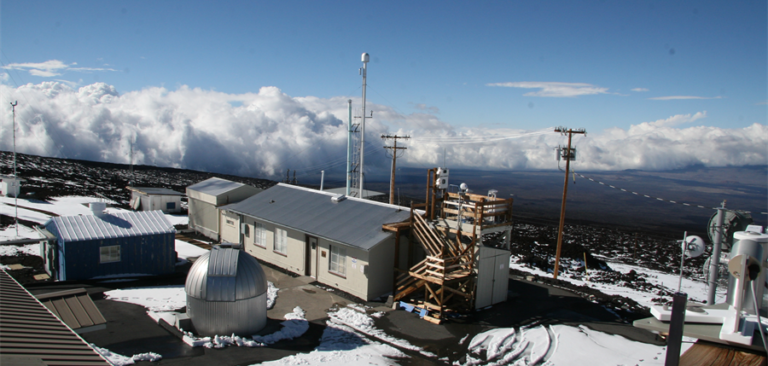
The US National Oceanic and Atmospheric Administration’s (NOAA) Mauna Loa Atmospheric Baseline Observatory is set to undergo a major renovation and upgrade once road access is restored following the eruption of the Mauna Loa volcano.

The redevelopment project will modernize the site’s aging infrastructure and renovate the historic Keeling building. Plans call for increased solar generation and installation of a battery power backup system to make the observatory more energy efficient and resilient to future natural disasters. The project will increase the observatory’s scientific capabilities and create new opportunities for research collaboration.

Ariel Stein, acting director of NOAA’s Global Monitoring Laboratory, said, “Mauna Loa is a premier international research facility. This project will honor our history as we upgrade our scientific facilities, make them energy-efficient and generate power on-site to reduce the risk of disruption. This will provide a more productive and effective research campus for NOAA and our scientific partners for decades to come.”

The observatory is the benchmark sampling site for monitoring global climate change and is located at an elevation of 3,395m on the north flank of the Mauna Loa volcano on Hawaii’s Big Island. The facility has operated since 1957 and consists of more than a dozen small research buildings across a 3.2ha campus. Charles David Keeling of the Scripps Institution of Oceanography initiated carbon dioxide measurements at the site in 1958. NOAA’s carbon dioxide measurements began in 1974.

Mauna Loa is one of four baseline observatories stretching from the Arctic village of Utqiagvik, Alaska, to the South Pole, which form the foundation of NOAA’s global network of atmospheric observation sites. Data is carefully analyzed and compiled in archives like the Global Greenhouse Gas Reference Network, and made available to scientists worldwide.

Elements of the renovation project include refurbishing the Keeling building; adding a new staff office area; updating the site’s workshop and staging area; and dedicating more space for cooperative research near the base of a new 40m-tall sampling tower. The latter will replace an on-site, aging 37m sampling tower. Building designs will maximize rooftop solar energy generation. A new site-wide power and grounding distribution system will be installed, along with fiber-optic infrastructure. Obsolete facilities will be removed.

Observatory operations are currently curtailed by fresh lava flows from Mauna Loa’s November 2022 volcanic eruption, which buried about 1,823m of the access road and electric poles under as much as 9m of lava. Although the facility lost power, the campus itself was not threatened. It will be several months before the lava is cool enough for engineers to re-establish the roadway.

To maintain the continuity of long-term observations, NOAA contracted with a local helicopter company, Paradise Helicopters, which began weekly flights to the site on December 21, 2022, to collect air samples via a portable, battery-powered flask system. The flask samples are then shipped to and analyzed at NOAA’s Global Monitoring Laboratory in Boulder, Colorado. In January 2023, a battery storage system was delivered by helicopter and will be linked to existing solar panels to allow for the restart of some of the facility’s important sampling instrumentation.

NOAA and the Scripps Institution of Oceanography, which make independent, complementary on-site measurements at the Mauna Loa Observatory, are currently taking daily greenhouse gas measurements from a temporary location at the University of Hawaii astronomical observatory on Maunakea.

The timeline for renovation and facility upgrades will depend on when access to the road leading to the Mauna Loa facility is restored.

Previous ArticleNOC publishes open-access software for calculating air-sea exchanges
Next Article Antarctic sea-ice extent lowest on record for January

Read Similar Stories

Climate Measurement

China completes Antarctic meteorological research mission with Xuelong icebreaker

April 21, 20262 Mins Read
Climate Measurement

Study identifies atmospheric trigger behind flash droughts in Puerto Rico

April 15, 20263 Mins Read
Satellites

AI tool uses weather satellite data to map ocean currents in near real time

April 14, 20263 Mins Read
Latest News

Extreme heat posing significant risks to ecosystems and agriculture, FAO-WMO report warns

April 22, 2026

Atmospheric G2 secures Japan weather forecasting license

April 21, 2026

China completes Antarctic meteorological research mission with Xuelong icebreaker

April 21, 2026

Receive breaking stories and features in your inbox each week, for free


Enter your email address:


Supplier Spotlights
  • Adolf Thies GmbH & Co. KG
Getting in Touch
  • Contact Us / Advertise
  • Meet the Editors
  • Media Pack
  • Free Weekly E-Newsletter
Our Social Channels
  • Facebook
  • LinkedIn
© 2026 UKi Media & Events a division of UKIP Media & Events Ltd
  • Cookie Policy
  • Privacy Policy
  • Terms and Conditions
  • Notice and Takedown Policy

Type above and press Enter to search. Press Esc to cancel.