


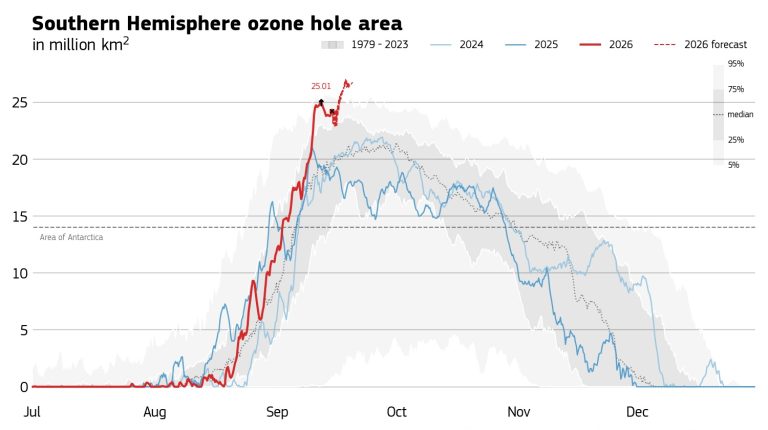
The Copernicus Atmosphere Monitoring Service (CAMS) has reported that the 2026 Antarctic ozone hole reached a “significant size threshold” earlier than average and that it has grown to a larger size than is commonly seen in the month of September.
The ozone hole’s area – measured using regions where ozone values fall below 220 Dobson Units – reached 15,000,000km2, larger than the area of Antarctica, by the end of August 2026. CAMS said this was slightly earlier than average but similar to 2025, when the ozone hole reached the same area on August 30.
In the first half of September, the ozone hole’s area then increased sharply to an estimated 25,000,000km2 on September 12, around 5,000,000km2 above average for that period, with CAMS forecasting a possible further increase in mid-September. According to the organization, this rapid development coincided with a sudden drop in minimum temperature at around 20km above the South Pole. Other diagnostics monitored by CAMS, including the ozone column minimum value and ozone mass deficit, remained close to average.
Laurence Rouil, director of CAMS, said, “The Antarctic ozone hole’s development can vary considerably from year to year, depending on a range of atmospheric and chemical factors. While we have seen its area increase rapidly in early September this year, other indicators remain close to historical averages. These findings highlight the importance of monitoring the complicated interaction between human-made disturbances and natural factors. CAMS provides the high-quality data, forecasts and analyses needed to understand the state of the ozone layer and track its long-term recovery.”
CAMS notes that the ozone layer protects life on Earth from harmful ultraviolet radiation, and that decades of human-made emissions have thinned this protective layer. The organization said global warming tends to cool the stratosphere, which favors the formation of polar stratospheric clouds involved in ozone depletion. The Antarctic ozone hole, monitored since the late 1970s, spanned a record 29,600,000km2 on September 9, 2006, according to CAMS, though the organization said recent years have seen smaller and shorter-lived ozone holes, indicating recovery.
Related news, August 2026 was joint warmest month on record, Copernicus reports