


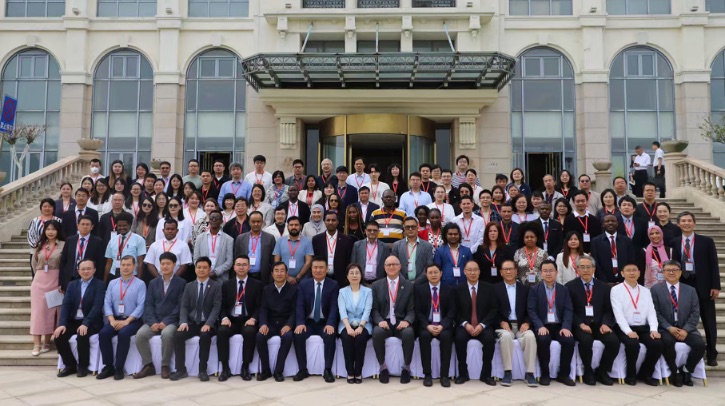
The 21st Session of the Forum on Regional Climate Monitoring, Assessment and Prediction for Asia (FOCRAII) has taken place in Qingdao, China, on May 14-16, hosted by WMO and the Beijing Climate Centre and sponsored by Shandong Provincial Meteorological Service.
Attendee research
Representatives have shared the latest research and held discussions on climate services development, new technologies and methods like artificial intelligence (AI), and climate prediction and seasonal climate prediction.
They have also consulted on the sub-seasonal to seasonal prediction project (S2S) and reached consensus on the forecast conclusions adopted by all WMO Regional Association II (Asia) (RA II) members. A total of 41 offline and online reports have been discussed at the forum.
Since 2005, FOCRAII has been held 21 times, with over 720 overseas experts and scholars from 69 countries and regions (including 32 Members of WMO RA II) attending the event, and over 160 representatives participating in relevant training courses.
Key points raised
The forum attracted domestic and international representatives from the Secretariat of the World Meteorological Organization (WMO) and over 30 countries and regions, including China, the USA, Australia, Japan, the Republic of Korea, Russia, Mongolia, Pakistan, Thailand, Myanmar, Vietnam, Indonesia, Malaysia, Maldives, Egypt, Ethiopia, Cameroon, and others. There were also representatives from the China Meteorological Administration, Nanjing Normal University, Fudan University, Nanjing University of Information of Information Science and Technology, Ocean University of China, and Jimo District Government, as well as from other institutions.
Ben Churchill, director of the regional office for Asia and the southwest Pacific (RAP) at WMO, stressed that through robust partnerships, the industry can elevate the work of National Meteorological and Hydrological Services (NMHSs), enhance the visibility and accessibility of climate information and develop more meaningful, impactful products and services for stakeholders and communities throughout Asia.
In an online address, Ardhasena Sopaheluwakan, vice-president of the WMO Commission for Weather, Climate, Hydrological, Marine and Related Environmental Services and Applications (SERCOM) and the deputy head for climatology in the Agency for Meteorology Climatology and Geophysics (BMKG) of Indonesia, remarked that participants should transform science into services to better support relevant decisions, and also be committed to helping different countries and regions enhance climate resilience and better address the challenges brought about by climate change.
In related news, WMO recently released its State of the Climate in Africa 2024 report. Click here to read the full story