


Close Menu
Meteorological Technology International
  • News
    • A-E
      • Agriculture
      • Automated Weather Stations
      • Aviation
      • Climate Measurement
      • Data
      • Developing Countries
      • Digital Applications
      • Early Warning Systems
      • Extreme Weather
    • G-P
      • Hydrology
      • Lidar
      • Lightning Detection
      • New Appointments
      • Nowcasting
      • Numerical Weather Prediction
      • Polar Weather
    • R-S
      • Radar
      • Rainfall
      • Remote Sensing
      • Renewable Energy
      • Satellites
      • Solar
      • Space Weather
      • Supercomputers
    • T-Z
      • Training
      • Transport
      • Weather Instruments
      • Wind
      • World Meteorological Organization
      • Meteorological Technology World Expo
  • Features
  • Online Magazines
    • January 2026
    • April 2025
    • January 2025
    • September 2024
    • April 2024
    • Archive Issues
    • Subscribe Free!
  • Opinion
  • Videos
  • Supplier Spotlight
  • Expo
LinkedIn X (Twitter) Facebook
  • Sign-up for Free Weekly E-Newsletter
  • Meet the Editors
  • Contact Us
  • Media Pack
LinkedIn Facebook
Subscribe
Meteorological Technology International
  • News
      • Agriculture
      • Automated Weather Stations
      • Aviation
      • Climate Measurement
      • Data
      • Developing Countries
      • Digital Applications
      • Early Warning Systems
      • Extreme Weather
      • Hydrology
      • Lidar
      • Lightning Detection
      • New Appointments
      • Nowcasting
      • Numerical Weather Prediction
      • Polar Weather
      • Radar
      • Rainfall
      • Remote Sensing
      • Renewable Energy
      • Satellites
      • Solar
      • Space Weather
      • Supercomputers
      • Training
      • Transport
      • Weather Instruments
      • Wind
      • World Meteorological Organization
      • Meteorological Technology World Expo
  • Features
  • Online Magazines
    1. April 2026
    2. January 2026
    3. September 2025
    4. April 2025
    5. January 2025
    6. September 2024
    7. April 2024
    8. January 2024
    9. Archive Issues
    10. Subscribe Free!
    Featured
    May 5, 2026

    In this Issue – April 2026

    By Web TeamMay 5, 2026
    Recent

    In this Issue – April 2026

    May 5, 2026

    In this Issue – January 2026

    November 27, 2025

    In this Issue – September 2025

    August 11, 2025
  • Opinion
  • Videos
  • Supplier Spotlight
  • Expo
Facebook LinkedIn
Subscribe
Meteorological Technology International
Data

European wildfire carbon emissions highest for 15 years, finds CAMS

Dan SymondsBy Dan SymondsSeptember 6, 20223 Mins Read
Share LinkedIn Facebook Twitter Email
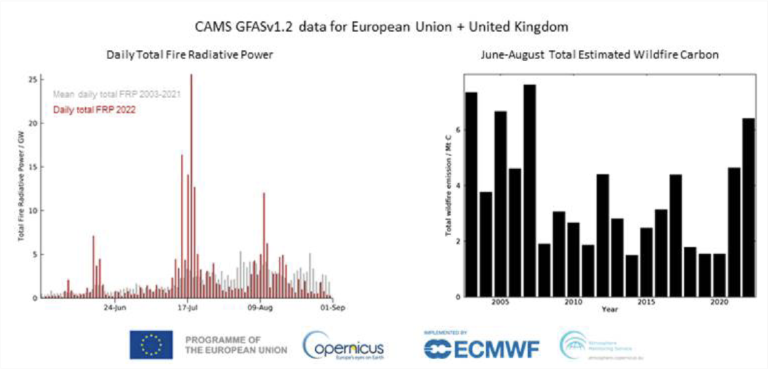
Left: CAMS GFAS daily total fire radiative power for EU+UK in 2022 (red bars) compared to the 2003-2021 average (grey bars). Right: CAMS GFAS June-August total estimated wildfire carbon emissions from 2003 to 2022. Credit: Copernicus Atmosphere Monitoring Service
Share
LinkedIn Facebook Twitter Email

The Copernicus Atmosphere Monitoring Service (CAMS) has reported that this year’s wildfires across Europe caused the highest emissions since 2007.

The combination of August’s heatwave with prolonged dry conditions across Western Europe resulted in increased wildfire activity, intensity and persistence.

According to data from the CAMS Global Fire Assimilation System (GFAS), which uses satellite observations of wildfire locations and fire radiative power (FRP) – a measure of intensity to estimate emissions of the air pollutants that are present in the smoke – the total wildfire emissions from the European Union plus the UK from June 1 to August 31, 2022, are estimated to be 6.4 megatons of carbon.

CAMS, implemented by the European Centre for Medium-Range Weather Forecasts (ECMWF), reports that the emissions recorded for summer 2022 were largely driven by wildfires across Southwestern France and the Iberian Peninsula, with France and Spain experiencing their highest wildfire emissions in the last 20 years.

In other regions around the northern hemisphere, which typically experience a peak in wildfire activity during the summer months, the total estimated emissions were considerably less than in recent years. The Sakha Republic and Chukotka Autonomous Oblast in the far east of Russia did not experience as much fire as recent summers, with most fires this summer further south in Khabarovsk Krai. More central and westerly regions of Russia, including Khanty-Mansy Autonomous Okrug and Ryazan Oblast, experienced higher numbers of wildfires resulting in several days of thick smoke and degraded air quality. Total estimated emissions from the fires in the Central Federal District of Russia were the highest since the large peat fires which affected West Russia in 2010.

In North America, wildfires that started burning in Alaska in May continued through June and early July with large fires in the Yukon and Northwest Territories of Canada. In the Western United States daily total fire intensity and seasonal total emissions were much lower for California, Oregon, Washington, Idaho and Montana in comparison to the summers of 2020 and 2021 and were more typical for the time of year, according to the CAMS GFAS data.

Mark Parrington, senior scientist and wildfire expert, CAMS, said, “The scale and persistence of the fires in the Southwest of Europe leading to the highest emissions for Europe in 15 years was extremely concerning throughout the summer. The majority of the fires occurred in places where the changing climate has increased the flammability of the vegetation such as in Southwestern Europe, and as we have seen in other regions in other years. CAMS is now closely monitoring the current fire emissions and smoke transport in the Amazon region, and across South America, as the peak fire season approaches in the coming weeks.”

Previous ArticleNCAR celebrates completion of $25m Research Aviation Facility
Next Article Leaders call for improved early warning systems across Southern Africa

Read Similar Stories

Nowcasting

Colorado State University and Nvidia partner to extend severe storm prediction lead times

June 2, 20262 Mins Read
Weather Instruments

R.M. Young Company reengineers SNOdar snow-depth sensor

May 21, 20262 Mins Read
Data

Ventusky adds fire monitoring to its weather maps

May 14, 20262 Mins Read
Latest News

VIDEO: Sentinel-6 satellite detects El Niño precursor in Pacific

June 4, 2026

New forecasting framework targets solar-limb flare blind spot

June 4, 2026

Colorado State University and Nvidia partner to extend severe storm prediction lead times

June 2, 2026

Receive breaking stories and features in your inbox each week, for free


Enter your email address:


Supplier Spotlights
  • ZOGLAB Microsystem Co., Ltd
Getting in Touch
  • Contact Us / Advertise
  • Meet the Editors
  • Media Pack
  • Free Weekly E-Newsletter
Our Social Channels
  • Facebook
  • LinkedIn
© 2026 UKi Media & Events a division of UKIP Media & Events Ltd
  • Cookie Policy
  • Privacy Policy
  • Terms and Conditions
  • Notice and Takedown Policy

Type above and press Enter to search. Press Esc to cancel.