


Meteorological Technology International
  • News
    • A-E
      • Agriculture
      • Automated Weather Stations
      • Aviation
      • Climate Measurement
      • Data
      • Developing Countries
      • Digital Applications
      • Early Warning Systems
      • Extreme Weather
    • G-P
      • Hydrology
      • Lidar
      • Lightning Detection
      • New Appointments
      • Nowcasting
      • Numerical Weather Prediction
      • Polar Weather
    • R-S
      • Radar
      • Rainfall
      • Remote Sensing
      • Renewable Energy
      • Satellites
      • Solar
      • Space Weather
      • Supercomputers
    • T-Z
      • Training
      • Transport
      • Weather Instruments
      • Wind
      • World Meteorological Organization
      • Meteorological Technology World Expo
  • Features
  • Online Magazines
    • January 2026
    • April 2025
    • January 2025
    • September 2024
    • April 2024
    • Archive Issues
    • Subscribe Free!
  • Opinion
  • Videos
  • Supplier Spotlight
  • Expo
LinkedIn Twitter Facebook
  • Sign-up for Free Weekly E-Newsletter
  • Meet the Editors
  • Contact Us
  • Media Pack
LinkedIn Facebook
Subscribe
Meteorological Technology International
  • News
      • Agriculture
      • Automated Weather Stations
      • Aviation
      • Climate Measurement
      • Data
      • Developing Countries
      • Digital Applications
      • Early Warning Systems
      • Extreme Weather
      • Hydrology
      • Lidar
      • Lightning Detection
      • New Appointments
      • Nowcasting
      • Numerical Weather Prediction
      • Polar Weather
      • Radar
      • Rainfall
      • Remote Sensing
      • Renewable Energy
      • Satellites
      • Solar
      • Space Weather
      • Supercomputers
      • Training
      • Transport
      • Weather Instruments
      • Wind
      • World Meteorological Organization
      • Meteorological Technology World Expo
  • Features
  • Online Magazines
    1. January 2026
    2. September 2025
    3. April 2025
    4. January 2025
    5. September 2024
    6. April 2024
    7. January 2024
    8. September 2023
    9. April 2023
    10. Archive Issues
    11. Subscribe Free!
    Featured
    November 27, 2025

    In this Issue – January 2026

    By Hazel KingNovember 27, 2025
    Recent

    In this Issue – January 2026

    November 27, 2025

    In this Issue – September 2025

    August 11, 2025

    In this Issue – April 2025

    April 15, 2025
  • Opinion
  • Videos
  • Supplier Spotlight
  • Expo
Facebook LinkedIn
Subscribe
Meteorological Technology International
Data

Met Office research shows machine learning can boost seasonal forecasting capabilities

Hazel KingBy Hazel KingSeptember 4, 20254 Mins Read
Share LinkedIn Facebook Twitter Email
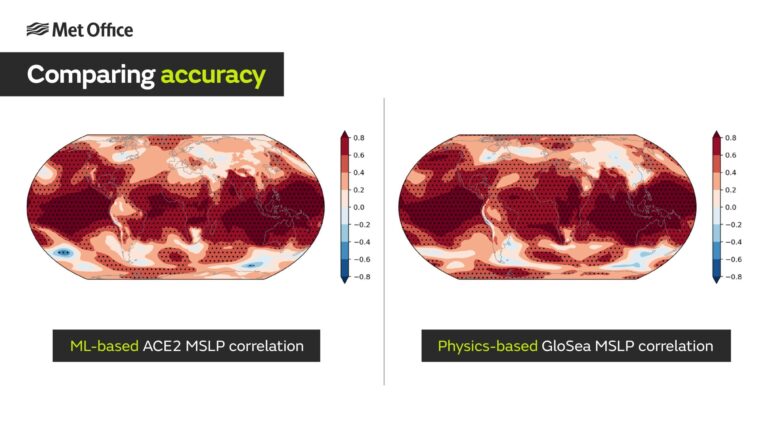
A map showing the correlation of ML-based ACE2 (left) and physics-based GloSea (right) models to the observed conditions over 23 northern hemisphere winters from 1993-94 to 2015-16. The deeper reds indicate higher levels of accuracy and the blues lower levels of accuracy
The above maps show the correlation of ML-based ACE2 (left) and physics-based GloSea (right) models to the observed conditions over 23 northern hemisphere winters from 1993-94 to 2015-16. The deeper reds indicate higher levels of accuracy and the blues lower levels of accuracy
Share
LinkedIn Facebook Twitter Email

New research from the UK’s Met Office has revealed the potential of machine learning-based weather models to revolutionize global seasonal forecasting.

The peer-reviewed paper Skilful global seasonal predictions from a machine learning weather model trained on reanalysis data, published in npj Climate and Atmospheric Science, assesses the viability of applying an ML weather model to global seasonal forecasts, which are vital for understanding global weather patterns.

According to the Met Office, seasonal forecasts – which look at the likely conditions for the next three months – can provide valuable insights for long-term planning and decision making, including for agriculture, water resources and public health.

Existing methods to provide seasonal forecasts involve running physics-based models multiple times to understand the most likely scenarios, with probabilities applied to different conditions. (Ai2)

According to new HCCP-funded research, the Allen Institute for AI’s ML model (known as ACE2) demonstrates comparable performance to existing methods, with significantly less computing power required.

Met Office lead author and senior scientist Chris Kent explained, “We’ve already seen how ML-based approaches show skill in short-range forecasting, what this paper does is explore using these methods at a much longer timescale at a global level.

“We’ve found that ACE2 shows skill comparable to existing physics-based methods, which could open up new opportunities on generating more detailed and accurate forecasts at a seasonal range.”

Comparing accuracy

To assess the accuracy of ACE2’s seasonal predictions, an ensemble of global forecasts covering 23 northern hemisphere winters was compared to both physics-based predictions for the same period, as well as the reality of the observed conditions that are known to have taken place.

The ensemble spread was similar to existing methods, with skilful predictions of the North Atlantic Oscillation, which often affects weather conditions in Europe and North America. When predicting the wintertime North Atlantic Oscillation, correlation scores of 0.3–0.6 are typically seen across physics-based models, whilst ACE2 achieves a score just under 0.5. In this methodology, a score of 1 would demonstrate perfect accuracy to the observed conditions.

However, varied levels of skill were demonstrated in different locations around the world, and in general the ML-based model did not yet outperform the existing physics-based methodology.

Predicting extremes

Despite demonstrating potential for winter predictions, the research also underlines potential limitations of solely relying on ML-based seasonal forecasts.

The 2009/10 winter was particularly cold, with a record negative North Atlantic Oscillation and the eighth coldest winter for the UK since records began in 1884.

Paper co-author and Met Office head of long-range forecasting Adam Scaife explained, “We also found that the ML model struggled to predict conditions beyond the training data. 2009/10 was an exceptional winter and is a key test case for predictions but without the underpinning physics of conventional models, the ML-based solutions struggled to predict this more extreme case.

“It’s going to be important to leverage the benefits of these fast ML-based models for accelerated improvements to seasonal forecasting, while still being underpinned by physics-based understanding of the atmosphere.”

Next steps

This proof-of-concept study is another step on the way to the next generation of weather forecasting. Oliver Watt-Meyer, lead research scientist for climate modelling at Ai2, enthused, “It is an exciting moment for machine learning in earth science as we move beyond medium-range weather to seasonal and longer time scales. Importantly, it will be necessary to stop solely predicting atmospheric conditions and start including the ocean and other components of the climate system.”

Further research is still required to better understand opportunities and limitations, with the Met Office aiming to bring through both short and long-term forecasting improvements in a safe and reliable way by fusing together the combined strengths of physics and AI/ML-based forecasts.

PIC CAPTION: The above maps show the correlation of ML-based ACE2 (left) and physics-based GloSea (right) models to the observed conditions over 23 northern hemisphere winters from 1993-94 to 2015-16. The deeper reds indicate higher levels of accuracy and the blues lower levels of accuracy

Previous ArticleTransZero launches AI-powered climate risk platform to help businesses safeguard global supply chains
Next Article Vaisala launches new climate business after Quanterra acquisition

Read Similar Stories

Climate Measurement

UK to strengthen climate observations and satellite functions with £17m space innovation investment

December 4, 20253 Mins Read
Climate Measurement

Uncrewed systems prove new method for observing deep ocean currents in real time

December 4, 20253 Mins Read
Climate Measurement

WMO predicts borderline La Niña conditions

December 4, 20252 Mins Read
Latest News

UK to strengthen climate observations and satellite functions with £17m space innovation investment

December 4, 2025

Uncrewed systems prove new method for observing deep ocean currents in real time

December 4, 2025

WMO predicts borderline La Niña conditions

December 4, 2025

Receive breaking stories and features in your inbox each week, for free


Enter your email address:


Supplier Spotlights
  • Adolf Thies GmbH & Co. KG
Getting in Touch
  • Contact Us / Advertise
  • Meet the Editors
  • Download Media Pack
  • Free Weekly E-Newsletter
Our Social Channels
  • Facebook
  • LinkedIn
© 2025 UKi Media & Events a division of UKIP Media & Events Ltd
  • Cookie Policy
  • Privacy Policy
  • Terms and Conditions
  • Notice and Takedown Policy

Type above and press Enter to search. Press Esc to cancel.

We use cookies on our website to give you the most relevant experience by remembering your preferences and repeat visits. By clicking “Accept”, you consent to the use of ALL the cookies.
Cookie settingsACCEPT
Manage consent

Privacy Overview

This website uses cookies to improve your experience while you navigate through the website. Out of these, the cookies that are categorized as necessary are stored on your browser as they are essential for the working of basic functionalities of the website. We also use third-party cookies that help us analyze and understand how you use this website. These cookies will be stored in your browser only with your consent. You also have the option to opt-out of these cookies. But opting out of some of these cookies may affect your browsing experience.
Necessary
Always Enabled

Necessary cookies are absolutely essential for the website to function properly. These cookies ensure basic functionalities and security features of the website, anonymously.

CookieDurationDescription
cookielawinfo-checbox-analytics11 monthsThis cookie is set by GDPR Cookie Consent plugin. The cookie is used to store the user consent for the cookies in the category "Analytics".
cookielawinfo-checbox-functional11 monthsThe cookie is set by GDPR cookie consent to record the user consent for the cookies in the category "Functional".
cookielawinfo-checbox-others11 monthsThis cookie is set by GDPR Cookie Consent plugin. The cookie is used to store the user consent for the cookies in the category "Other.
cookielawinfo-checkbox-necessary11 monthsThis cookie is set by GDPR Cookie Consent plugin. The cookies is used to store the user consent for the cookies in the category "Necessary".
cookielawinfo-checkbox-performance11 monthsThis cookie is set by GDPR Cookie Consent plugin. The cookie is used to store the user consent for the cookies in the category "Performance".
viewed_cookie_policy11 monthsThe cookie is set by the GDPR Cookie Consent plugin and is used to store whether or not user has consented to the use of cookies. It does not store any personal data.

Functional

Functional cookies help to perform certain functionalities like sharing the content of the website on social media platforms, collect feedbacks, and other third-party features.

Performance

Performance cookies are used to understand and analyze the key performance indexes of the website which helps in delivering a better user experience for the visitors.

Analytics

Analytical cookies are used to understand how visitors interact with the website. These cookies help provide information on metrics the number of visitors, bounce rate, traffic source, etc.

Advertisement

Advertisement cookies are used to provide visitors with relevant ads and marketing campaigns. These cookies track visitors across websites and collect information to provide customized ads.

Others

Other uncategorized cookies are those that are being analyzed and have not been classified into a category as yet.

SAVE & ACCEPT
Powered by