


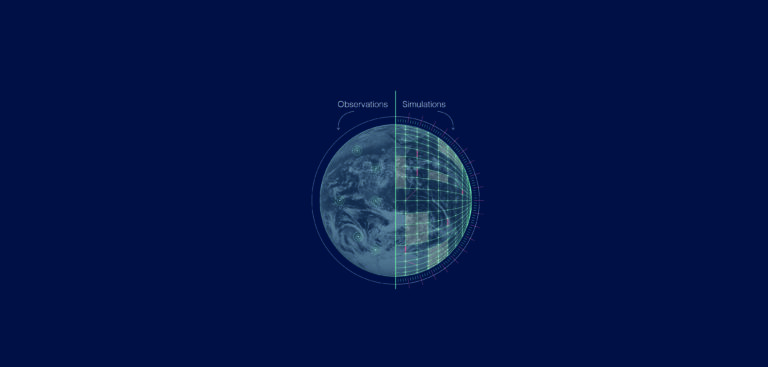
The European Centre for Medium-Range Weather Forecasts (ECMWF) has announced details of its new team assembled to work on digital twins of Earth as part of its contribution to the EU’s Destination Earth (DestinE) initiative. The new staff will work alongside existing ECMWF teams and with outside partners to develop these new capabilities.
Peter Bauer, director of DestinE at ECMWF, said, “We are very impressed by the extremely high level of recruited staff expertise across science, digital technology, management, administration and communication in such a short time after the initiative has started. This will carry ECMWF’s contribution to DestinE for years to come.”
ECMWF has also accepted a bid led by the French national meteorological service, Météo-France, to develop the ‘on-demand’ component of one of the digital twins. This twin will enable the configurable and tailored impact assessment and prediction of weather-induced extremes at sub-kilometer scales.
Florence Rabier, ECMWF’s director general, said, “I am delighted that Météo-France and its partners have won this bid, which illustrates the close relationship between ECMWF and the national meteorological and hydrological services of our member and cooperating states.”
Digital twin concept
Using an unprecedented number of observations, innovative Earth system models and cutting-edge computing, Destination Earth will develop several digital twins, or highly accurate replicas, of the Earth.
DestinE’s digital twins have three main characteristics: they will rely on better simulations based on more realistic models; they will develop better ways of combining observed and simulated information from the entire Earth system, namely the physical components and societal domains for food, water, energy and health management in support of action scenarios; and they will provide users with interactive and configurable access to data, models and workflows.
ECMWF will work with the European Space Agency (ESA) and the European Organisation for the Exploitation of Meteorological Satellites (EUMETSAT) to deliver DestinE’s vision. Efforts in DestinE will complement existing national and European services, such as those offered by national meteorological services and the EU’s Copernicus program.
Digital twin on extremes
Météo-France and its partners have won a tender to build the on-demand component of the weather-induced extremes digital twin. This on-demand component will rely on short-range predictions with a resolution between 500 and 750m, and even 200m depending on the extremes case and the situation. These capabilities will initially be limited to Europe.
It will “develop configurable and scalable workflows for the monitoring and short-range prediction of extremes and their impacts on society”, said Irina Sandu, the science lead for DestinE at ECMWF.
ECMWF will deliver the global continuous component of this digital twin, which will focus on predictions of extremes a few days ahead, building on its Integrated Forecasting System. The first demonstration of the entire weather-induced extremes digital twin will be delivered by the end of the first phase of DestinE in April 2024.
Digital twin on climate change adaptation
ECMWF is also responsible for delivering a digital twin on climate change adaptation. This digital twin will focus on multi-decadal timescales, supporting sustainable development and climate adaptation and mitigation scenarios.
The contract for this digital twin is currently being negotiated, and the winning bid will be announced shortly.
Multi-level partnership
In addition to the digital twin contracts, ECMWF has signed an agreement with the Italian supercomputing institution Cineca for the first phase of DestinE until April 30, 2024. Cineca is expected to host some of the computationally extremely demanding simulations on a new pre-exascale machine called Leonardo.
The DestinE contract was signed in December 2021 and the initiative was officially launched in March 2022. ECMWF’s DestinE team will work from Bonn, Germany, and in collaboration with the partner entities ESA and EUMETSAT, and other institutions across Europe, to develop a multi-level partnership program.
To learn more about the EU’s Destination Earth initiative, view our cover story from the September issue of Meteorological Technology International by clicking here.
This article was originally posted on the ECMWF website, and can be viewed here.
Headline and opening paragraph adapted to suit the Meteorological Technology International website. Content shared under Creative Commons — Attribution 4.0 International — CC BY 4.0