


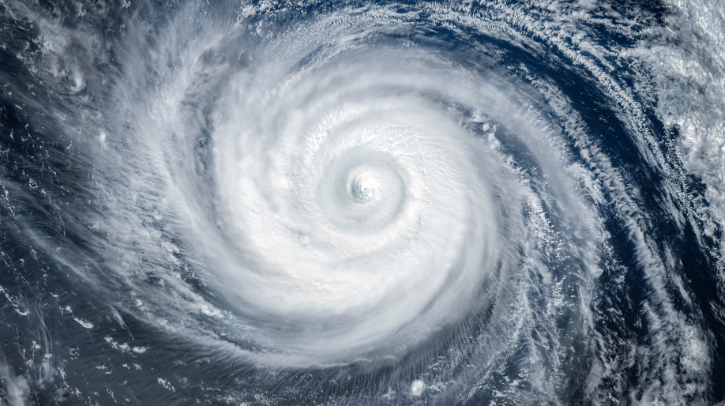
Scientists at the University of Washington in the USA have used artificial intelligence to simulate the Earth’s climate and its potential annual variations for up to 1,000 years into the future, in order to better predict so-called ‘100-year’ extreme weather events. What’s more, the AI model they’re developing takes only 12 hours to generate this long-range forecast, compared to the 90 days a supercomputer would take.
“We are developing a tool that examines the variability in our current climate to help answer this lingering question: Is a given event the kind of thing that happens naturally, or not?” said Dale Durran, a UW professor of atmospheric and climate science.
Duran and former UW graduate student Jonathan Weyn partnered with Microsoft Research more than five years ago to explore how AI could be used to improve weather forecasting. “To train an AI model, you have to give it tons of data,” Durran said. “But if you break up the available historical data by season, you don’t get very many chunks.”
Most global datasets go back only to 1979 and this shortage of historical data has been seen as a challenge for developing efficient and accurate forecasting using AI as while there are plenty of days in this period that can be used for training daily forecasts, there are not many seasons to use for seasonal variability.
Durran’s Deep Learning Earth SYstem Model (DLESyM) was trained for one-day forecasts but still learned how to capture seasonal variability.
“We were the first to apply this framework to AI and we found out that it worked really well,” said lead author Nathaniel Cresswell-Clay, an atmospheric and climate science graduate student at UW. “We’re presenting this as a model that defies a lot of the present assumptions surrounding AI in climate science.”
The study was published in AGU Advances on August 25.
The University of Washington has also announced that its College of the Environment has been awarded US$10m in funding from the Fund for Science and Technology philanthropic initiative set up by Microsoft co-founder Paul Allen, to be used to research climate change solutions, climate prediction and environmental modeling.
In related news, the Woods Hole Oceanographic Institution (WHOI) is participating in a new research initiative aimed at enhancing the understanding of extreme weather, such as hurricanes, using ocean data. Read the full story here