


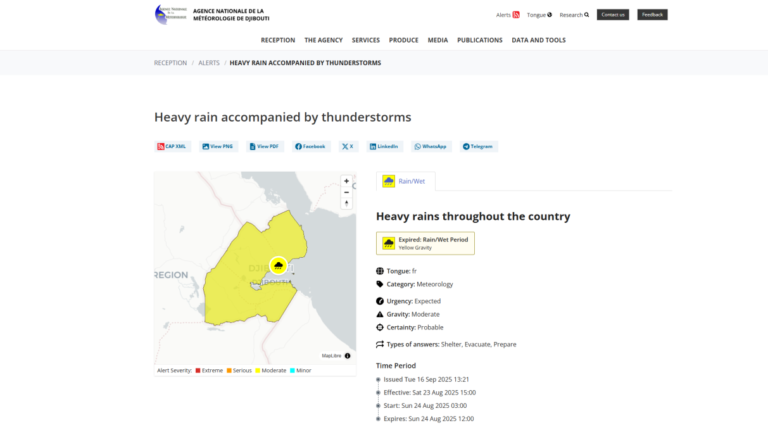
The National Meteorological Agency of Djibouti (ANM) successfully issued its first Common Alerting Protocol (CAP) warning in September through its new website.
A CAP warning is a standardized format for exchanging all-hazard emergency alerts and public warnings. It delivers real-time actionable risk information to relevant stakeholders and at-risk communities.
The upgraded platform, developed by the WMO Regional Office for Africa, is said to be the first centralized hub for disseminating critical risk information and strengthening early warning communication in the country.
The modern CMS web template has tools for marketing integration and for advanced interactive climate data visualization to personalize user experience.
Additionally, the website has an integrated CAP editor – a key element in ensuring that early warnings are issued and communicated to the entire population.
The moderate warning issued by ANM warned of heavy rain of more than 50mm throughout the country, with a risk of localized flooding in low-lying areas and flash flooding in urban areas.
In the message, a set of instructions was shared as guidelines for the public, ensuring better preparedness for this hydrometeorological event.
The move marks a significant step in Djibouti’s US$3.6m Climate Risk and Early Warning Systems Initiative (CREWS) project.
Jointly implemented by the WMO and the United Nations Agency for Disaster Risk Reduction (UNDR), the project aims to improve the production, delivery and dissemination of multi-hazard early warning systems, enabling better preparedness, early action and response to hazardous hydrometeorological events affecting Djibouti.
The WMO is mandated to ensure its members are CAP compliant to enhance preparedness, early action and response efforts related to hazardous hydrometeorological events.
In related news, Uganda is set to upgrade its early warning systems with support from the FMI and WMO