


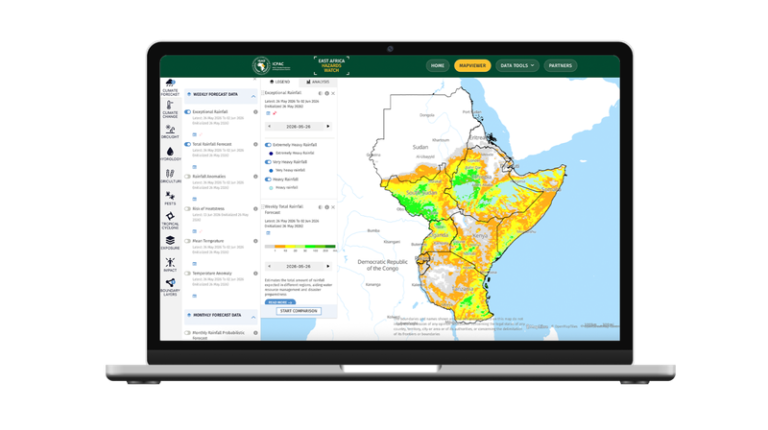
The IGAD Climate Prediction and Applications Centre (ICPAC) has completed its transition to Google Cloud services, enabling it to provide early weather warnings more quickly by processing geospatial data in just 30 minutes, down from eight hours.
ICPAC provides forecasting and early warning services to 11 nations across Afric, giving farmers, pastoralists and governments the data they need for proper planning and resilience.
For years, providing these essential services was a challenge due to infrastructure limitations, according to the center. Relying on on-premises data centers meant that power outages or internet disruptions could interrupt necessary warnings at pivotal moments.
Seeking better reliability, ICPAC began a transition to Google Cloud in 2017. However, the need to get services online quickly led to a monolithic architecture where overprovisioned virtual machines weren’t as cost-effective or as fast as they could be. To ensure its infrastructure could fully support its regional mission, ICPAC worked with Google Cloud partner Incentro Africa.
Together they conducted a full environment audit that uncovered misconfigured network settings and security gaps. Incentro helped the ICPAC team prioritize these findings and build a remediation roadmap – laying the groundwork for a more secure, cost-effective infrastructure, enabling it to scale its impact across the region.
“Technology’s the foundation of our work in enhancing resilience for the region, and we needed to ensure we were using it effectively,” explained Leonard M Kimotho, IT admin at ICPAC.
“By optimizing our Google Cloud environment, we’ve created a primary platform for mission-critical systems that are available 24/7, no matter the conditions on the ground.”
Stable system
ICPAC moved away from a monolithic setup toward a microservices approach using Google Kubernetes Engine (GKE). By breaking their systems into independent services for messaging, data ingestion and user feedback, ICPAC ensured that the system remained stable even when one component needed an update.
This efficiency is most evident in the East Africa Hazards Watch platform, where ICPAC uses Cloud Run to process massive amounts of geospatial data. In the past, complex data tasks could take up to eight hours. Today, they’re completed in just 30 minutes – a reduction of more than 90%.
Internal workflows
This transformation also redefined how ICPAC handles its internal workflows. Previously, manual deployment processes were time-consuming and carried the risk of errors. Now, by using Cloud Build and Artifact Registry to create automated CI/CD pipelines, updates are pushed with total confidence. Security has also been improved by moving data into Cloud Storage buckets and adopting custom service accounts using Identity and Access Management (IAM).
“The shift to microservices and automated workflows has removed a significant burden from our team,” said Jason Kinyua, lead developer and data officer at ICPAC. “With our data now sitting securely in Cloud Storage, we also have total confidence in the reliability of the early warnings we send to our mobile users across the region.”
Conversational climate reporting
The platform is now highly available and optimized for various devices, which means government officials and disaster management teams can access actionable reports from anywhere.
The organization is now looking toward a future where climate data is made even more accessible through generative AI. ICPAC plans to use Gemini to create conversational interfaces, enabling users to ask questions in their local languages.
“Our work to modernize our infrastructure has allowed us to stop focusing on maintenance and focus even more on providing climate knowledge,” said Kinyua. “We’re now equipped to provide insights to help our communities stay resilient and prosperous, and we’re excited to see how Gemini will help us reach even more people.”
Related news, Extreme weather affected 13 million people in Africa in 2025, says WMO