


Meteorological Technology International
  • News
    • A-E
      • Agriculture
      • Automated Weather Stations
      • Aviation
      • Climate Measurement
      • Data
      • Developing Countries
      • Digital Applications
      • Early Warning Systems
      • Extreme Weather
    • G-P
      • Hydrology
      • Lidar
      • Lightning Detection
      • New Appointments
      • Nowcasting
      • Numerical Weather Prediction
      • Polar Weather
    • R-S
      • Radar
      • Rainfall
      • Remote Sensing
      • Renewable Energy
      • Satellites
      • Solar
      • Space Weather
      • Supercomputers
    • T-Z
      • Training
      • Transport
      • Weather Instruments
      • Wind
      • World Meteorological Organization
      • Meteorological Technology World Expo
  • Features
  • Online Magazines
    • January 2026
    • April 2025
    • January 2025
    • September 2024
    • April 2024
    • Archive Issues
    • Subscribe Free!
  • Opinion
  • Videos
  • Supplier Spotlight
  • Expo
LinkedIn Twitter Facebook
  • Sign-up for Free Weekly E-Newsletter
  • Meet the Editors
  • Contact Us
  • Media Pack
LinkedIn Facebook
Subscribe
Meteorological Technology International
  • News
      • Agriculture
      • Automated Weather Stations
      • Aviation
      • Climate Measurement
      • Data
      • Developing Countries
      • Digital Applications
      • Early Warning Systems
      • Extreme Weather
      • Hydrology
      • Lidar
      • Lightning Detection
      • New Appointments
      • Nowcasting
      • Numerical Weather Prediction
      • Polar Weather
      • Radar
      • Rainfall
      • Remote Sensing
      • Renewable Energy
      • Satellites
      • Solar
      • Space Weather
      • Supercomputers
      • Training
      • Transport
      • Weather Instruments
      • Wind
      • World Meteorological Organization
      • Meteorological Technology World Expo
  • Features
  • Online Magazines
    1. January 2026
    2. September 2025
    3. April 2025
    4. January 2025
    5. September 2024
    6. April 2024
    7. January 2024
    8. September 2023
    9. April 2023
    10. Archive Issues
    11. Subscribe Free!
    Featured
    November 27, 2025

    In this Issue – January 2026

    By Hazel KingNovember 27, 2025
    Recent

    In this Issue – January 2026

    November 27, 2025

    In this Issue – September 2025

    August 11, 2025

    In this Issue – April 2025

    April 15, 2025
  • Opinion
  • Videos
  • Supplier Spotlight
  • Expo
Facebook LinkedIn
Subscribe
Meteorological Technology International
Climate Measurement

NOAA’s US$3m AI-powered fire detection system undergoes second evaluation

Elizabeth BakerBy Elizabeth BakerMay 21, 20254 Mins Read
Share LinkedIn Facebook Twitter Email
NOAA’s US$3m experimental Next Generation Fire System (NGFS) will undergo a second evaluation in the Fire Weather Testbed, which is managed by the Global Systems Laboratory in Boulder, Colorado.
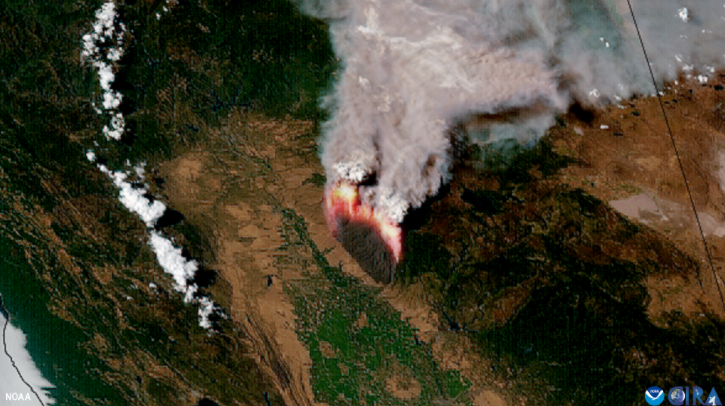
An image of California's Park Fire and smoke taken from space by NOAA's GOES-18 satellite on July 26, 2024. Credit: NOAA Satellites
Share
LinkedIn Facebook Twitter Email

NOAA’s US$3m experimental Next Generation Fire System (NGFS) is undergoing a second evaluation in the Fire Weather Testbed, which is managed by the Global Systems Laboratory in Boulder, Colorado. The follow-up visit is intended to evaluate how to best send NGFS fire detections directly to land management partners across the western USA.

NGFS was developed by NOAA Satellites and CIMSS, NOAA’s cooperative institute with the University of Wisconsin-Madison. During the first test in June 2024, NOAA scientists evaluated routing NGFS detections through NWS offices, which would issue hotspot notifications to partner agencies.

Technological features

The first of two key features of the experimental system are the Advanced Baseline Imager, the primary instrument on NOAA’s two GOES geostationary satellites orbiting 22,000 miles above the equator. The second is a set of NGFS algorithms that continuously comb through data generated by the imager and automatically identify heat anomalies or hot spots, even through clouds and smoke.

Any new sources of heat are overlaid on surface imagery and geolocated. Then an alert is sent instantly to an online dashboard so users can easily visualize the location. Once a fire is detected, the system tracks and records the fire’s spread and intensity. The information is simultaneously available to weather forecasters, fire dispatchers and first responders.

“NGFS can provide alerts in as little as one minute from the time the energy from the fire reaches the satellite,” said Mike Pavolonis, NOAA’s satellites wildland fire program manager, who is leading the research and development effort. “I’ve seen NGFS alerts for fires as small as a quarter acre.”
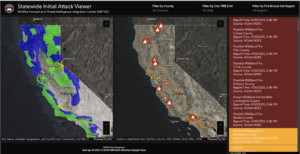
Multiple potential wildfire starts in California detected by NOAA’s Next Generation Fire System on April 30, 2025, are displayed on this California Office of Emergency Services dashboard. Credit: Courtesy of California Office of Emergency Services

The satellites’ stationary positions enable the system to scan new imagery over an area covering multiple states every minute and generates a fresh image of the entire contiguous USA every five minutes.

“Lives can be saved or lost from what you learn in minutes or even seconds,” said Todd Lindley, science and operations officer with the Norman Weather Forecast Office in Oklahoma, which relied on the system during the spring wildfire outbreak.

Once a fire is burning, NGFS provides real-time weather and fire monitoring needed by fire incident management teams to keep firefighters safe.

Industry adoption

Less than a year after first being evaluated in NOAA’s Fire Weather Testbed, the automated satellite fire detection capability of the experimental Next Generation Fire System (NGFS) has been embraced by the firefighting community and is being increasingly integrated into operations across the country, NOAA said.

“The rapid adoption of NGFS demonstrates its significant value to meteorologists,” said Zach Tolby, the fire weather testbed manager at NOAA. “Now we want to look for ways to optimize the system for wildland fire management in the field.”

During the recent Oklahoma wildfire outbreak, state officials said GOES satellites provided initial detection on 19 separate fires. Of those, preliminary analysis of fire spread modeling found that rapid firefighter response likely saved more than US$850m worth of structures and property. In comparison, the total cost of NGFS development was under US$3m.

“The amount of damage that NGFS helped firefighters prevent during this single outbreak was 250 times greater than the cost of developing this system,” Pavolonis said.

Overall, 90% of the NWS’s 122 Weather Forecast Offices around the country have subscribed to the NGFS feed since it became available. Forecast offices in California, Oregon, New Mexico, Texas, Oklahoma, Nebraska and North Carolina have used it so far in 2025.
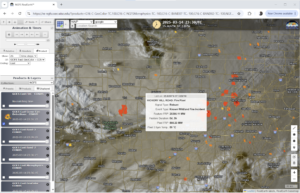
Dozens of fires were detected by NGFS in Oklahoma during the Great Plains wildfire outbreak on March 14, 2025. Credit: NOAA NESDIS/CIMMS

The California Office of Emergency Services (Cal OES) is using NGFS to improve situational awareness, and displays NGFS fire detections on its Statewide Initial Attack Viewer. In recent weeks, NGFS tracked the progress of a large fire in New Jersey’s Pine Barrens.

In related news, researchers at Bar-Ilan University in Israel recently developed an AI model that can predict where and when lightning strikes are most likely to cause wildfires, achieving over 90% accuracy. Click here to read the full story

Previous ArticleShip’s satellite receiver detects landslide-generated tsunami for the first time
Next Article VIDEO: Caltech’s autonomous underwater vehicle harnesses ocean currents to improve ocean monitoring

Read Similar Stories

Climate Measurement

UK to strengthen climate observations and satellite functions with £17m space innovation investment

December 4, 20253 Mins Read
Climate Measurement

Uncrewed systems prove new method for observing deep ocean currents in real time

December 4, 20253 Mins Read
Climate Measurement

WMO predicts borderline La Niña conditions

December 4, 20252 Mins Read
Latest News

UK to strengthen climate observations and satellite functions with £17m space innovation investment

December 4, 2025

Uncrewed systems prove new method for observing deep ocean currents in real time

December 4, 2025

WMO predicts borderline La Niña conditions

December 4, 2025

Receive breaking stories and features in your inbox each week, for free


Enter your email address:


Supplier Spotlights
  • EUMETSAT
Getting in Touch
  • Contact Us / Advertise
  • Meet the Editors
  • Download Media Pack
  • Free Weekly E-Newsletter
Our Social Channels
  • Facebook
  • LinkedIn
© 2025 UKi Media & Events a division of UKIP Media & Events Ltd
  • Cookie Policy
  • Privacy Policy
  • Terms and Conditions
  • Notice and Takedown Policy

Type above and press Enter to search. Press Esc to cancel.

We use cookies on our website to give you the most relevant experience by remembering your preferences and repeat visits. By clicking “Accept”, you consent to the use of ALL the cookies.
Cookie settingsACCEPT
Manage consent

Privacy Overview

This website uses cookies to improve your experience while you navigate through the website. Out of these, the cookies that are categorized as necessary are stored on your browser as they are essential for the working of basic functionalities of the website. We also use third-party cookies that help us analyze and understand how you use this website. These cookies will be stored in your browser only with your consent. You also have the option to opt-out of these cookies. But opting out of some of these cookies may affect your browsing experience.
Necessary
Always Enabled

Necessary cookies are absolutely essential for the website to function properly. These cookies ensure basic functionalities and security features of the website, anonymously.

CookieDurationDescription
cookielawinfo-checbox-analytics11 monthsThis cookie is set by GDPR Cookie Consent plugin. The cookie is used to store the user consent for the cookies in the category "Analytics".
cookielawinfo-checbox-functional11 monthsThe cookie is set by GDPR cookie consent to record the user consent for the cookies in the category "Functional".
cookielawinfo-checbox-others11 monthsThis cookie is set by GDPR Cookie Consent plugin. The cookie is used to store the user consent for the cookies in the category "Other.
cookielawinfo-checkbox-necessary11 monthsThis cookie is set by GDPR Cookie Consent plugin. The cookies is used to store the user consent for the cookies in the category "Necessary".
cookielawinfo-checkbox-performance11 monthsThis cookie is set by GDPR Cookie Consent plugin. The cookie is used to store the user consent for the cookies in the category "Performance".
viewed_cookie_policy11 monthsThe cookie is set by the GDPR Cookie Consent plugin and is used to store whether or not user has consented to the use of cookies. It does not store any personal data.

Functional

Functional cookies help to perform certain functionalities like sharing the content of the website on social media platforms, collect feedbacks, and other third-party features.

Performance

Performance cookies are used to understand and analyze the key performance indexes of the website which helps in delivering a better user experience for the visitors.

Analytics

Analytical cookies are used to understand how visitors interact with the website. These cookies help provide information on metrics the number of visitors, bounce rate, traffic source, etc.

Advertisement

Advertisement cookies are used to provide visitors with relevant ads and marketing campaigns. These cookies track visitors across websites and collect information to provide customized ads.

Others

Other uncategorized cookies are those that are being analyzed and have not been classified into a category as yet.

SAVE & ACCEPT
Powered by