


Probability-based forecasts can better inform weather-related decision-making, according to new research from the UK Met Office.
The study brings together 25 years of research to explain why probabilistic forecasting is becoming central to weather prediction. Funded by the Public Weather Service and published in the Royal Meteorological Society’s Weather, it examines how probability-based forecasts that account for uncertainty in predicted weather patterns can support more informed decisions.
The peer-reviewed research also suggests that public understanding of probabilistic forecasts should not be a barrier to their wider use, challenging earlier assumptions.
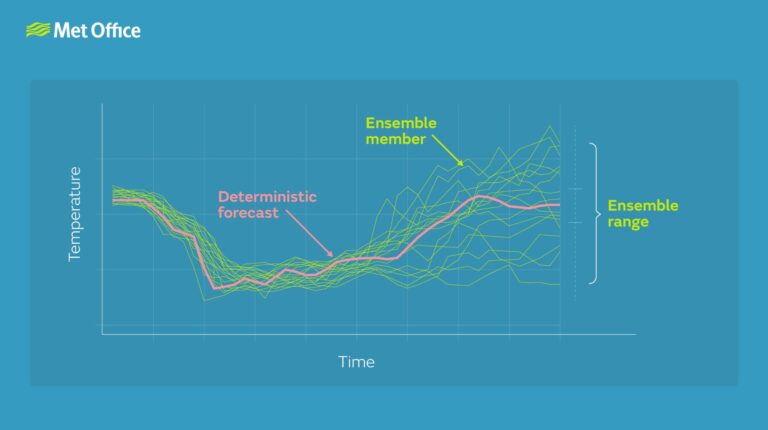
Probability forecasts are based on ensemble forecasting, a different approach from traditional deterministic forecasts often presented on television. Rather than relying on a single projection of future weather, ensemble forecasts run multiple simulations using slightly different starting conditions. Typically producing 20 to 50 model runs, this approach offers a broader view of possible outcomes and the uncertainty surrounding them.
The Met Office has been carrying out ensemble predictions, initially for month-ahead forecasts using research dating back to 1986, and has been running models multiple times to better understand likely atmospheric scenarios. Even small changes in starting conditions can lead to significant differences in forecasts, particularly at longer lead times, and ensemble forecasting is designed to capture that uncertainty.
Ken Mylne, Met Office science fellow and author of the research, said, “Ensemble forecasts have often operated as a supplementary system for meteorologists, running alongside single deterministic model runs to provide a measure of uncertainty.
“However, studies over many years show how ensembles provide better predictive skill than single deterministic runs and could, with greater focus on ensembles, capture the range of uncertainty to provide the public with the information they need to make better decisions.”
The research also examined whether people understand uncertainty in forecasts. Many weather apps already communicate uncertainty through measures such as the percentage chance of rain, which reflects ensemble model outputs.
Mylne commented, “Most previous discussions on expressing probabilities in forecasts started from an assumption that they can be hard for people to understand and that expressing uncertainty could undermine people’s confidence in the forecast and therefore undermine their ability to make decisions.
“However, this research suggests that this assumption is wrong. People can understand probabilistic forecasts and could indeed find it more useful for informing weather-based decisions.”
The Met Office says its Research and Innovation Strategy aims to expand the use of ensemble forecasting in research, operational forecasts and warnings. Blended probabilistic forecast data has already been rolled out across the Met Office website and app.
Met Office chief information and data officer Charles Ewen said, “These papers bridge the gap between cutting-edge research and developing an understanding with customers and users about what it means for them.
“It’s crucial to educate and inform people that any prediction has in-built uncertainties, but our use of ensembles is a method to calculate and communicate uncertainties in a useful way. This allows our users, public, industry and government, to make better decisions based on that uncertainty.”
Related news, Nvidia launches open Earth-2 model family for AI weather forecasting