


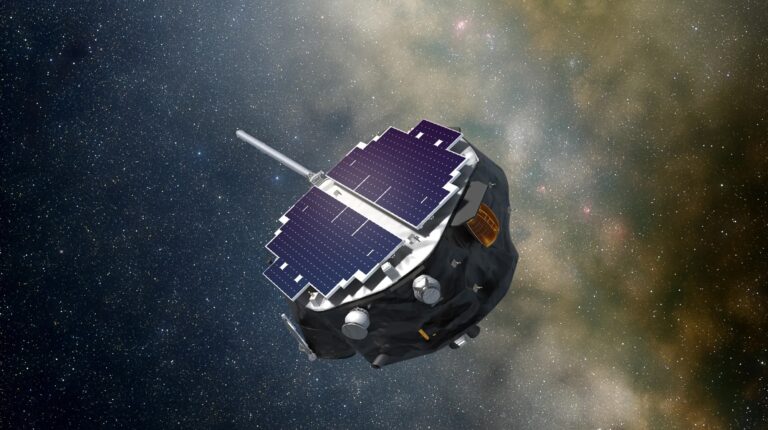
NASA has made a new real-time data stream from its Interstellar Mapping and Acceleration Probe (IMAP) observatory available to support space weather research and forecasting.
The IMAP spacecraft launched on September 24, 2025, and has recently entered orbit around the Sun-Earth L1 Lagrange point. From this position, it can monitor solar and interstellar conditions and transmit measurements that are important for operational space weather forecasting.
Five in situ instruments aboard IMAP are providing continuous measurements that are transmitted in near real time through the low-latency IMAP Active Link for Real-Time (I-ALiRT) data stream. The system is designed to support both scientific research and operational forecasting by providing rapid access to solar wind and energetic particle data.
The I-ALiRT dataset includes products derived from the Advanced Composition Explorer (ACE) mission but at higher measurement cadences. It also introduces new data products available for the first time in a near real-time space weather pipeline. These include high-energy electron count rates, helium ion count rates, solar wind charge-state ratios and elemental abundances, and information on counterstreaming electron flows.
The data is expected to support improvements in forecasting solar energetic particle events and other space weather hazards. Forecasters at NOAA’s Space Weather Prediction Center plan to use the IMAP data stream to enhance the timeliness of warnings, alerts and forecasts related to energetic particle events.
In related news, China’s Xihe-2 Sun-Earth L5 solar exploration project officially launches