


Researchers from UC San Diego’s Scripps Institution of Oceanography have led an international team that directly measured cold, deep water upwelling via turbulent mixing along the slope of a submarine canyon in the Atlantic Ocean.
Measurement methodology
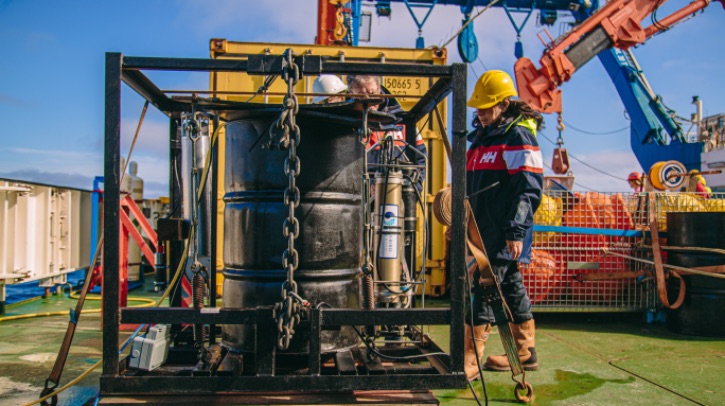
Floating above the submarine canyon in a research vessel, the team lowered a 55-gallon drum of fluorescein to 10m (32.8ft) above the seafloor and then remotely triggered the release of the dye.
Then the team tracked the dye for two and a half days until it dissipated using several instruments adapted in-house at Scripps for the demands of the experiment. The researchers were able to track the dye’s movement at high resolution by slowly moving the ship up and down the canyon’s slope. The key measurements came from devices called fluorometers that are capable of detecting the presence of tiny amounts of the fluorescent dye – down to less than 1 part per billion – but other instruments also measured changes in water temperature and turbulence.
Tracking the dye’s movements revealed turbulence-driven upwelling along the slope of the canyon, confirming the inferences from the WHOI experiments with direct observations for the first time. Not only did the team measure upwelling along the canyon’s slope, that upwelling was much faster than Munk’s 1966 calculations predicted.
The report was led by Scripps postdoctoral fellow Bethan Wynne-Cattanach alongside Matthew Alford, professor of physical oceanography at Scripps and senior author of the study, and Raffaele Ferrari, oceanographer at the Massachusetts Institute of Technology and co-author of the current study.
Further co-authors are: Nicole Couto, Arnaud Le Boyer, and Gunnar Voet of Scripps; Henri Drake of the University of California Irvine, Herlé Mercier Ifremer of the Centre de Bretagne, Marie-José Messias of the University of Exeter, Xiaozhou Ruan of Boston University, Carl Spingys of the National Oceanography Centre in the United Kingdom, Hans van Haren of the Royal Netherlands Institute for Sea Research, Kurt Polzin of WHOI, and Alberto Naveira Garabato of the University of Southampton and the National Oceanography Centre co-authored the study. Jim Ledwell of WHOI, who pioneered studies of ocean mixing using tracers and dye and passed away late in 2022, also contributed to the study.
Credit: San Nguyen
Research context
The pace of upwelling the researchers observed was more than 10,000 times the global average rate predicted by the late renowned oceanographer Walter Munk in the 1960s. Such upwelling was implied by work in the 1990s by the Woods Hole Oceanographic Institution (WHOI) led in part by the late James Ledwell.
The world as we know it requires large-scale ocean circulation, often called conveyor belt circulation, in which seawater becomes cold and dense near the poles, sinks into the deep, and eventually rises back up to the surface where it warms, beginning the cycle again. These broad patterns maintain a turnover of heat, nutrients and carbon that underpins global climate, marine ecosystems, and the ocean’s ability to mitigate human-caused climate change.
Despite the conveyor belt’s importance, however, a component of it known as meridional overturning circulation (MOC), has proven difficult to observe. In particular, the return of cold water from the deep ocean to the surface through upwelling has been theorized and inferred but never directly measured.
In 1966, Munk calculated a global average pace of upwelling using the rate at which cold, deep water was formed near Antarctica. He estimated the speed of upwelling at 1cm per day. The volume of water transported by this rate of upwelling would be huge, said Matthew Alford, professor of physical oceanography at Scripps and senior author of the study, “but spread out over the entire global ocean, that flow is too slow to measure directly.”
Munk proposed that this upwelling occurred via turbulent mixing caused by breaking internal waves under the ocean’s surface. About 25 years ago, large-scale microstructure surveys and tracer releases conducted by WHOI began to reveal that undersea turbulence was higher near the seafloor. The observations suggested that upwelling was occurring and that near-bottom turbulence was responsible, but it could not be resolved directly, and the processes were unclear.
If turbulence is strongest near the bottom where the water is coldest, then a given parcel of water would experience stronger mixing beneath it where the water is colder. This would have the effect of making bottom waters even colder and denser, pushing water down instead of lifting it toward the surface. This theoretical prediction, since confirmed by measurements, appears to contradict the observed fact that the deep ocean has not simply filled up with the cold, dense water formed at the poles.
In 2016, researchers including MIT oceanographer Raffaele Ferrari proposed a new theory that had the potential to resolve this paradox. The idea was that steep slopes on the seafloor in places like the walls of underwater canyons might produce the right kind of turbulence to cause upwelling.
Wynne-Cattanach, Alford and their collaborators first set out to see if they could directly observe this phenomenon by conducting an experiment at sea with the help of a barrel of a non-toxic, fluorescent green dye called fluorescein. Beginning in 2021, the researchers visited a roughly 2,000m deep undersea canyon in the Rockall Trough, about 370km (230 miles) northwest of Ireland.
“We selected this canyon out of the roughly 9,500 we know of in the oceans because this spot is pretty unremarkable as deep sea canyons go,” said Alford. “The idea was for it to be as typical as possible to make our results more generalizable.”
Oceanography findings
Credit: San Nguyen
The results appear in a new study led by Scripps postdoctoral fellow Wynne-Cattanach and published in the journal Nature.
The oceanography findings are expected to eventually help improve humanity’s ability to forecast climate change. The research was supported by grants from the Natural Environment Research Council (NERC) and the National Science Foundation (NSF).
Where Munk inferred a global average of 1cm per day, measurements at Rockall Trough found upwelling proceeding at 100m per day. Additionally, the team observed some dye migrating away from the canyon’s slope and toward its interior, suggesting the physics of the turbulent upwelling were more complex than Ferrari originally theorized.
“We’ve observed upwelling that’s never been directly measured before,” said Wynne-Cattanach. “The rate of that upwelling is also really fast, which, along with measurements of downwelling elsewhere in the oceans, suggests there are hotspots of upwelling.”
Alford called the study’s findings “a call to arms for the physical oceanography community to understand ocean turbulence a lot better”.
Future plans
The next step will be to test whether there is similar upwelling in other submarine canyons around the world. Given the canyon’s unremarkable features, Alford said it seems reasonable to expect the phenomenon to be relatively common.
If the results hold true elsewhere, the researchers said global climate simulations will need to begin explicitly accounting for this type of turbulence-driven upwelling at ocean floor topographical features. “This work is the first step to adding in missing ocean physics to our climate models that will ultimately improve the ability of those models to predict climate change,” he said.
The route to improving the scientific understanding of ocean turbulence is two-fold, according to Alford. First, “We need to be doing more high-tech, high-resolution experiments like this one in key parts of the ocean to better understand the physical processes”, he said; and second, “We need to be measuring turbulence in as many different places as possible with autonomous instruments like the Argo floats.”
The researchers are already in the process of conducting a similar dye-release experiment just off the coast of the Scripps campus in the La Jolla submarine canyon.
In related news, the American Bureau of Shipping (ABS) has approved the preliminary design of a hydrogen-hybrid research vessel that will join the fleet at UC San Diego’s Scripps Institution of Oceanography when completed. Click here to read the full story.