


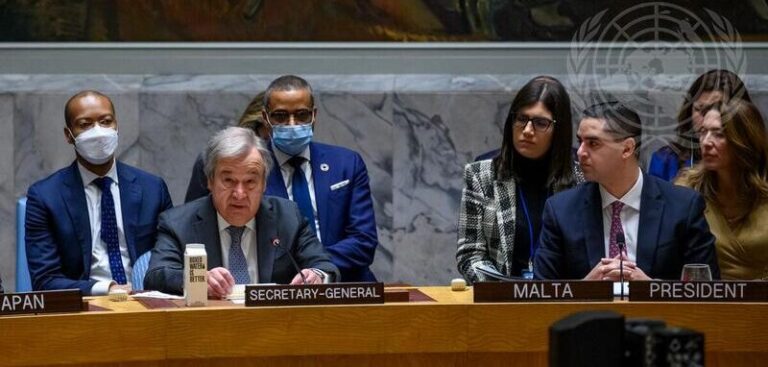
Members of the United Nations (UN) Security Council have been warned of the risk posed by sea-level rise and how it could result in a “mass exodus of entire populations on a biblical scale”.
Taking place in New York on February 14, 2023, ‘Sea-level Rise: Implications for International Peace and Security’ was the first-ever debate held by council members on the global implications of rising sea levels.
The meeting was opened by António Guterres, UN secretary-general, who warned of the “unthinkable” consequences of melting glaciers and how rising sea levels had already created “new sources of instability and conflict”.
Guterres said, “Rising seas are sinking futures. Sea-level rise is not only a threat in itself, it is a threat multiplier.
“The danger is especially acute for nearly 900,000,000 people who live in coastal zones at low elevations – that is one out of 10 people on Earth. Some coastlines have already seen triple the average rate of sea-level rise. I have seen with my own eyes how people in small island developing states (SIDS) in the Western Pacific are facing sea-rise levels up to four times the global average.
“In the Caribbean, rising seas have contributed to the devastation of local livelihoods in the tourism and agriculture sectors. Rising seas and other climate impacts are already forcing some relocations in Fiji, Vanuatu, the Solomon Islands and elsewhere.”
Guterres referenced the latest data compilation from the World Meteorological Organization (WMO), which demonstrates how global average sea levels have risen faster since 1900 than over any preceding century in the last 3,000 years. It also shows how the global ocean has warmed more quickly over the past century than at any time in the past 11,000 years.
“The WMO tells us that even if global heating is miraculously limited to 1.5°C, there will still be a sizeable sea-level rise,” he continued. “But every fraction of a degree counts. If temperatures rise by 2°C, that level rise could double, with further temperature increases bringing exponential sea-level increases.”
He stressed that under any scenario, countries like Bangladesh, China, India and the Netherlands were at risk, and that cities on every continent will face serious effects, including Lagos, Maputo, Bangkok, Dhaka, Jakarta, Mumbai, Shanghai, Copenhagen, London, Los Angeles, New York, Buenos Aires and Santiago.
Commenting on the impact in Africa, Guterres said, “Flooding and coastal erosion in West Africa are damaging infrastructure and communities, undermining farming and often costing lives. In North Africa, saltwater intrusion is contaminating land and freshwater resources, destroying crops and livelihoods alike. Somalia is also grappling with saltwater intrusion, contributing to competition over scarce freshwater resources.”
Warning of the melting glaciers and ice sheets, Guterres referenced findings from NASA showing how Antarctica is losing an average of 150 billion tons of ice mass annually, and how the Greenland ice cap is melting even faster — losing 270 billion tons per year.
“And consider the hundreds of millions of people living in the river basins of the Himalayas,” he added. “We have already seen how Himalayan melts have worsened flooding in Pakistan.
“But as these glaciers recede over the coming decades, over time the Indus, Ganges and Brahmaputra rivers will shrink, and rising sea levels combined with a deep intrusion of saltwater will make large parts of their huge deltas simply uninhabitable.
“We see similar threats in the Mekong Delta and beyond,” he continued. “The consequences of all of this are unthinkable. Low-lying communities and entire countries could disappear forever. We would witness a mass exodus of entire populations on a biblical scale, and we would see ever-fiercer competition for fresh water, land and other resources.
“The impact of rising seas is already creating new sources of instability and conflict,” said Guterres.
Guterres suggested three courses of action to combat rising sea levels: addressing the climate crisis as the root cause of rising seas; broadening the UN’s understanding of the root causes of insecurity to include sea-level rise; and addressing the impacts of rising seas across legal and human rights frameworks.
To view the accompanying WMO report, Global Sea-Level Rise & Implications – key facts and figures, click here.
To view the full transcript of the council debate, click here.